Bible, Actually
Original Sin: Augustine’s Legacy and the Differences Within Christianity
“Original sin” can sound like a phrase lifted straight from Genesis. It is actually a theological expression used to interpret a group of biblical texts, especially the relationship between Adam and Christ in Romans 5. Asking where the term came from opens a history of interpretation, not simply a search for a missing verse.
Augustine of Hippo is central to that history. But neither the date of his terminology nor the diversity of later Christian teaching fits neatly into a story in which one controversy created a doctrine accepted uniformly throughout the West.
Before the argument with Pelagius
Augustine’s Ad Simplicianum, written around 396–397, already uses original-sin language. This precedes the controversy with Pelagius and his associates that intensified from the early 410s. The later dispute sharpened Augustine’s account; it did not mark the first appearance of his concern with inherited sin and the priority of grace.
In On the Merits and Forgiveness of Sins and the Baptism of Infants (411–412), Augustine argues that Adam’s sin affects his descendants and that infants need Christ’s saving work. Romans 5 and the church’s practice of infant baptism belong together in his reasoning. He is discussing more than imitation of a bad example.
The Council of Carthage in 418 rejected positions associated with Pelagianism and defended the need for grace and infant baptism for remission of sin. Its decisions were influential, but a council’s rejection of particular claims should not be expanded into endorsement of every detail of Augustine’s wider theology. “Pelagianism” also needs care as a label for disputed positions, rather than a substitute for examining what each participant actually wrote.
What is inherited?
In his tenth homily on Romans, John Chrysostom explains the consequences of Adam’s disobedience with particular attention to mortality and condemnation to death. This is an important source for the Eastern emphasis on the condition into which human beings are born. Modern Orthodox explanations commonly distinguish sharing the consequences of the first sin from being personally guilty of Adam’s own act.
Western accounts give substantial attention to inherited sin and guilt, but their vocabulary needs definition. The Catholic Catechism, §405, explicitly says that original sin does not have the character of a personal fault in Adam’s descendants. It describes a deprivation of original holiness and justice and a wounded human nature. That is not equivalent to saying every newborn personally performed Adam’s transgression.
Protestant traditions also differ in their descriptions of inherited corruption, imputation, freedom, and grace. A comparison must identify the particular confession or theologian being discussed. “The West believes in personal blame; the East believes in consequences” is too blunt to represent the evidence.
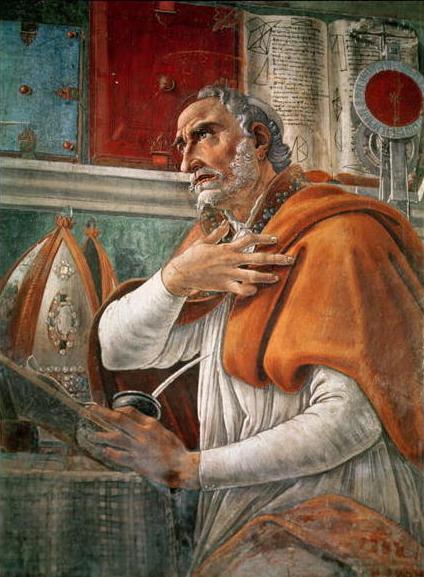 Sandro Botticelli, Augustine, c. 1480 · Ognissanti, Florence · Public Domain. Image record.

Difference without caricature
Eastern theology often describes salvation through healing, victory over death, and participation in divine life, or theosis. Western theology has developed influential accounts of forgiveness and justification. These are differences of emphasis and theological organization, not exclusive dictionaries: Western writers also speak of healing and participation, while Eastern writers also speak of sin’s forgiveness and judgment.
Nor does emphasizing the damaged human condition mean every Western tradition teaches that the image of God has been wholly erased. Broad contrasts can orient a reader, but become misleading when made absolute.
Reading the history constructively
A useful discussion asks what each writer means by sin, guilt, mortality, and grace before comparing conclusions. It also distinguishes the origin of terminology from the biblical and ecclesial questions that the terminology addresses.
Augustine helped give Western Christianity a lasting language for those questions. Eastern traditions preserve other emphases, and differences also run within each broad family. Reading them carefully makes the conversation more demanding—and more fruitful—than deciding which half of Christianity inherited the correct slogan.
Sources and further reading
- Augustine, Ad Simplicianum 1.1, and On the Merits and Forgiveness of Sins, Book 1.
- John Chrysostom, Homilies on Romans 10.
- Catechism of the Catholic Church, §§404–405.
- Orthodox Church in America, “St. Augustine & Original Sin”, for an Orthodox explanation of inherited consequences.
- John Meyendorff, Byzantine Theology: Historical Trends and Doctrinal Themes (Fordham University Press, 1974).
Explore original-language and historical context for sermon preparation at Didymus Lab.
Comments
Leave a comment
Comments are reviewed before being published. Only your name and comment are stored — no personal data collected.
You might also like
Bible, Actually
The Millennium Was Already Debated in the Early Church
Justin and Irenaeus expected an earthly millennium. Augustine helped establish another reading, but neither position began with unanimous agreement.
Bible, Actually
'Scripture Alone' Never Meant Throw Out Everything Else
Luther and Calvin treated Scripture as final authority while honoring creeds and teachers. What distinguishes sola scriptura from solo scriptura?
Bible, Actually
When Did Satan Become Lucifer? A Name's Patristic History
Isaiah taunts a Babylonian king. Early Christians read a spiritual fall in the poem, while an existing Latin word gradually became a name for Satan.
Loading comments…