Bible, Actually
The Millennium Was Already Debated in the Early Church
Does Revelation 20 describe a future thousand-year reign on earth, or the reign of Christ already present in the life of the church? Christians can inherit either answer so thoroughly that it feels like the only historic reading. Early Christian sources tell a more interesting story: strong convictions and recognized disagreement existed side by side.
The modern labels “premillennial,” “postmillennial,” and “amillennial” help organize present debates. They should be applied carefully to ancient writers, who did not work with all the assumptions now attached to those systems.
Justin makes room for disagreement
In chapter 80 of his Dialogue with Trypho, Justin Martyr defends a resurrection followed by a thousand years in a restored Jerusalem. He regards this as the sound reading of the prophets. Yet in that same chapter, before his emphatic statement of his own position, he acknowledges Christians of genuine faith who think differently. Chapter 81 then develops the scriptural argument, including an appeal to Revelation.
Justin’s distinction matters. He rejects denial of the resurrection, but does not identify every disagreement over the millennium with that denial. His testimony establishes that an earthly millennium had a prominent second-century advocate. It also prevents us from treating his view as the unanimous position of the entire early church.
Irenaeus and the goodness of creation
Irenaeus gives an earthly kingdom a substantial place in Book 5 of Against Heresies. His discussion belongs to a defense of bodily resurrection and God’s purposes for material creation. In chapter 33 he preserves a striking tradition about extraordinary agricultural abundance, associated with elders and with Papias.
The chain of transmission is part of Irenaeus’s testimony; it should not be treated as independent proof that every detail can be traced directly to Jesus. What is clear is the theological work the tradition does for him. The promised future concerns embodied people and a renewed creation, rather than rescue from material existence as though creation were simply a mistake.
Augustine’s influential alternative
Augustine acknowledges in City of God 20.7 that he once held a form of millennial expectation. His mature discussion treats the thousand years symbolically and locates the saints’ reign within the present age, while still awaiting the final bodily resurrection and judgment. Chapters 7–9 must be read together: a spiritual “first resurrection” does not mean that all resurrection language becomes merely symbolic.
He was not the first Christian to interpret the millennium spiritually. Earlier interpreters, notably the fourth-century African writer Tyconius, had already connected Revelation’s visions with the church’s life. Augustine gave this trajectory lasting influence in the Latin West. Influence is different from invention, and the history cannot be reduced to one theologian abruptly reversing a unanimous church.
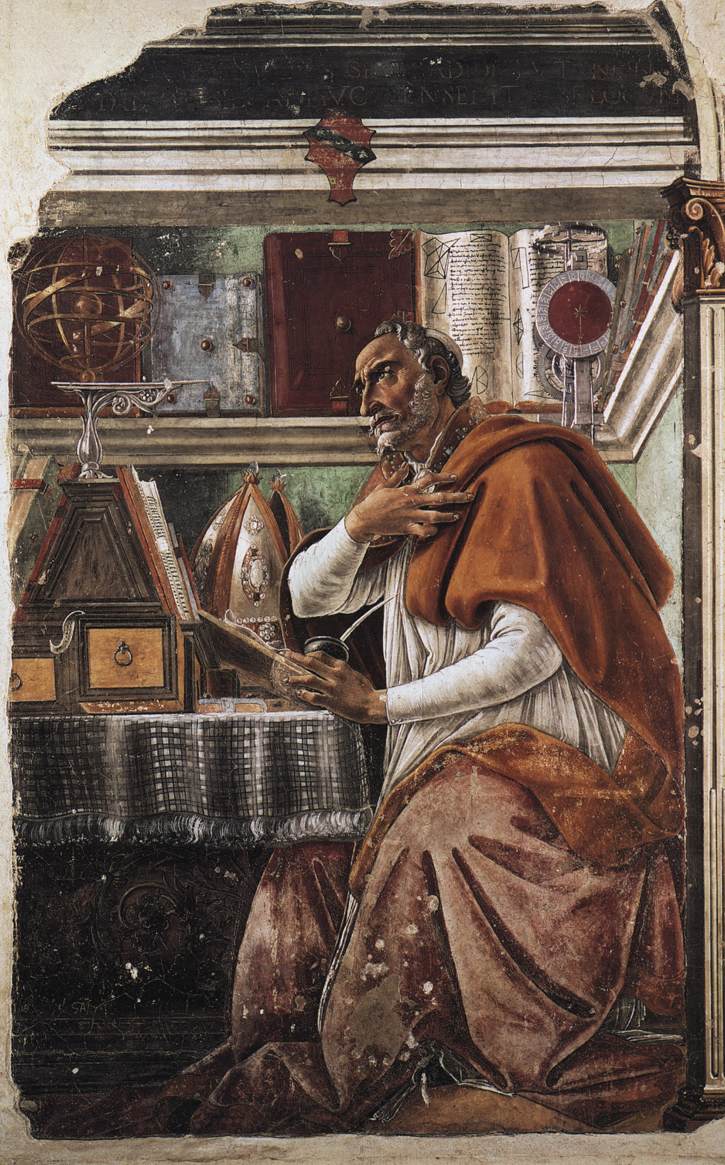 Sandro Botticelli, Saint Augustine in His Study, 1480 · Ognissanti, Florence · Public Domain. Image record.

What the history can settle
These sources establish the antiquity of an earthly millennial expectation and of disagreement about it. They also show how a reading could gain authority through later reception. They do not establish that every modern end-times system existed in the second century, or that the oldest surviving advocate automatically resolves the interpretation of Revelation.
For a church discussion, Justin offers a useful historical example: a writer can defend his own position vigorously while distinguishing it from the boundaries of Christian faith. Almost nineteen centuries later, that distinction still deserves attention. Reading Revelation carefully includes recognizing both the convictions and the limits of the interpreters we cite.
Sources and further reading
- Justin Martyr, Dialogue with Trypho 80–81.
- Irenaeus, Against Heresies 5.33.
- Augustine, City of God 20.7–9.
- “Augustine on Revelation 20: A Root of Amillennialism”, Foundations 65 (2013), including the discussion of Tyconius.
Explore original-language and historical context for sermon preparation at Didymus Lab.
Comments
Leave a comment
Comments are reviewed before being published. Only your name and comment are stored — no personal data collected.
You might also like
Bible, Actually
Original Sin: Augustine’s Legacy and the Differences Within Christianity
Augustine shaped original-sin teaching. Comparing East and West requires distinguishing inherited condition from personal fault.
Bible, Actually
666 or 616? The Ancient Debate About the Beast’s Number
Papyrus 115 reads 616 in Revelation 13:18. The variant is ancient, and Nero’s name offers a plausible explanation—but not a conclusive solution.
Bible, Actually
When Did Satan Become Lucifer? A Name's Patristic History
Isaiah taunts a Babylonian king. Early Christians read a spiritual fall in the poem, while an existing Latin word gradually became a name for Satan.
Loading comments…