Bible, Actually
When Did Satan Become Lucifer? A Name's Patristic History
Isaiah 14:12 reads, “How art thou fallen from heaven, O Lucifer, son of the morning!” in the KJV. Readers familiar with later Christian tradition may hear this as a direct account of Satan’s rebellion and expulsion from heaven. Reading the passage in its own setting introduces another question: whom does Isaiah’s poem explicitly address?
What the Text Actually Says
Isaiah 14:4 tells us exactly what we are reading: “you will take up this taunt against the king of Babylon.” The famous lines in verses 12–15 describe a figure called in Hebrew helel ben-shachar — “shining one, son of the dawn” — who tries to ascend above the stars and is instead thrown down to Sheol. This is a mashal, a taunt-song, a well-worn genre in the ancient Near East for mocking a defeated tyrant. Scholars have long noted the resemblance between this imagery and the Ugaritic myth of Athtar, the deity who attempts to occupy the throne of the storm-god Baal and cannot remain there. This comparison may illuminate the poem’s mythic imagery, though its precise relationship to the Ugaritic account remains debated. The explicit target of the taunt is the Babylonian king. Nowhere in the passage does the word “Satan” appear, and nothing in it identifies the figure as an angel.
Early Christian readings of Satan’s fall
By the early third century CE, Christian interpreters were connecting Isaiah’s language with Satan. Tertullian’s Against Marcion 5.11 and 5.17 provides early examples. Origen’s On First Principles 1.5.5 reads Isaiah 14 alongside Ezekiel 28, the lament over the king of Tyre, in an argument about the devil’s origin and fall.
Origen reasons that the elevated language reaches beyond an ordinary human ruler. His reading belongs to a theological interpretation of Scripture in which earthly powers can disclose a spiritual drama. These are early surviving witnesses to the connection, not proof that either author invented it. The prophetic passage’s historical setting and its later Christian interpretation answer different questions.
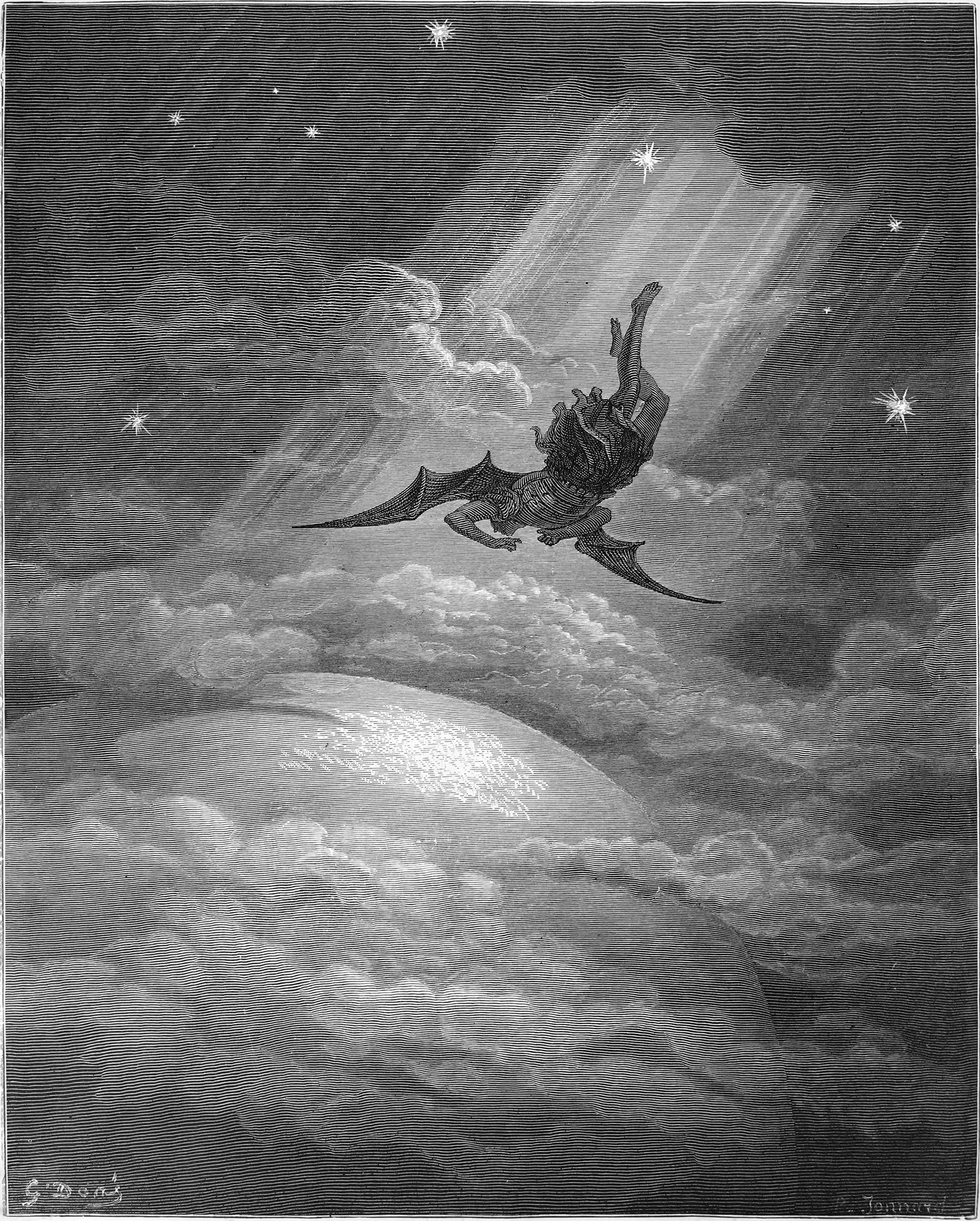 Gustave Doré (1832–1883), illustration for John Milton’s Paradise Lost (1866) · Public Domain, Wikimedia Commons. The patristic reading of Isaiah 14 as Satan’s fall would go on, centuries later, to shape Milton’s epic — and through it, the visual imagination of the Western world.

Where “Lucifer” Comes From
Lucifer existed in Latin before Christianity as a word for the morning star, Venus. Jerome used it for Hebrew helel in the Vulgate, but earlier Latin Christian writers had already used it when quoting Isaiah. The Septuagint’s Greek heōsphoros, “dawn-bringer,” likewise expressed the celestial image.
Jerome was therefore neither inventing the word nor introducing a new name for the devil. A familiar Latin expression appeared in a passage Christians were already reading as Satan’s fall. Through that reception, “Lucifer” increasingly functioned as a personal name. The KJV’s retention of the Latin form helped make this usage familiar to English readers.
Luke 10:18 and the Absorption of Ezekiel 28
The story did not stop there. Jesus’ words in Luke 10:18 — “I saw Satan fall like lightning from heaven” — offered a New Testament anchor that made the connection to Isaiah 14 feel confirmed rather than merely inferred. Alongside it, Ezekiel 28’s lament over the king of Tyre — already paired with Isaiah 14 by Origen — was drawn in as further evidence, largely on the strength of its reference to a being “in Eden, the garden of God” (Ezekiel 28:13). By combining three originally distinct texts — a taunt against a Babylonian king, a lament for a Phoenician king, and a single sentence from the Gospels — later tradition assembled the now-familiar narrative: a proud angel named Lucifer, cast out of heaven for rebellion, becoming Satan. That composite story would receive a highly influential retelling centuries later in Milton’s Paradise Lost (1667), and from there it entered the visual and literary imagination of the West so thoroughly that most readers today assume it was always simply “in the Bible.”
Knowing the Text and Knowing the Story
Isaiah’s historical setting and its later theological interpretation can both be studied carefully. The important distinction is between the king named in the prophetic poem and the spiritual narrative developed through reading it alongside other passages. Understanding that history does not, by itself, settle whether the later theological reading is persuasive.
Didymus Lab offers original-language and reception-history resources for sermon preparation.
References
- Tertullian, Against Marcion 5.11, 5.17.
- Origen, On First Principles 1.5.5, third century CE.
- Jerome, Biblia Sacra Vulgata, Isaiah 14:12 (“quomodo cecidisti de caelo lucifer”)
- Isaiah 14:4–21; Ezekiel 28:1–19; Luke 10:18, compared with the Masoretic Text and Septuagint
- John Milton, Paradise Lost (1667)
Comments
Leave a comment
Comments are reviewed before being published. Only your name and comment are stored — no personal data collected.
You might also like
Bible, Actually
Why Michelangelo’s Moses Has Horns
Moses’s horns belong to the history of Exodus 34 in Latin and art. Calling them the result of one elementary mistake misses a debated translation.
Bible, Actually
The Millennium Was Already Debated in the Early Church
Justin and Irenaeus expected an earthly millennium. Augustine helped establish another reading, but neither position began with unanimous agreement.
Bible, Actually
Original Sin: Augustine’s Legacy and the Differences Within Christianity
Augustine shaped original-sin teaching. Comparing East and West requires distinguishing inherited condition from personal fault.
Loading comments…