Bible, Actually
The Nine Orders of Angels: Not the Bible's List, but a Fifth-Century Philosopher's
Ask most churchgoers where the nine orders of angels come from, and the answer will be something like “the Bible” or “early church teaching.” The hierarchy runs from seraphim and cherubim at the top, through thrones, dominions, virtues, powers, and principalities, down to archangels and angels. It appears in hymns, catechisms, devotional art, and Dante’s Paradiso. It feels old, authoritative, and scriptural.
Its actual history is more specific — and considerably more interesting.
What the Canon Actually Says
The New Testament and the Hebrew Bible name exactly two angels. Gabriel appears in Daniel 8:16 and Luke 1:19; Michael in Daniel 10:13 and Jude 1:9. Uriel, frequently added as a third, appears only in deuterocanonical texts (2 Esdras, 1 Enoch) — outside the Protestant and Jewish canons. Beyond these named individuals, the biblical witness describes angels in function and in action but does not produce an organizational chart.
The passage most frequently cited as a biblical foundation for the hierarchical scheme is Colossians 1:16, where Paul writes that all things were created “whether thrones or dominions or rulers or authorities.” Paul Rorem, in his critical commentary on the Dionysian corpus, notes that this list is a rhetorical enumeration whose primary purpose is Christological: whatever invisible powers exist, they were created through Christ and for Christ. The point is the subordination of all things to Christ, not a taxonomy of heaven.
 Fra Angelico · Annunciation, north corridor fresco, Convent of San Marco, Florence, c. 1437–1446 · Public Domain. A depiction of the angel Gabriel — one of only two angels named in the canonical scriptures — announcing the incarnation to Mary. An artist’s theological interpretation, not a documentary image.
Pseudo-Dionysius the Areopagite
The nine-tier hierarchy, organized into three triads, was first systematized in a treatise called De Caelesti Hierarchia (On the Celestial Hierarchy). Its author claimed to be Dionysius the Areopagite, the Athenian judge whom Acts 17:34 records as a convert from Paul’s sermon on the Areopagus — which would place the text in the first century and tie it directly to apostolic witness.
This claim did not survive scholarly scrutiny. Andrew Louth’s study Denys the Areopagite traces the language, philosophical framework, and citation patterns of the text to the late fifth or early sixth century CE — roughly five hundred years after Paul’s visit to Athens. The author drew deeply on the Neoplatonic tradition, particularly the philosopher Proclus (412–485 CE), to construct a cosmic hierarchy in which every level participates in and transmits divine illumination to the level below it. Scholars now consistently refer to the author as Pseudo-Dionysius the Areopagite — a pseudonym that misled medieval Christianity for nearly a thousand years.
The three triads the text establishes are: Seraphim, Cherubim, and Thrones (first hierarchy); Dominions, Virtues, and Powers (second); Principalities, Archangels, and Angels (third). This specific arrangement cannot be derived from any biblical text by normal exegetical methods.
Thomas Aquinas and the Western Settlement
The scheme reached its widest influence through Thomas Aquinas. In the Summa Theologiae I, questions 50–64 and 106–114 (written 1265–1274), Aquinas engaged the Dionysian hierarchy systematically, incorporating it into Scholastic theology and giving it the imprimatur of the most authoritative theological synthesis of the medieval West. From Aquinas onward, the nine-tier structure became standard teaching across Catholic Europe, and it passed from there into the broader Christian tradition.
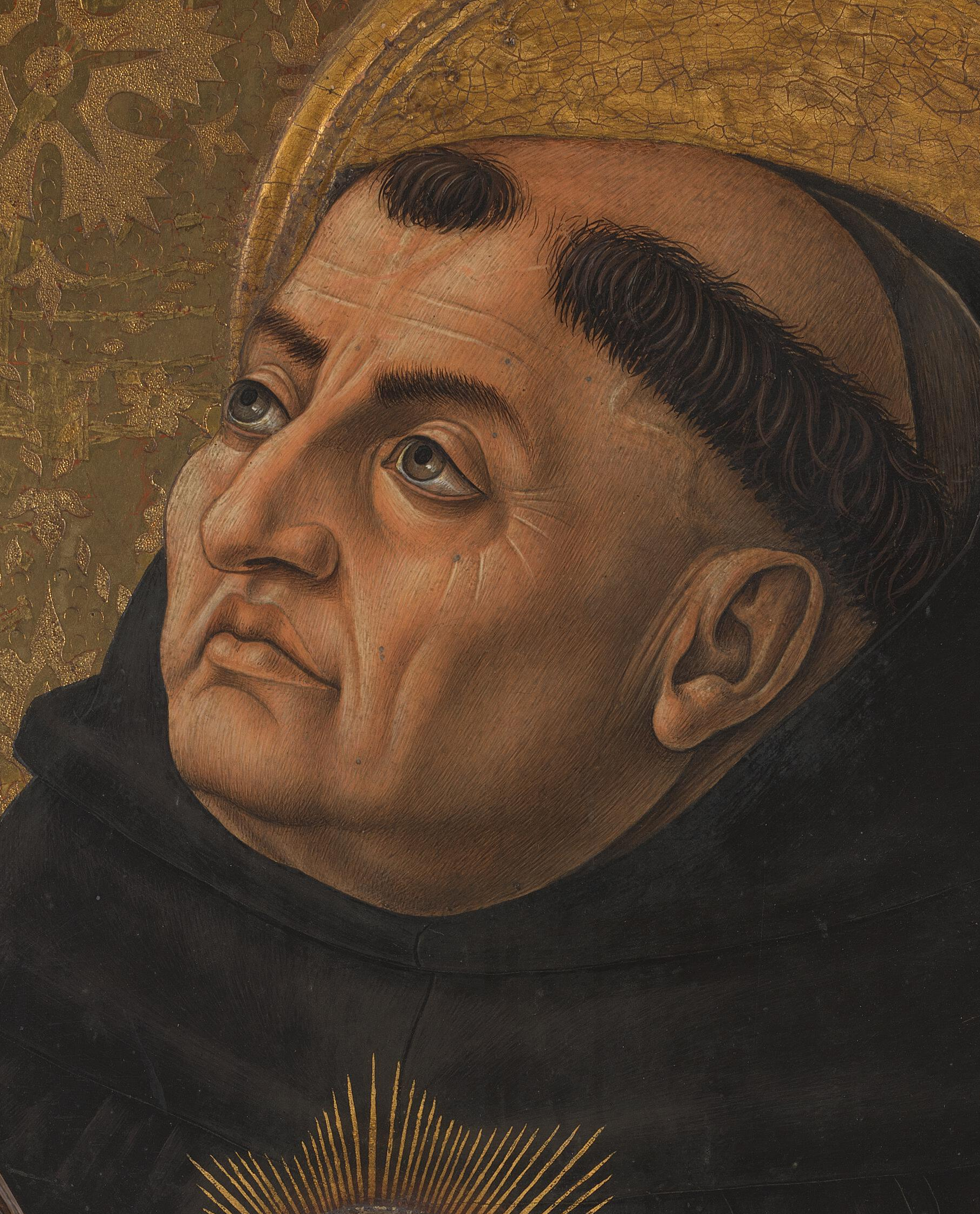 Carlo Crivelli · Saint Thomas Aquinas, c. 1476 · National Gallery, London · Public Domain. The Dominican theologian whose Summa Theologiae systematized the nine-order hierarchy and established it as standard teaching in Western Christianity. A fifteenth-century panel painting.
For nearly a millennium, the treatise had circulated under the authority of a supposed first-century companion of Paul, and that claimed antiquity amplified its influence. The humanist scholars of the Renaissance — notably Lorenzo Valla and Erasmus — began raising serious questions about the dating. By the Reformation era, the pseudonymous authorship was broadly accepted among critical readers, though the tradition the text had generated proved durable long after the authority claim was abandoned.
The Difference Between Witness and System
None of this disputes the reality of angels as the canonical texts describe them. Gabriel announces the incarnation to Mary; Michael contends with evil; unnamed angels minister, guard, and act throughout both Testaments. The biblical witness to angelic beings is clear and consistent.
What the Colm Luibheid and Paul Rorem translation of Pseudo-Dionysius: The Complete Works makes transparent is that the system — the triads, the names of each order, the graduated hierarchy of illumination — derives from fifth-century Neoplatonic Christian theology, not from apostolic or prophetic witness. The Bible is largely silent on the question of exactly how many orders exist and what they are named. That silence was filled, around the year 500 CE, by a brilliant philosophical imagination working in a tradition considerably shaped by Plato rather than Moses.
Knowing the difference is not a reason to dismiss the tradition. It is a reason to hold it with the right kind of authority — theological and philosophical, rather than strictly scriptural.
References
- Paul Rorem, Pseudo-Dionysius: A Commentary on the Texts and an Introduction to Their Influence (Oxford University Press, 1993)
- Colm Luibheid and Paul Rorem, trans., Pseudo-Dionysius: The Complete Works (Classics of Western Spirituality; Paulist Press, 1987)
- Andrew Louth, Denys the Areopagite (Outstanding Christian Thinkers; Continuum, 1989; repr. 2002)
Comments
Leave a comment
Comments are reviewed before being published. Only your name and comment are stored — no personal data collected.
You might also like
Bible, Actually
The Millennium Was Already Debated in the Early Church
Justin and Irenaeus expected an earthly millennium. Augustine helped establish another reading, but neither position began with unanimous agreement.
Bible, Actually
Original Sin: Augustine’s Legacy and the Differences Within Christianity
Augustine shaped original-sin teaching. Comparing East and West requires distinguishing inherited condition from personal fault.
Bible, Actually
When Did Satan Become Lucifer? A Name's Patristic History
Isaiah taunts a Babylonian king. Early Christians read a spiritual fall in the poem, while an existing Latin word gradually became a name for Satan.
Loading comments…