Bible, Actually
The Hebrew Text Never Says 'Red Sea' — It Says 'Sea of Reeds'
Every English reader of Exodus knows that the Israelites crossed the Red Sea. The phrase appears in most Bible translations, has been enshrined in two millennia of sermons and commentary, and was cemented visually by Cecil B. DeMille’s 1956 film. The problem is that the Hebrew text of Exodus never uses it.
The original term — in Exodus 13:18, Exodus 15:4, and the other passages where it appears — is יַם סוּף (yam suph). And suph does not mean red.
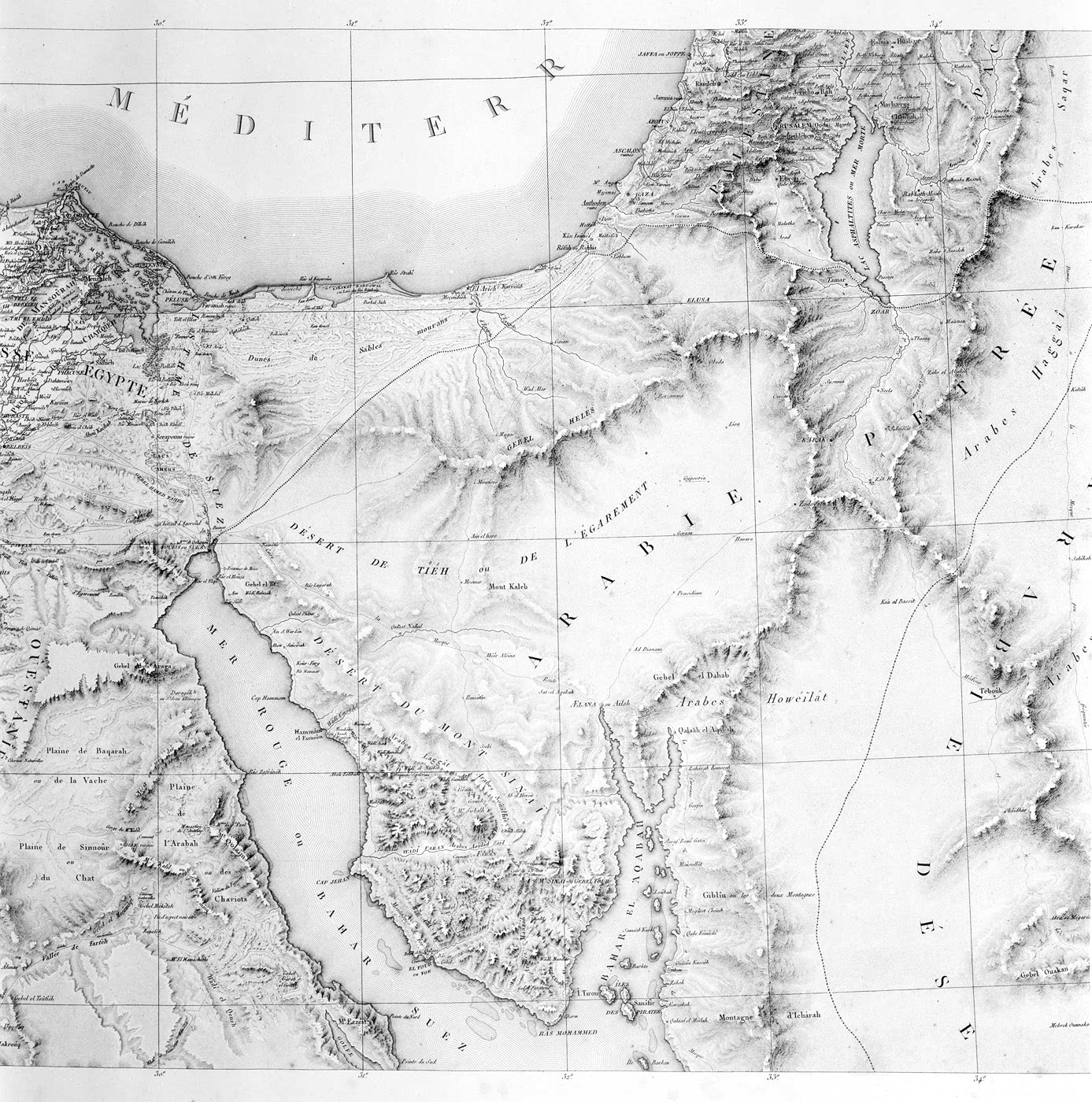 Sinai Peninsula · NASA satellite image · Public Domain. The geographic candidates for yam suph include the northern tips of the Red Sea’s two arms (Gulf of Suez and Gulf of Aqaba), as well as shallow marshy areas along Egypt’s northeastern border — all visible in this image.
What Suph Actually Means
Yam (יַם) is sea, a common enough Hebrew word. The question is suph (סוּף). The Hebrew Bible provides its own definition through two unambiguous uses elsewhere in the same corpus.
Exodus 2:3 describes how Moses’ mother hid her infant in “an ark of bulrushes” and set it in the Nile — and the word for “bulrushes” is suph. Isaiah 19:6 describes the vegetation along the channels of the Nile with the same word, translated in most English versions as “reeds” or “rushes.” Suph is a plant. It grows in water. It is not a color.
Hebrew has a completely separate word for red: אָדֹם (adom). This is the root behind the name Edom, behind Esau’s epithet “the red one,” behind the red heifer of Numbers 19. It shares nothing with suph. The two words come from entirely different roots, refer to entirely different things, and appear in different contexts throughout the Hebrew Bible. Yam suph, in the Hebrew, is the Sea of Reeds.
How the Translation Happened
The shift from “Reed Sea” to “Red Sea” begins in the third century BC, when Jewish scholars in Alexandria produced the Greek translation of the Hebrew Bible known as the Septuagint (LXX). In the Septuagint, yam suph becomes Ἐρυθρὰ Θάλασσα — Erythra Thalassa, the Red Sea. Erythrá is Greek for red.
Whether this was a misreading, a geographic identification, or a deliberate interpretive choice is not entirely clear. The Greek term Erythra Thalassa in the Hellenistic period referred to a large expanse of water — not just what we call the Red Sea today, but the entire body including the Persian Gulf and the Indian Ocean beyond Arabia. The translators may have understood yam suph as pointing toward that general region and rendered it with the common Greek geographic term. From the Septuagint, the expression passed into the Latin Vulgate as Mare Rubrum (Red Sea), then into the Reformation-era vernacular translations, and finally into every English Bible from Tyndale forward.
A translation decision made in Alexandria around 250 BC has shaped how billions of people have pictured the Exodus ever since.
Where Was It? An Open Question
Once the “Red Sea” label is set aside, the geographic question becomes genuinely interesting and genuinely unsettled.
Bernard F. Batto, writing in Biblical Archaeology Review in 1984, proposed that suph may actually derive from a different Hebrew root meaning “end” or “limit,” making yam suph something closer to the “Sea at the Edge of the World” — a cosmological expression rather than a geographic name. In this reading, the term carries mythological weight: the waters of chaos at the boundary of the inhabitable world, which God parts for his people.
James K. Hoffmeier, in Ancient Israel in Sinai (Oxford University Press, 2005), takes a more geographical approach. Surveying ancient Egyptian records for references to papyrus-reed marshes along Egypt’s northeastern frontier, Hoffmeier identifies several shallow lagoon and marsh areas in the Sinai isthmus region as credible candidates for the crossing site.
Other scholars have proposed the Gulf of Suez, the Gulf of Aqaba, or Lake Timsah as possibilities. None of these identifications has achieved consensus. What scholars across these competing positions largely agree on is the more basic point: the Hebrew term yam suph does not, by itself, point to the deep-water body we now call the Red Sea.
Why It Matters
The theology of the Exodus narrative does not depend on settling the geography. Whether the Israelites crossed a shallow reed-filled marsh or a spectacular parting of deep ocean water, the text’s claim is the same: God opened a path and closed it behind them. The divine action is the story’s center, not the precise elevation of the waterbed.
But the translation history matters for a different reason. “Red Sea” is such a familiar phrase that most readers do not realize it is an interpretive tradition, not a translation of what the Hebrew actually says. When a translation becomes invisible — when readers assume they are reading the original — it forecloses questions the original text invites.
Yam suph invites questions. Where exactly was it? What does the reed imagery suggest about the landscape? What did the crossing actually look like? These are questions that the Hebrew keeps open and that the phrase “Red Sea” has historically kept closed.
References
- Bernard F. Batto, “Red Sea or Reed Sea?” Biblical Archaeology Review 10.4 (Jul/Aug 1984): 56–63
- James K. Hoffmeier, Ancient Israel in Sinai: The Evidence for the Authenticity of the Wilderness Tradition (Oxford University Press, 2005)
- Exodus 2:3; 13:18; 15:4; Isaiah 19:6, Masoretic Text (suph usage confirmed)
Comments
Leave a comment
Comments are reviewed before being published. Only your name and comment are stored — no personal data collected.
You might also like
Bible, Actually
"Spare the Rod": What the Hebrew Word Behind Proverbs 13:24 Actually Covers
Proverbs 13:24 warns against sparing 'the rod.' The Hebrew word, shebet, is the same word for a shepherd's staff, a king's scepter, and an Israelite tribe. A look at its range — and at scholars who read the discipline texts differently.
Bible, Actually
Was Eve Made From a Rib — Or From Adam's Side?
The Hebrew word behind 'rib' in Genesis 2:21-22, tsela, almost always means 'side' or a structural wall-panel everywhere else in the Old Testament. Where did the rib translation come from, and is it wrong?
Bible, Actually
Jeremiah 29:11 Was Written to Exiles, Not to You — and That Makes It Better
Jeremiah 29:11 is one of the most quoted verses in personal prayer. But the 'you' in the original Hebrew is plural, the timeline is seventy years, and the recipients were a shattered community in Babylon — and knowing that actually makes the promise more powerful.
Loading comments…