Bible, Actually
The Widow's Two Mites — Reading Mark 12 with the Actual Coins
The story is familiar enough that the shock has worn off. A widow drops two small coins into the temple treasury. Jesus, watching, tells his disciples she has given more than anyone else. We nod along — inspiring story about sacrificial giving — and move on. But the story has a specific economic texture that is easy to miss if we do not know what a lepton actually was.
The Lepton — The Smallest Coin in Jewish Palestine
The Greek word lepton (λεπτόν, plural λεπτά) comes from a root meaning “thin” or “small.” In the monetary system of first-century Palestine, it was the lowest denomination in everyday circulation — a tiny bronze coin worth a fraction of any other unit in the system.
Leptons had been minted since the Hasmonean period. Some of the most recognizable types were struck during the reign of Alexander Jannaeus (103–76 BCE), a Hasmonean king-priest whose coins continued circulating well into the first century AD. These coins bore simple designs — an anchor or a star on one side, the king’s name in Hebrew or Greek on the other — and were small enough that their thinness was their most noticeable feature.
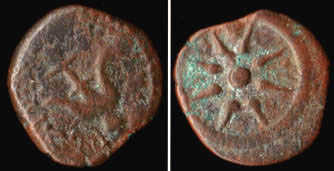 Randy Benzie, ancient Jewish lepton coin (the type known as “widow’s mite”), from a private collection. CC0 1.0.
Mark’s Translation Note — Two Leptons Equal One Quadrans
What makes Mark 12:42 particularly instructive is that Mark does not assume his readers know Jewish coinage. He pauses and explains:
“And a poor widow came and put in two small copper coins, which are worth a penny.” (Mark 12:42, ESV — Greek: δύο λεπτά ὅ ἐστιν κοδράντης, “two leptons, which is a quadrans”)
The quadrans (the “kodrantes” of the Greek, the “penny” of older English translations) was the smallest coin in Roman bronze currency — one sixty-fourth of a denarius, which was roughly a day’s wage for a laborer. Some ancient sources give the equivalence as one sixty-fourth, others as one one-hundred-twenty-eighth; the precise ratio varies, but the direction is consistent: this was an almost negligible sum in any frame of reference.
Mark’s aside — “which is a quadrans” — is a translation note for readers unfamiliar with Palestinian coinage. He wants them to feel the smallness of the amount, not just accept it as a narrative given.
 Anonymous mint worker, Quadrans of Augustus, Rome, c. 9 BCE — Bibliothèque nationale de France (IMP-4434). Public domain.
Why Two Coins, Not One
The detail that the widow dropped two leptons rather than one is quietly significant. She had both of them. She could have kept one. Two leptons cannot be broken — there was no smaller unit of currency — but she could have given one and retained something for herself. She gave both.
Mark places this episode immediately after Jesus’s sharp critique of the scribes who “devour widows’ houses” and perform their religion for public show (Mark 12:38–40). The widow’s offering does not merely illustrate generosity; it completes a pointed contrast. The scribes perform for maximum visibility while consuming the resources of the vulnerable. The widow, with maximum vulnerability and minimum visibility, gives everything.
Jesus’s Evaluation and Its Reversal
Jesus’s assessment is worth reading precisely:
“Truly I tell you, this poor widow has put in more than all those who are contributing to the treasury. For all of them have contributed out of their abundance; but she out of her poverty has put in everything she had, all she had to live on.” (Mark 12:43–44)
The comparison is not between small money and large money. It is between partial giving and total giving. The Greek phrase holon ton bion autēs — “her whole life” or “all she had to live on” — indicates that the two leptons were genuinely her last resources. Jesus is not saying her two leptons had more monetary value than the large sums others gave. He is using a different accounting system entirely.
Reading the Text Again
The next time you read Mark 12:41–44, notice the physical setting: Jesus sat down opposite the treasury and watched (v. 41). He is deliberately observing. He sees many rich people putting in large amounts. He sees one widow put in two coins so small that Mark has to explain them to his audience. And he calls his disciples over and redirects their attention.
Knowing what a lepton was — a thin, nearly worthless bronze coin that had been circulating for over a century — makes the redirection more striking. The coin Jesus chose to point at was the smallest thing in the room.
Sources
- Kenneth W. Harl, Coinage in the Roman Economy, 300 B.C. to A.D. 700 (Johns Hopkins University Press, 1996)
- Anchor Bible Dictionary, s.v. “Money, Coins”
Comments
Leave a comment
Comments are reviewed before being published. Only your name and comment are stored — no personal data collected.
You might also like
Bible, Actually
Did Mark Intend to End at “They Were Afraid”?
Some early manuscripts end Mark at 16:8. The longer ending is ancient, but its history leaves a second question about Mark’s own ending.
Bible, Actually
A Ship in the Storm: Acts 27 and the Ancient Sea-Voyage Narrative
A storm that wrecks a ship at sea was a stock scene in ancient literature — the equivalent of a modern car chase. Acts 27 uses every piece of that convention, then breaks it exactly where you'd expect the hero to save himself.
Bible, Actually
Archaeologists Found Odysseus's Shrine — What It Has to Do With the New Testament
Ithaca has yielded roof tiles stamped 'to Odysseus.' It isn't biblical archaeology, but it puts a concrete face on the religious world the book of Acts was written into.
Loading comments…