Bible, Actually
Archaeologists Found Odysseus's Shrine — What It Has to Do With the New Testament
While Christopher Nolan’s The Odyssey packs theaters worldwide, grossing over a billion dollars this year, a much quieter discovery happened in Greece last spring. At Agios Athanasios in northern Ithaca — a site known since the 19th century as the “School of Homer” — a team led by Professor Emeritus Giannos G. Lolos, excavating since 2018, announced inscribed roof tiles and a small bronze bust bearing the name of Odysseus. This isn’t biblical archaeology. But it’s worth a look anyway, because it fills in a picture the New Testament assumes its readers already have.
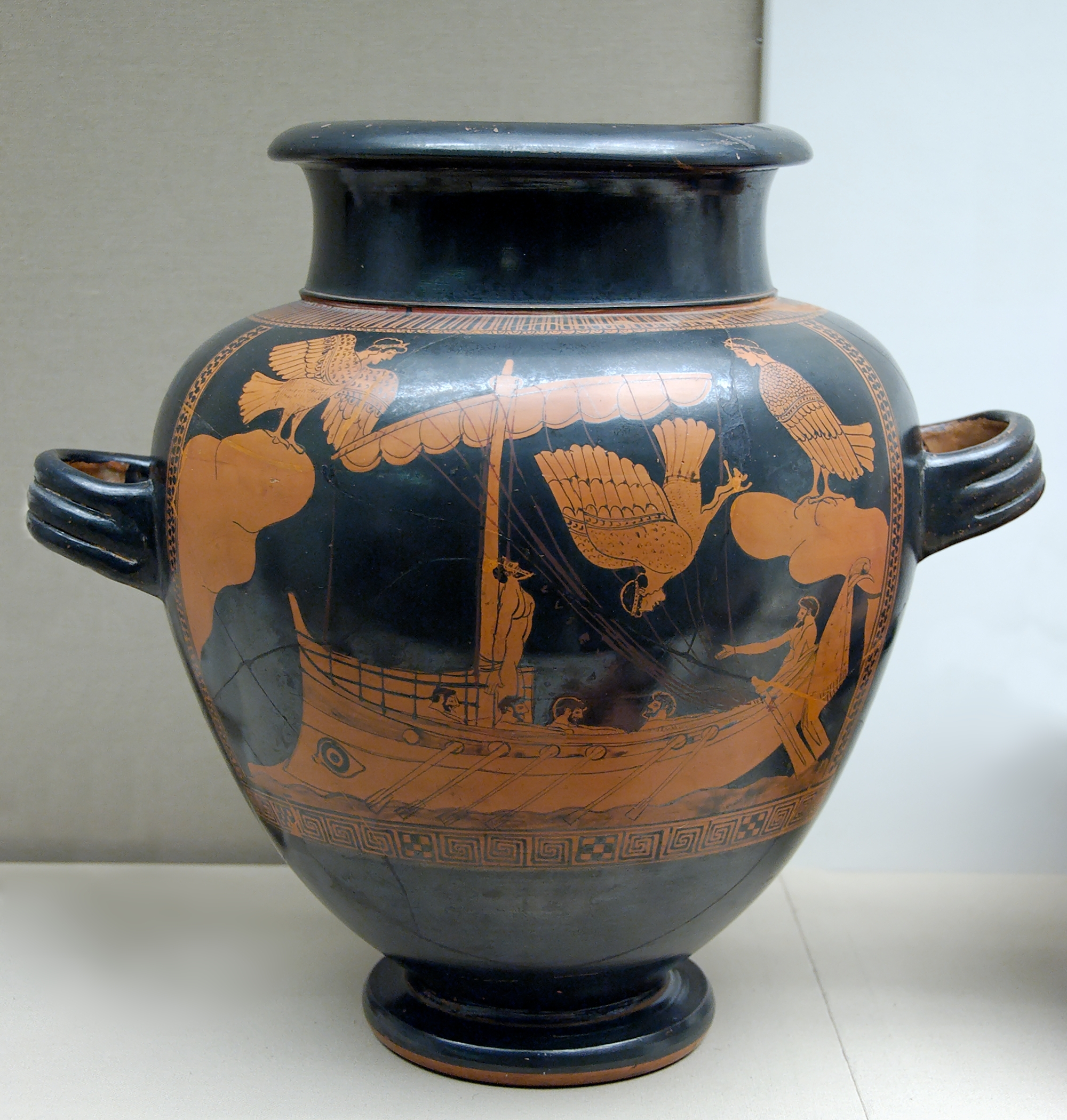 The Siren Painter, Odysseus and the Sirens, Attic red-figure stamnos, c. 480–470 BC — British Museum (GR 1843.11-3.31). Public domain.
What Turned Up
Three of the tile fragments carry the name Odysseus stamped or incised into the clay. One reads roughly “of Odysseus”; another, “to Odysseus” — the standard formula for a dedicatory offering to a god or hero. In an interview with Archaeology magazine’s May/June 2026 issue, Lolos called the tiles, the dedication, and the bronze bust “conclusive evidence” that the site is the long-sought Odysseion, Ithaca’s hero-shrine to Odysseus. The shrine’s existence was already known from a 2nd-century BC decree found at Magnesia in Asia Minor, which mentions both the Odysseion and an athletic and cultural festival held in Odysseus’s honor, the Odysseia.
Archaeologists are careful to note what this discovery doesn’t prove: it says nothing about whether Odysseus was a real historical person. What it does show is that a legendary figure was worshipped, over a long stretch of time, by a real community. Archaeologist Carla Antonaccio, in An Archaeology of Ancestors: Tomb Cult and Hero Cult in Early Greece (1995), defines this kind of “hero” precisely as a semi-divine figure tied to a specific place — a grave or a site associated with them becomes a shrine, and a recurring, localized ritual grows up around it. The Ithaca tiles are physical evidence that fits that definition exactly.
Where This Touches the New Testament
That’s exactly the apparatus that Acts assumes and never has to explain. Read Acts 14:11–13: after Paul heals a man in Lystra, the crowd hails Barnabas as Zeus and Paul as Hermes, and the local priest of Zeus shows up with oxen and garlands, ready to sacrifice. The scene only makes sense in a world where legendary figures — heroes, gods, sometimes both — received real cultic worship at real local shrines, complete with priests and dedication rituals. The hands that stamped “to Odysseus” into wet clay on Ithaca belonged to the same religious habit as the hands that led oxen out at Lystra to honor Paul and Barnabas.
Why Zeus and Hermes, Specifically
The choice of gods in Acts 14 isn’t random. The Roman poet Ovid, in Metamorphoses 8.611–724, tells a well-known legend set in Phrygia: Zeus and Hermes travel in human disguise, are turned away at every door, and are finally welcomed only by an elderly, poor couple, Philemon and Baucis. Lystra sat in Lycaonia, on Phrygia’s doorstep. If that legend circulated locally — as its Phrygian setting suggests — then the Lystra crowd’s cry that “the gods have come down to us in human form” (Acts 14:11) wasn’t vague superstition. It reads as a specific, local anxiety: don’t repeat the mistake of failing to recognize the gods twice.
 Workshop of Peter Paul Rubens, Jupiter and Mercury at the House of Philemon and Baucis, c. 1620–1625 — Kunsthistorisches Museum, Vienna. Public domain (PD-Art).
The same landscape stands behind Paul’s line to the Athenian court on the Areopagus: “what you worship as unknown, this I proclaim to you” (Acts 17:23). Every city had its own dense cluster of altars to its own heroes and gods, bound up with civic identity. It’s also why Paul had to give such concrete pastoral instructions in 1 Corinthians 8 about meat sacrificed to idols — this wasn’t an abstract theological question. It was groceries, sold in a market that ran on exactly this cult system.
 Map of Paul’s first missionary journey, including Cyprus, Pamphylia, Pisidia, and Lystra — from The Oxford and Cambridge Bible for Schools: Acts of the Apostles (1894). No known copyright restrictions.
What the Background Buys You
The Odysseion isn’t a New Testament text. But because it came out of the ground rather than off a page, it puts a face on scenes like “the whole city was filled with confusion” (Acts 19:29) — scenes that otherwise stay abstract. If a moviegoer walks out of The Odyssey and opens Acts the following Sunday, the distance between the two may be smaller than it looks. Both come out of the same Mediterranean world, lined with the same shrines and the same altars.
References
- Giannos G. Lolos and excavation team, “Odysseus’ Original Fan Club,” Archaeology magazine, May/June 2026
- Carla M. Antonaccio, An Archaeology of Ancestors: Tomb Cult and Hero Cult in Early Greece (Lanham: Rowman & Littlefield, 1995)
- Ovid, Metamorphoses 8.611–724 (Philemon and Baucis)
Comments
Leave a comment
Comments are reviewed before being published. Only your name and comment are stored — no personal data collected.
You might also like
Bible, Actually
A Ship in the Storm: Acts 27 and the Ancient Sea-Voyage Narrative
A storm that wrecks a ship at sea was a stock scene in ancient literature — the equivalent of a modern car chase. Acts 27 uses every piece of that convention, then breaks it exactly where you'd expect the hero to save himself.
Bible, Actually
Revelation 3:20 Is a Rebuke to a Church, Not an Invitation to Unbelievers
The famous image of Christ standing at the door and knocking (Rev 3:20) is addressed to the church at Laodicea — an already-Christian community being called back from spiritual lukewarmness. The city's tepid aqueduct water gives the passage a sharper local edge than most modern readers realize.
Bible, Actually
The Widow's Two Mites — Reading Mark 12 with the Actual Coins
The widow's offering in Mark 12:41–44 was not an abstraction. Two leptons were the smallest Jewish coins in circulation, and Mark himself converts them into Roman quadrans for readers who might not know the local currency. Understanding the coins sharpens the force of Jesus's reversal.
Loading comments…