Bible, Actually
The Star of Bethlehem: An Ancient Question, an Unsettled Debate
Every December, the same star reappears. On cards, on tree toppers, in a thousand nativity paintings, it hangs over the manger exactly as we expect it to: a single unambiguous beam of light, miraculous and beyond question. We have seen this image so often that we rarely stop to ask what Matthew 2 is actually describing. What, precisely, was “the star in the east” that the magi followed?
The question has a long history within Christianity. Origen discussed it in the third century, using the celestial categories available to him. Later astronomers brought other tools and assumptions to the same passage.
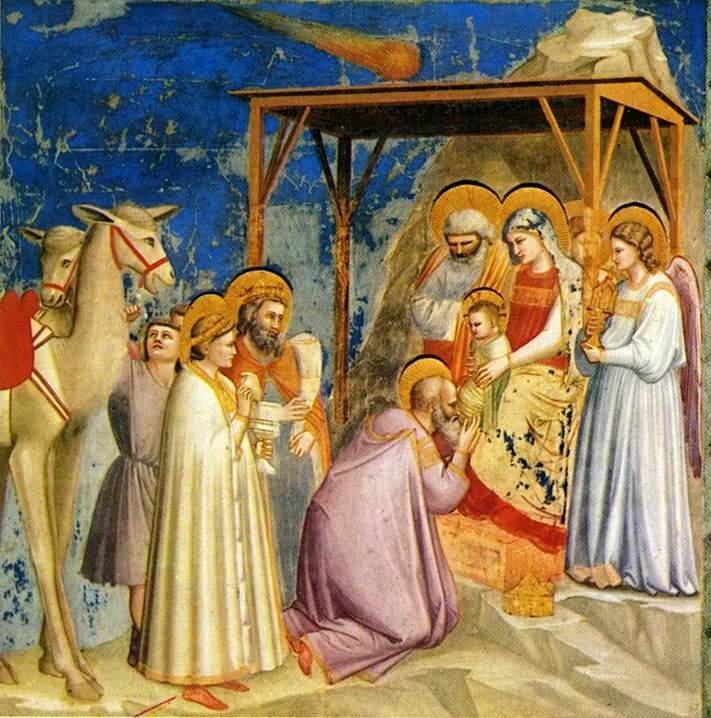 Giotto di Bondone, Adoration of the Magi, c. 1304–1306, Scrovegni Chapel, Padua · Public Domain, Wikimedia Commons. Giotto is thought to have painted the star as a comet after witnessing Halley’s Comet in 1301.

Origen Takes the Question Seriously
The third-century Alexandrian theologian Origen wrote Contra Celsum, a lengthy defense of Christianity against the pagan philosopher Celsus’s attacks. In 1.58-59, Origen addresses the star head-on — and what is striking is what he does not do. He does not simply declare it an unexplainable supernatural light and move on. Instead, he places it alongside a piece of ancient astronomical common sense: that newly appearing stars, including objects classed as comets, could be interpreted as omens of major events. His categories should not be equated too closely with modern distinctions between comets, novae, and supernovae.
For Origen, this was not an attempt to explain the miracle away. He was arguing within the astronomical vocabulary his contemporaries already used, showing that the birth of Christ could be understood within that tradition of celestial omens even as it exceeded it. Taking the star’s possible natural character seriously and affirming that it announced the Messiah’s birth were, for Origen, not in tension at all.
Kepler Runs the Numbers
That conversation resurfaces, unexpectedly, in the early seventeenth century. After observing a new star in 1604, now classified as a supernova, the astronomer Johannes Kepler turned his attention back to the Bethlehem star. Working the calculations backward, he identified a rare triple conjunction — Jupiter and Saturn drawing close to each other three times within a single year — in the constellation Pisces around 7 BC. Kepler did not simply identify the conjunction itself with Matthew’s star. Drawing on the apparent proximity of planetary alignments to the new star he had observed, he proposed that an associated new star had appeared around the time of Christ’s birth. The conjunction and the hypothesized new star are different parts of his explanation; modern astronomy does not treat a conjunction as a cause of a nova.
Kepler’s math was rigorous, but his motive was not detached from faith. He was trying to locate a biblical event within the order of a sky he believed God had designed — which places him, whether he framed it this way or not, on the same road Origen had opened centuries earlier.
The Debate Continues
Michael R. Molnar’s The Star of Bethlehem: The Legacy of the Magi (1999) places the question in ancient astrology. His proposal centers on a configuration on 17 April 6 BCE, including the Moon’s occultation of Jupiter in Aries, which he argues could have been interpreted as a royal birth sign. It is an attempt to reconstruct what ancient astrologers might have understood, not a demonstration that a spectacular object was visible to every observer.
The interpretation of that configuration, its relation to Judea, and its fit with Matthew’s story remain disputed. A calculation showing that a configuration occurred cannot by itself establish that it was Matthew’s star. Comet and nova theories also face difficulties, especially in explaining the narrative’s claim that the star guided the visitors and stopped over the child’s location. Some interpreters instead emphasize a miraculous sign or the story’s literary and theological design.
Two Different Questions
These examples show that astronomical inquiry has a long place in the story’s reception. They do not establish a uniform Christian view, either ancient or modern.
Matthew portrays the magi’s journey as a response to the birth of a king worthy of their homage. Interpreters can study that narrative purpose alongside questions about ancient observations of the sky. Origen offers one early example of bringing celestial phenomena and theological meaning into conversation. Historical reconstruction and theological interpretation remain distinct tasks; neither automatically settles the other.
Didymus Lab offers sermon-preparation resources that bring textual study, patristic interpretation, and historical context together.
References
- Origen, Contra Celsum 1.58–59.
- Johannes Kepler, De Stella Nova (1606); John Mosley, historical discussion of Kepler and the Christmas star (1981).
- Michael R. Molnar, The Star of Bethlehem: The Legacy of the Magi (Rutgers University Press, 1999)
- Bradley E. Schaefer, “Astronomical and Historical Evaluation of Molnar’s Solution for the Star of Bethlehem” (2015 book chapter; arXiv version, 2016), an assessment supporting Molnar’s proposal.
Comments
Leave a comment
Comments are reviewed before being published. Only your name and comment are stored — no personal data collected.
You might also like
Bible, Actually
'Virgin' or 'Young Woman'? Reading Isaiah 7:14 Carefully
The Hebrew word, the sign to Ahaz, and Matthew’s account of Jesus address connected but distinct questions.
Bible, Actually
The Song of Songs: Human Love and a Long History of Sacred Reading
The Song celebrates desire, yet generations read it as divine love. Its interpretation is richer than a choice between embarrassment and literalism.
Bible, Actually
Judas's Thirty Pieces of Silver — The Number That Came from Exodus
The price Judas was paid for betraying Jesus wasn't arbitrary. Matthew loaded 'thirty silver coins' with a double echo from the Hebrew Bible: a slave compensation law in Exodus and a prophet's biting irony in Zechariah.
Loading comments…