Bible, Actually
The Song of Songs: Human Love and a Long History of Sacred Reading
The Song of Songs speaks the language of desire. Lovers search for one another, praise each other’s bodies, and picture intimacy through gardens, fruit, fragrance, and wine. Its opening request for kisses gives readers little reason to expect an abstract theological treatise.
Yet Jewish and Christian communities have repeatedly found a language of divine love in this book. The history is not simply a contest between people who noticed the erotic poetry and people who failed to notice it. Many spiritual interpreters knew exactly what kind of language they were interpreting.
Does the poem name God?
The Song contains little explicit religious instruction. Even the familiar claim that it never mentions God’s name, however, needs qualification. In 8:6, shalhevetyah can be understood as “a flame of Yah,” with a shortened form of the divine name, or as an intensive expression, “a mighty flame.” Translations differ accordingly.
The uncertainty does not turn the book into an ordinary theological discourse. It does prevent the supposed total absence of God’s name from becoming a decisive argument for how the whole poem must be read.
What Akiva actually defended
Mishnah Yadayim 3:5 records a discussion of whether the Song and Ecclesiastes “defile the hands,” a ritual category associated with the holiness of sacred writings. Rabbi Akiva strongly defends the Song and calls it the “holy of holies.”
That passage does not explicitly say its holiness depends on an allegory of God and Israel. Traditions criticizing the use of its verses as banquet entertainment appear elsewhere, including Babylonian Talmud Sanhedrin 101a; they should not be inserted into the Mishnah as an explanation it does not give. Reverence for a sacred book does not, by itself, establish a complete theory of its interpretation.
Later Jewish interpretation certainly did develop sustained allegory. The Targum of the Song retells the relationship between God and Israel through its lovers’ language. That is an important witness to reception, but it should not be treated as a transcript of Akiva’s reasoning.
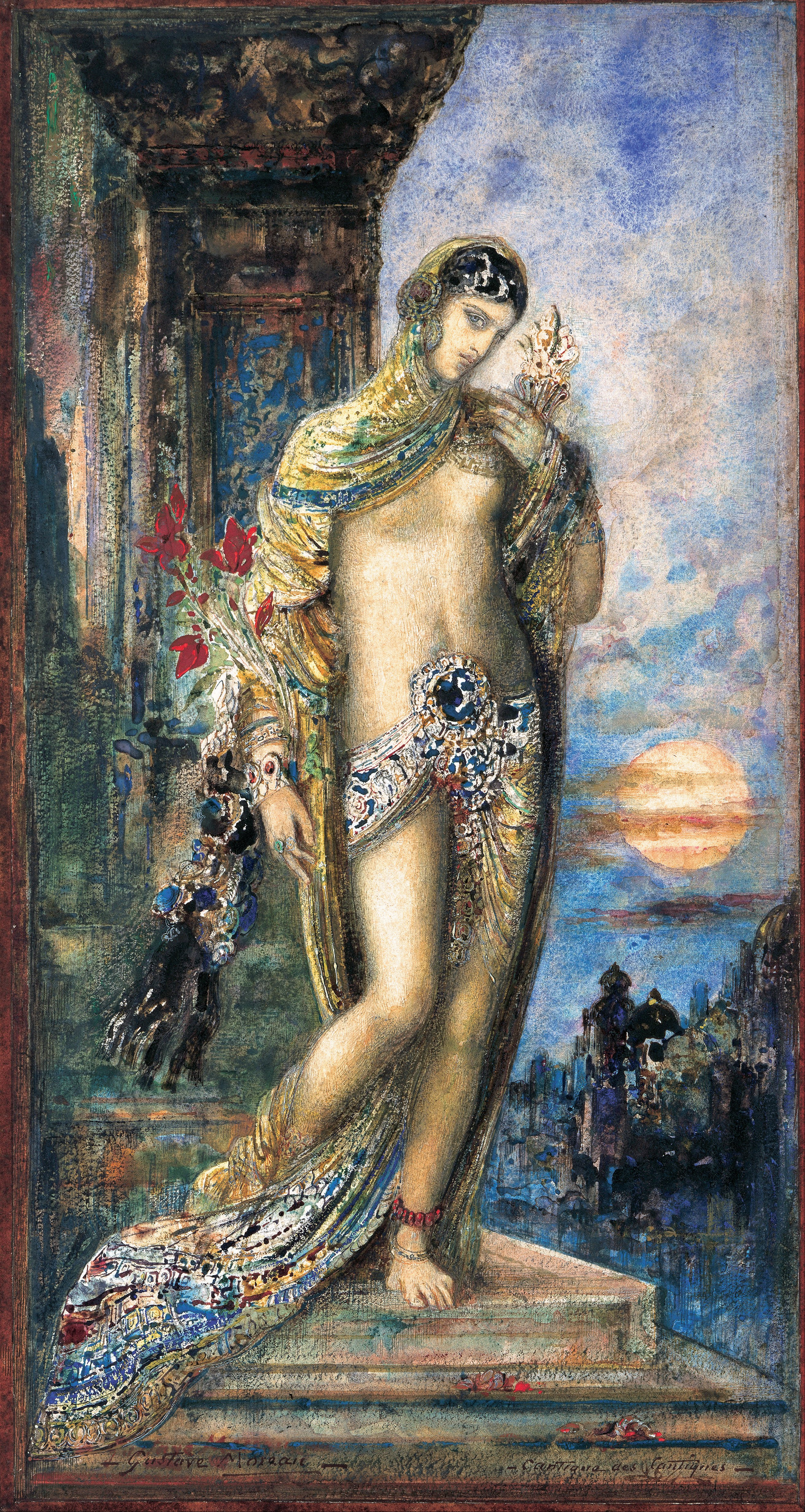 Gustave Moreau, The Song of Songs, 1893, watercolor · Ohara Museum of Art, Kurashiki · Wikimedia Commons · Public Domain.
_-_Google_Art_Project.jpg)
Origen and Bernard’s spiritual readings
Origen’s third-century commentary and homilies read the lovers as Christ and the Church, and also as Christ and the believing soul. Portions of his commentary survive through Rufinus’s Latin translation. For Origen, bodily language could speak about the soul’s growth in love and knowledge of God.
Bernard of Clairvaux later composed eighty-six sermons on the Song. The unfinished series makes the bride’s desire a language of prayer and spiritual encounter. These readings profoundly shaped Christian devotion. Describing them as allegorical identifies their method; it need not dismiss their theological seriousness.
Modern comparison is not one theory
Modern scholars often begin with the poem’s human lovers and its relationship to ancient love poetry, including Egyptian examples. Shared images and conventions help explain its language without assigning every detail a hidden spiritual equivalent. Literary comparison does not automatically establish direct borrowing or explain how the book entered the canon.
Marvin Pope’s extensive 1977 commentary is an important comparative resource, but it is not a simple manifesto for secular romance. Pope explores fertility cult, sacred marriage, and funeral-feast settings. Those hypotheses are debated and should not be presented as the consensus of modern scholarship.
Reading on more than one level
A literary reading asks what the lovers say and how the poetry works. A theological reading asks how a sacred community receives that language within its wider convictions. Those questions can interact without becoming identical.
Preachers can first let the poem speak about longing, mutual delight, separation, and the power of love. They can then explain how a particular tradition draws on that language for divine love. Naming the interpretive step respects both the poem and its readers across history. Didymus Lab brings textual study and reception history together for this work.
References
- Mishnah Yadayim 3:5; Song of Songs 8:6.
- Origen, The Song of Songs: Commentary and Homilies, trans. R. P. Lawson (Ancient Christian Writers 26; Newman Press, 1957).
- Bernard of Clairvaux, Sermons on the Song of Songs.
- Marvin H. Pope, Song of Songs: A New Translation with Introduction and Commentary (Anchor Bible 7C; Doubleday, 1977).
Comments
Leave a comment
Comments are reviewed before being published. Only your name and comment are stored — no personal data collected.
You might also like
Bible, Actually
The Star of Bethlehem: An Ancient Question, an Unsettled Debate
Origen, Kepler, and modern astronomers proposed different accounts of Matthew’s star. Their theories require distinctions as well as curiosity.
Bible, Actually
"Your Latter Days Will Be Greater" — Why Job 8:7 Is Not a Promise from God
Job 8:7 is a conditional argument made by Bildad, one of Job's friends. At the end of the book, God himself rebukes Bildad for not speaking rightly. Understanding who says what in Job reshapes how we read — and quote — the book.
Bible, Actually
The Forbidden Fruit Wasn't an Apple — Genesis Never Says What It Was
Genesis never names the fruit Eve ate. The West pictured an apple for over a millennium; East Asia, including Korea, pictured a peach. Here's where both traditions actually come from — and why the text itself doesn't care.
Loading comments…