Bible, Actually
Romans 8:28 — Who Is the Promise For, and What Is the 'Good'?
Few sentences in the New Testament are quoted as often in moments of crisis as Romans 8:28. When someone faces illness, loss, failure, or grief, the verse arrives quickly: all things work together for good. It is a genuine word of comfort. But it is also a verse that is regularly quoted in a form stripped of its qualifications — and the qualifications are doing important theological work.
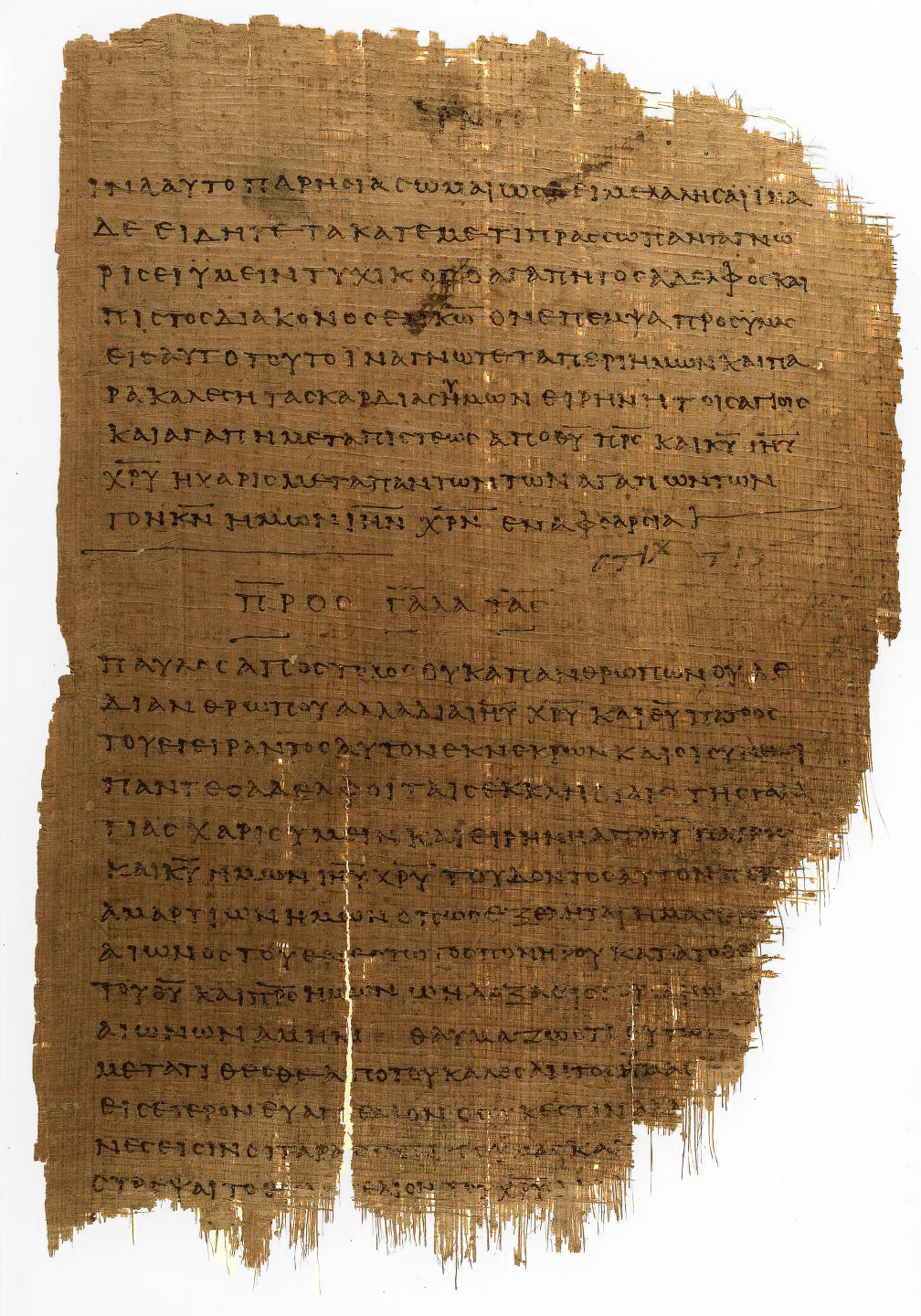 Papyrus 46 (P46), Chester Beatty collection, early 3rd century. This page shows Galatians; Romans is also contained in this manuscript. Public domain.
The Scope of the Promise — “Those Who Love God”
The full verse in most English translations reads something like this:
“And we know that in all things God works for the good of those who love him, who have been called according to his purpose.” (Rom 8:28, NIV)
Or in the older KJV rendering:
“And we know that all things work together for good to them that love God, to them who are the called according to his purpose.”
However it is translated, the promise has a specific addressee: those who love God, who have been called according to his purpose. These qualifying phrases are not fine print. They are the frame within which the promise operates. Romans 8 as a whole is structured around the contrast between those who are “in the Spirit” (8:1–4) and those who are not, and between present suffering and future glory. The promise of 8:28 belongs inside that structure, not outside it.
When the verse is quoted in detachment — “all things work together for good,” full stop — the implied audience becomes universal. But Paul’s audience is specific.
What Is the “Good”? — The Answer in Verse 29
The second often-missed element is the definition of agathon (good). In the Greek text, the word is left without further specification in verse 28. Verse 29 supplies that specification:
“For those God foreknew he also predestined to be conformed to the image of his Son, that he might be the firstborn among many brothers and sisters.” (Rom 8:29)
The “good” toward which all things work is conformity to the image of Christ. This is not general prosperity, favorable circumstances, or resolved difficulties. It is a particular theological telos: becoming more like Jesus. The logic of the passage is that God works through all of the experiences of those who love him — suffering included — to accomplish this transformation.
Paul has just spent the previous verses (8:18–27) sitting with the reality of present suffering, groaning creation, and the Spirit’s intercession in weakness. He is not promising that the suffering goes away. He is promising that it is not random. It is held within a purpose: conformity to Christ.
 Anonymous scribe, Codex Vaticanus, 4th century — Vatican Apostolic Library. Public domain.
What Ancient Manuscripts Disagree About
Romans 8:28 has a well-documented textual variant that adds a further layer of precision to the discussion. Bruce Metzger addresses it in his Textual Commentary on the Greek New Testament (2nd ed., 1994).
In the majority of manuscripts, the subject of the verb “work together” is implicit — it can be taken as “all things” (πάντα, panta), making the sentence: all things work together for good. But in several significant early witnesses — including Papyrus 46 and Codex Vaticanus, two of the oldest and most respected manuscripts — the word theos (God) appears as an explicit subject: God works all things together for good.
The two readings carry different emphases. The majority text gives a kind of providential synergy: everything in creation cooperates toward God’s purposes. The minority text (found in the oldest papyrus we have of Paul) makes God the explicit agent: God himself is working everything together. Metzger discusses the manuscript evidence and the arguments for each reading in detail.
Here is the point for practical reading: either way, the verse is not promising that circumstances will improve. It is promising that God (or: all things under God’s sovereign governance) is oriented toward a specific goal for a specific people. The guarantee is not about outcomes in the worldly sense. It is about direction.
 Anonymous scribe, Codex Sinaiticus, 4th century — British Library (Add MS 43725). CC0 1.0.
Reading Verses 28 and 29 Together
The most reliable way to prevent misreading Romans 8:28 is to read verse 29 alongside it every time. When you do, the verse resolves from an open-ended promise into a precisely defined one:
- The addressees: those who love God, called according to his purpose.
- The agent: God (explicitly in the older manuscripts) working through all things.
- The goal: conformity to the image of his Son.
This is a stronger and stranger promise than “it’ll all work out.” It does not guarantee that difficulties will be removed. It guarantees that they will not be wasted — that they are being woven into a pattern whose final shape is Christ.
The next time Romans 8:28 is quoted to someone in pain, it may be worth pausing long enough to read verse 29 as well. Not to reduce the comfort, but to make it more honest and more durable.
Sources
- Bruce M. Metzger, A Textual Commentary on the Greek New Testament, 2nd ed. (United Bible Societies, 1994), on Romans 8:28
Comments
Leave a comment
Comments are reviewed before being published. Only your name and comment are stored — no personal data collected.
You might also like
Bible, Actually
The 'Gospel of Jesus's Wife': How a 2012 Media Sensation Turned Out to Be a Forgery
A Harvard scholar's 2012 announcement of a papyrus fragment quoting Jesus saying 'my wife' made front-page news worldwide. Four years later, investigative reporting traced it to a modern forger — and it has nothing to do with the real ancient Gospel of Mary.
Bible, Actually
'Virgin' or 'Young Woman'? Reading Isaiah 7:14 Carefully
The Hebrew word, the sign to Ahaz, and Matthew’s account of Jesus address connected but distinct questions.
Bible, Actually
The Missing Verb in 'Wives, Submit to Your Husbands'
P46 and Vaticanus omit a verb in Ephesians 5:22. The shorter text links the verse to 5:21, while its theological implications remain debated.
Loading comments…