Bible, Actually
The 'Needle's Eye Gate' Never Existed — Matthew 19:24 and a Medieval Gloss
The story has appeared in countless sermons and study Bibles. In the wall surrounding Jerusalem, the explanation goes, there was a small gate called the Needle’s Eye. To pass through it, a camel had to kneel down, have its baggage removed, and squeeze through on its knees. So Jesus, in Matthew 19:24, was not describing an impossibility — merely a difficulty. With enough effort and humility, even a rich person can enter the kingdom of God.
It is a tidy pastoral illustration. It is also unsupported by any evidence from antiquity.
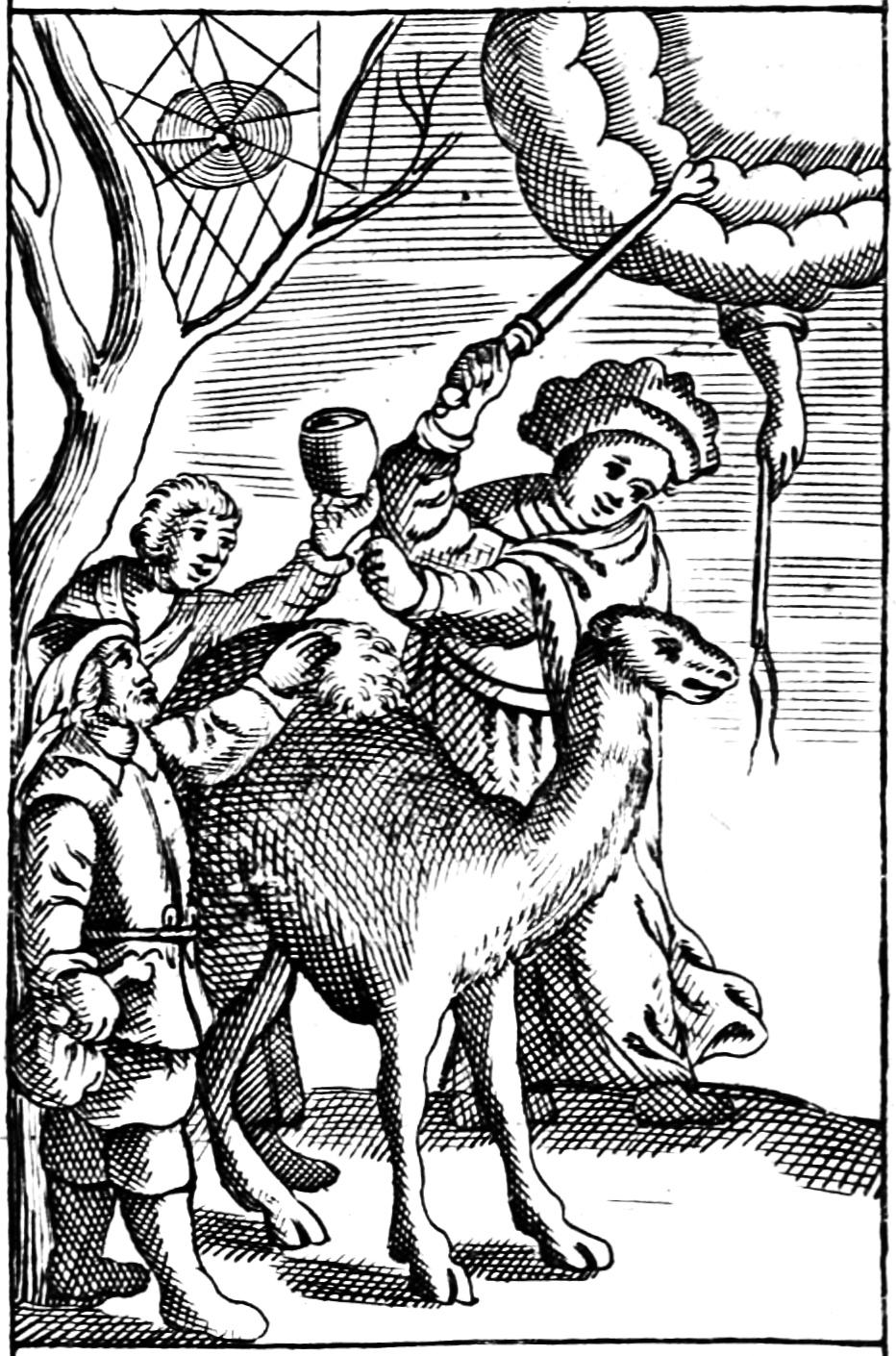 Anonymous · Camel through the Eye of a Needle (from Drexelius) · Public Domain.
What Ancient Sources Do Not Say
First-century Jewish and Roman sources are reasonably detailed about Jerusalem’s geography. Josephus describes the city’s walls and gates at length. Rabbinic literature records the names of Jerusalem’s gates. Neither mentions a gate called the Needle’s Eye or anything resembling a low passage designed for unloaded camels. Archaeological investigation of the city’s ancient walls has likewise turned up no structure that fits the description.
The claim has been traced back variously to commentators across the centuries, but each time scholars follow the thread backward, it leads not to antiquity but to the Middle Ages.
Anselm, Aquinas, and the Origin of the Legend
A 2022 article in New Testament Studies by Agnieszka Ziemińska (“The Origin of the ‘Needle’s Eye Gate’ Myth: Theophylact or Anselm?”) provides the most careful recent treatment of this question. Previous scholarship had often credited Theophylact of Bulgaria (11th century) as the first to propose the gate interpretation. Ziemińska’s documentary analysis revises this attribution: the earliest identifiable source for the legend is a marginal note associated with Anselm of Canterbury, which then entered the broad stream of Western Christian commentary through Thomas Aquinas’s Catena Aurea in the 13th century.
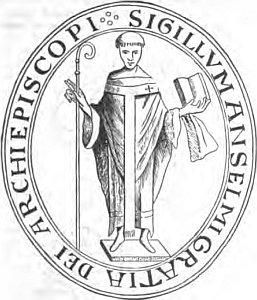 Anselm of Canterbury · Seal · Public Domain.
The gate interpretation, in other words, is not a piece of first-century Palestinian topography that scholars later confirmed. It is a medieval explanatory gloss that entered the homiletical tradition and hardened into assumed fact.
What the Greek Text Actually Says
The Greek of Matthew 19:24 is direct: κάμηλον (a camel) passing through a τρήματος ῥαφίδος (the eye of a needle). There is no architectural vocabulary here — no word for gate, passage, or low door. The pairing of the largest common land animal with the smallest common household opening is a deliberate rhetorical move: it creates an image of maximal absurdity.
This kind of extreme comparison was a recognized rhetorical device in the ancient world. The Babylonian Talmud uses “an elephant through the eye of a needle” to express the same kind of impossible hyperbole (b. Berakhot 55b). Whatever an ancient audience made of Jesus’s saying, they were not hearing a description of a real piece of architecture.
Why Verse 26 Requires the Impossibility
The disciples’ response confirms the exegesis. They ask, “Who then can be saved?” (v. 25). If the saying meant “it’s possible but difficult,” the question makes no sense. You don’t despair at a difficulty. You despair at an impossibility.
And Jesus answers accordingly: “With man this is impossible, but with God all things are possible” (v. 26). The logic of verse 26 depends entirely on the claim of verse 24 being genuinely impossible. Remove the impossibility — soften the camel into a kneeling beast squeezing through a gate — and the resolution in verse 26 loses its force. The whole rhetorical structure of the passage pivots on the absurdity being real.
When the Illustration Undercuts the Text
The gate interpretation is well-intentioned. It wants to make the text less bleak, less terrifying. It wants to offer hope to would-be rich Christians. But it does so by evacuating precisely the shock that Jesus built into verse 24 — and in the process, it weakens the theological claim of verse 26, which is that salvation is God’s work, not a feat of human effort or moral improvement.
The camel and the needle are meant to be funny in the way that absurdity is funny: wildly, impossibly comic. And then verse 26 answers it. That sequence — impossible, and yet — is the point.
How a commentary furnished the reader’s Jerusalem
Aquinas’s Catena Aurea gathers earlier interpretations around the biblical text. A reader encountering its gloss attributed to Anselm could picture a city gate where the Gospel names a needle. Ziemińska also identifies a related passage in Hugh of Saint-Cher; authorship and the relationship between these witnesses remain unresolved. Read the study.
The interpretive change is substantial. A passage that cannot accommodate a camel becomes one navigable through effort and humility. That makes a memorable moral illustration, but not evidence for first-century architecture. Reception history asks when an aid to imagining Scripture begins to replace the image Scripture actually gives.
References
- Agnieszka Ziemińska, “The Origin of the ‘Needle’s Eye Gate’ Myth: Theophylact or Anselm?,” New Testament Studies 68, no. 3 (2022): 358–361, Cambridge University Press
- Thomas Aquinas, Catena Aurea, commentary on Matthew 19:24
Comments
Leave a comment
Comments are reviewed before being published. Only your name and comment are stored — no personal data collected.
You might also like
Bible, Actually
The Five Thousand Were a Lower Bound — Reading Matthew 14:21 Carefully
Matthew 14:21 specifies that five thousand was the count of adult men (ἄνδρες), explicitly excluding women and children. The total crowd was larger; the text does not say by how much. The miracle's scale is bigger than the number suggests.
Bible, Actually
The Forbidden Fruit Wasn't an Apple — Genesis Never Says What It Was
Genesis never names the fruit Eve ate. The West pictured an apple for over a millennium; East Asia, including Korea, pictured a peach. Here's where both traditions actually come from — and why the text itself doesn't care.
Bible, Actually
The Star of Bethlehem: An Ancient Question, an Unsettled Debate
Origen, Kepler, and modern astronomers proposed different accounts of Matthew’s star. Their theories require distinctions as well as curiosity.
Loading comments…