Bible, Actually
The Legend Behind the Septuagint's Name — And What Actually Happened
Seventy-two scholars, locked in separate rooms with no contact with one another, translate the same text. Seventy-two days later, someone lines up the results — and every single version matches, word for word. That is not a modern urban legend. For centuries, it was the standard explanation for where the Greek Old Testament came from. And the story left a permanent mark on how we still refer to that translation today: the Septuagint.
What the Letter of Aristeas Actually Claims
The legend comes from a document called the Letter of Aristeas. It presents itself as a letter from Aristeas, a courtier of Ptolemy II Philadelphus (reigned c. 285–246 BC), to his brother. Scholars are near-unanimous that it is not what it claims to be: it is a pseudepigraphal work, most likely composed by an anonymous Alexandrian Jewish author sometime in the second century BC. Bruce M. Metzger, in An Introduction to the Apocrypha (Oxford University Press, 1957), summarizes the scholarly consensus bluntly — the author “cannot have been the man he represented himself to be,” and the account is a fictional narrative composed to elevate the standing of the Hebrew Scriptures.
The story itself runs like this. Ptolemy II wants a Greek translation of the Jewish Law for the Library of Alexandria. On the advice of his librarian, Demetrius, he writes to the High Priest Eleazar in Jerusalem requesting translators. Eleazar sends 72 elders — six from each of the twelve tribes of Israel. The translators are sequestered on the island of Pharos, off Alexandria, where each works independently. They finish in exactly 72 days. When their translations are compared, they are found to agree perfectly, down to the letter.
An Origin Story Built for a Purpose
Later writers pushed the story further. Philo of Alexandria, in On the Life of Moses (Book 2), turns the episode into an explicitly miraculous event — the translators, isolated from one another, produced identical Greek as if each had been dictated to by the same divine source. Josephus retells the Aristeas account at length in Book 12 of the Antiquities of the Jews, lending it further institutional weight by repeating it as established history.
The narrative logic is not hard to trace. A pagan king personally recognizes the value of the Jewish Law and commissions its translation; seventy-two independent scholars, working in isolation, arrive at an identical result as if guided by God himself. Both details point to the same conclusion: this Greek translation carries the same authority as the Hebrew original it renders. Karen H. Jobes and Moisés Silva, in Invitation to the Septuagint (2nd ed., Baker Academic, 2015), note that despite its legendary character, the letter remains valuable for understanding the kind of authority Alexandrian Jews wanted their Greek Scriptures to carry — even if the story of how that authority was earned is not historical.
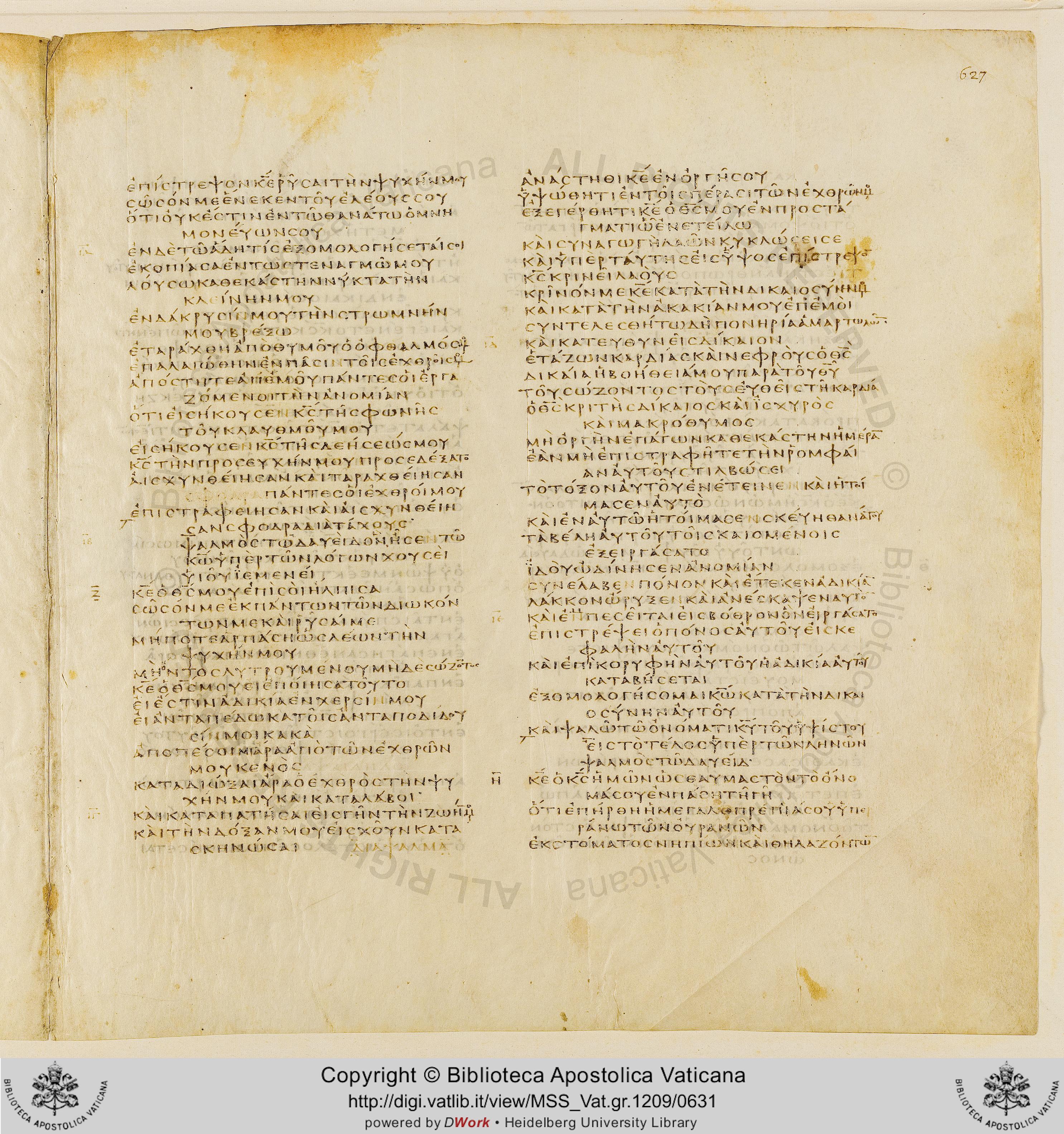 A page from Codex Vaticanus (Vat.gr.1209) showing Psalm 7, 4th century · Vatican Library · Public Domain. One of the oldest surviving near-complete manuscripts of the Septuagint — the product not of a 72-day miracle, but of generations of copying and transmission.
Even the Name Is a Fossil of the Legend
Here is the detail that surprises most readers: the very name we use for this translation is a relic of the story itself. The Latin phrase interpretatio septuaginta virorum — “the translation of the seventy men” — gave us both “Septuagint” and its scholarly abbreviation, LXX, the Roman numeral for seventy. But the Letter of Aristeas names exactly 72 translators, not 70. Seventy is simply 72 rounded down for convenience. Every time a seminary lecture or a footnote refers casually to “the LXX,” it is repeating a number quietly inherited from a legend nobody actually believes anymore.
What Actually Happened, According to the Evidence
So what do scholars think really occurred? Emanuel Tov, in Textual Criticism of the Hebrew Bible (Fortress Press, 1992), lays out the case built from linguistic and text-critical evidence: the Torah (the five books of Moses) was translated first, in Alexandria, in the early-to-mid third century BC — a date range that is compatible with the Ptolemy II setting of the legend, even though nothing supports the idea of a single 72-day, 72-person project. Jobes and Silva go further, noting that even the Torah alone shows signs of having been divided among multiple translators rather than produced by one hand (a tradition preserved in the minor tractate Soferim (Massekhet Soferim 1:7-8) names five translators, not seventy-two — though the Babylonian Talmud’s own main text, b. Megillah 9a-b, tells a version of the seventy-two-translator story, with some details differing from the Letter of Aristeas).
The strongest evidence, though, comes from the rest of the Hebrew Bible. The Prophets and the Writings were not translated in one coordinated push. The scholarly reconstruction has them rendered gradually, by different translators working independently, over roughly two centuries — from the third century BC into the first. That process left fingerprints in the text itself: some books read as rigidly literal, following Hebrew word order almost mechanically, while others read as free, idiomatic paraphrase. That kind of stylistic unevenness is exactly what you would expect from a patchwork project spanning generations of anonymous translators — and exactly what you would not expect from seventy-two scholars finishing in lockstep in 72 days. The Septuagint was not a miracle. It was accumulated labor, carried out over roughly two centuries by translators whose names, in almost every case, we will never know.
References
- R.J.H. Shutt, trans., “Letter of Aristeas,” in James H. Charlesworth, ed., The Old Testament Pseudepigrapha, vol. 2 (Garden City, NY: Doubleday, 1985)
- Bruce M. Metzger, An Introduction to the Apocrypha (New York: Oxford University Press, 1957)
- Karen H. Jobes and Moisés Silva, Invitation to the Septuagint, 2nd ed. (Grand Rapids: Baker Academic, 2015)
- Emanuel Tov, “The Septuagint,” in Textual Criticism of the Hebrew Bible (Minneapolis: Fortress Press, 1992)
Comments
Leave a comment
Comments are reviewed before being published. Only your name and comment are stored — no personal data collected.
You might also like
Bible, Actually
'Virgin' or 'Young Woman'? Reading Isaiah 7:14 Carefully
The Hebrew word, the sign to Ahaz, and Matthew’s account of Jesus address connected but distinct questions.
Bible, Actually
Goliath Was Nine Feet Tall — Unless You Ask an Older Manuscript
1 Samuel 17:4 records Goliath's height differently depending on which ancient manuscript you consult. The Masoretic Text says six cubits and a span; the Septuagint and Dead Sea Scrolls say four. The discrepancy opens a window into how the Old Testament was transmitted.
Bible, Actually
The Silver Scrolls That Took Three Years to Unroll — and Turned Out to Be Scripture
In 1979, a teenage volunteer at a Jerusalem dig found two tiny, corroded silver scrolls. What they contained — a blessing echoing Numbers 6:24-26 — made them the oldest known biblical text ever recovered.
Loading comments…