Bible, Actually
Junia in Romans 16: A Woman, an Apostle, and a Translation Debate
A short greeting in Romans has generated two different debates, often treated as though they were one. Was Junia a woman? And does Paul include Junia and Andronicus among the apostles, or say that the apostles knew them well? The evidence for the first question is considerably stronger than a claim that every detail of the second is settled.
The name in the greeting
Romans 16:7 commends Andronicus and Junia as Paul’s fellow Jews or kinspeople, fellow prisoners, and believers who preceded him in Christ. Junia was a well-attested Roman woman’s name. The proposed masculine “Junias” has no secure independent ancient attestation as a personal name in the evidence normally cited for this debate. A suggested contraction of Junianus has not supplied comparably strong evidence.
The early unaccented spelling of the Greek accusative, ΙΟΥΝΙΑΝ, does not resolve the choice by its letters alone. Later accentuation can signal a feminine or masculine interpretation, but it is an interpretation of the name, not an eyewitness record of the person’s identity. Evidence from naming practices and ancient reception therefore matters. Eldon Jay Epp’s Junia: The First Woman Apostle assembles the case for the feminine reading and traces its editorial history.
One familiar bearer of the name, Junia Tertia, was the wife of Cassius and half-sister of Marcus Brutus—not Brutus’s wife. She is evidence for the name’s ordinary Roman use, not evidence that Paul’s Junia belonged to the same household.
What Chrysostom actually understood
In his thirty-first homily on Romans, John Chrysostom explicitly describes Junia as a woman. He also admires her devotion and treats her as worthy of the designation “apostle.” His reading is important evidence that the inclusive interpretation was available to a highly accomplished ancient Greek reader.
That testimony does not establish what every fourth-century Christian thought. Nor does being a native Greek speaker remove every possible interpretive question. It does show that calling Junia a woman apostle is not a modern idea invented without ancient support.
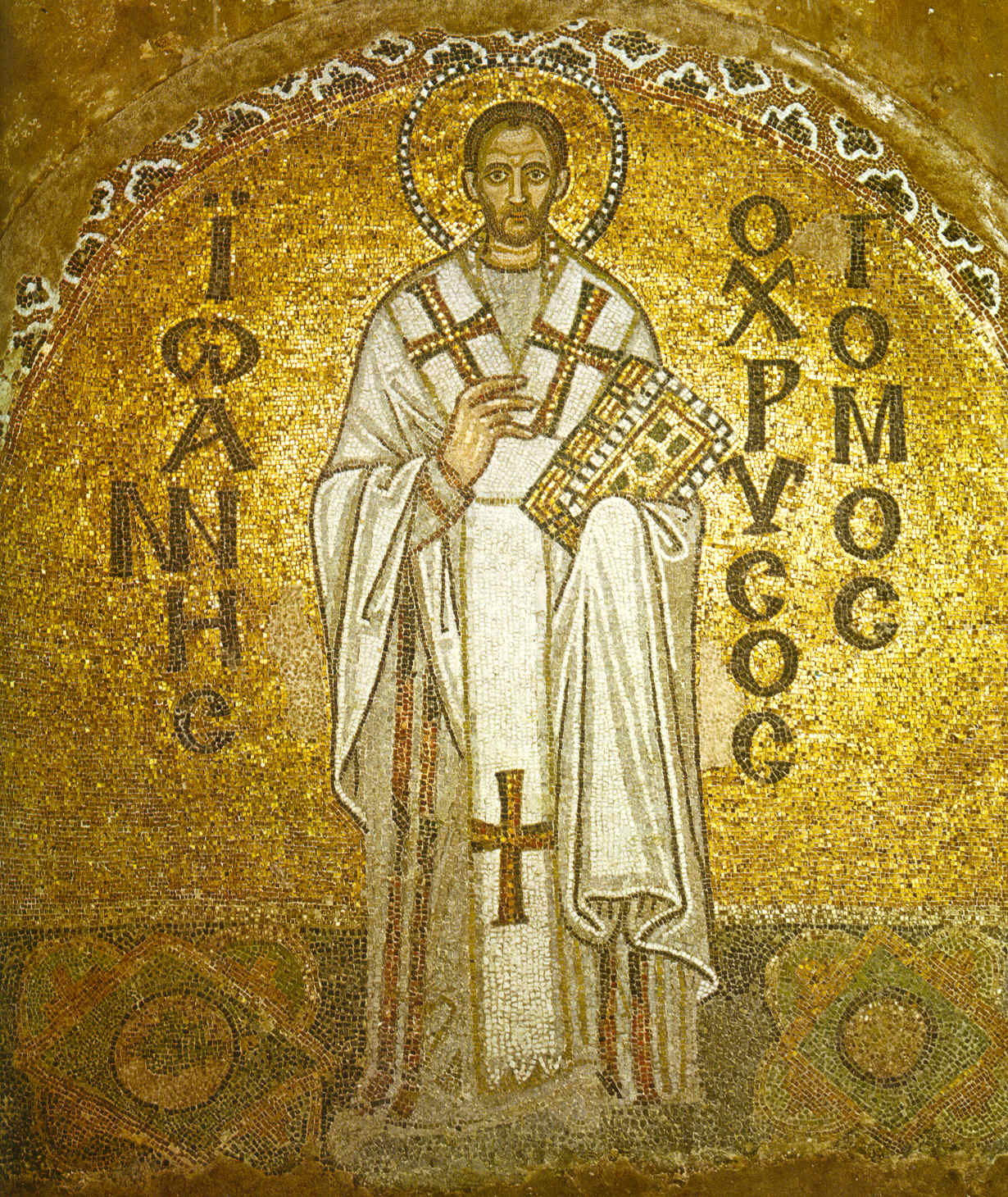 Byzantine mosaic of John Chrysostom at Hagia Sophia · Public domain · Wikimedia Commons. Chrysostom’s homily supplies evidence for an ancient reading of Romans 16:7; the mosaic itself is a later portrait.

An uneven translation history
Some medieval interpreters, including Giles of Rome, read the name as masculine. But the history is not one of uniform erasure from the thirteenth century onward. The King James Version retains “Junia.” The Nestle Greek editions initially printed the feminine accentuation; the thirteenth edition of 1927 adopted the masculine, and the feminine returned in the 1998 printing of NA27.
Assumptions about who could be an apostle plausibly influenced particular interpreters, but the motive of every editor cannot be inferred from the spelling alone. The documented changes are enough to make the point: editorial conventions can influence how readers imagine even a person mentioned only once.
Among the apostles, or known to them?
The phrase episēmoi en tois apostolois has been read inclusively, “prominent among the apostles,” and exclusively, “well known to the apostles.” The NIV and NRSV traditions illustrate the first approach; the ESV uses the second. Burer and Wallace’s 2001 article argues for the exclusive reading. Epp and other scholars defend the inclusive one, for which Chrysostom is a significant ancient witness.
That grammatical dispute should not be confused with the evidence for a female name. Even after accepting the inclusive reading, another question remains: what range does “apostle” have here? Paul uses the term beyond the Twelve, and identifying Junia as an apostle does not automatically define a later church office or settle present-day ordination policy.
The result is neither silence nor a forced consensus. There is strong historical and linguistic reason to read Junia as a woman; there is substantial ancient and modern support for including her among the apostles; and there is a real scholarly disagreement about the phrase. A responsible sermon can make all three points without making the text say less—or more—than the evidence warrants.
Didymus Lab helps readers distinguish textual evidence, reception history, and theological application.
References
- Eldon Jay Epp, Junia: The First Woman Apostle (Fortress Press, 2005), especially the history of printed Greek editions and translations.
- John Chrysostom, Homilies on Romans, Homily 31, on Romans 16:7.
- Michael H. Burer and Daniel B. Wallace, “Was Junia Really an Apostle? A Re-examination of Rom 16.7,” New Testament Studies 47 (2001): 76–91.
- Romans 16:7: KJV, NRSV/NRSVue, NIV, ESV; NA28/UBS5 Greek text.
Comments
Leave a comment
Comments are reviewed before being published. Only your name and comment are stored — no personal data collected.
You might also like
Bible, Actually
The 'Gospel of Jesus's Wife': How a 2012 Media Sensation Turned Out to Be a Forgery
A Harvard scholar's 2012 announcement of a papyrus fragment quoting Jesus saying 'my wife' made front-page news worldwide. Four years later, investigative reporting traced it to a modern forger — and it has nothing to do with the real ancient Gospel of Mary.
Bible, Actually
'Virgin' or 'Young Woman'? Reading Isaiah 7:14 Carefully
The Hebrew word, the sign to Ahaz, and Matthew’s account of Jesus address connected but distinct questions.
Bible, Actually
The Missing Verb in 'Wives, Submit to Your Husbands'
P46 and Vaticanus omit a verb in Ephesians 5:22. The shorter text links the verse to 5:21, while its theological implications remain debated.
Loading comments…