Bible, Actually
Joseph's Investiture in Genesis 41 Follows Actual Egyptian Court Protocol
Among the most compressed narrative pivots in Genesis is the movement from prison to palace: Joseph, having interpreted Pharaoh’s dreams, is summoned, cleaned up, and installed as second-in-command of Egypt in the space of a few verses (Genesis 41:14–45). Readers sometimes file this away as a satisfying fairy-tale resolution — the wrongly imprisoned hero suddenly elevated to rule. But the investiture ceremony that Genesis 41:42–45 describes is not vague court decoration. Read against the Egyptological record, it turns out to be a precise rendering of how Egyptian officials were actually appointed.
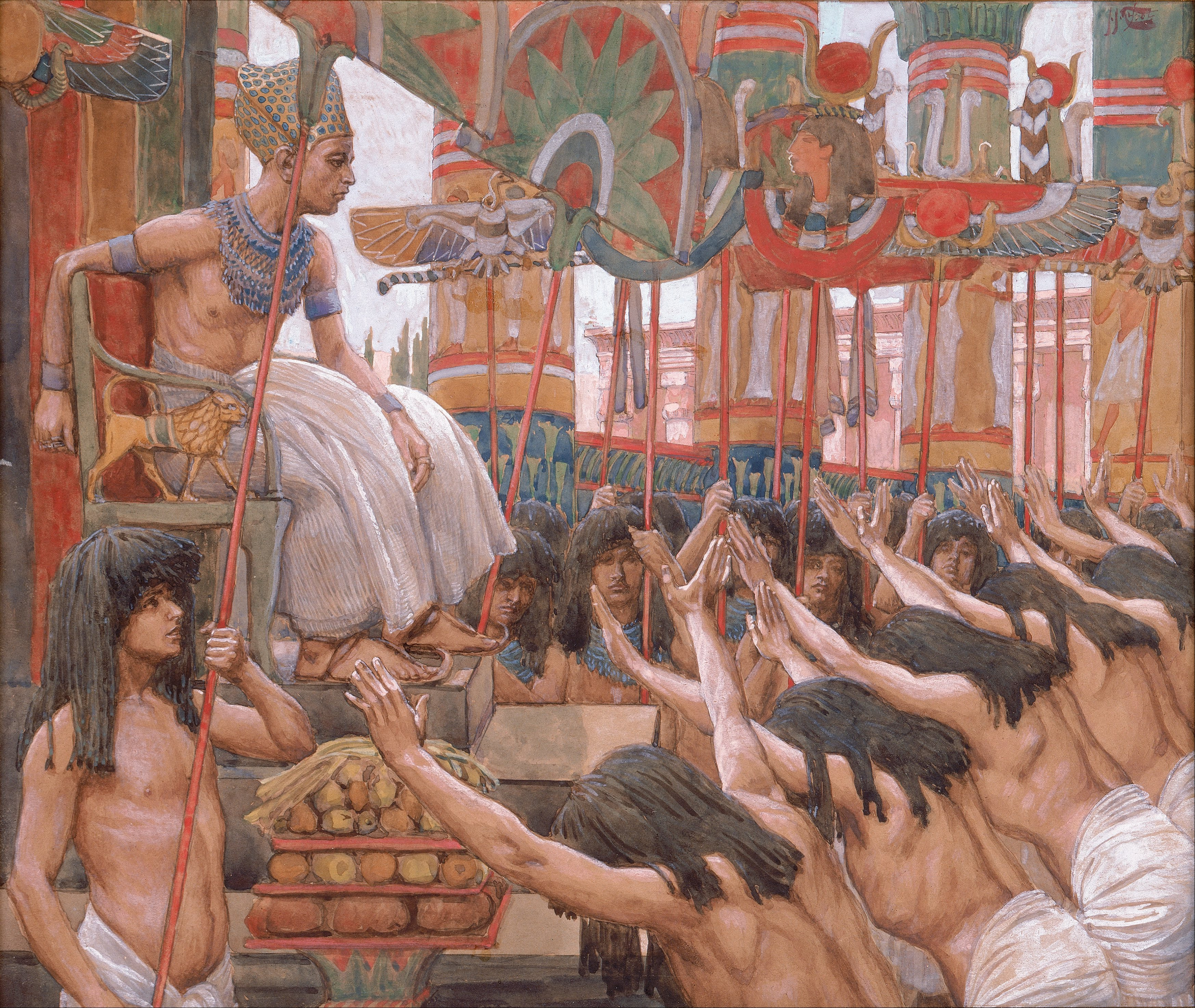 James Tissot · Joseph Dwelleth in Egypt, c. 1896–1902 · Public Domain. An artist’s imaginative rendering of Joseph’s life in Egypt, not a contemporary documentary source.
The Five Elements of the Investiture
Genesis 41:42–45 narrates Pharaoh’s appointment of Joseph through five sequential acts:
1. The signet ring. “Pharaoh took his signet ring from his hand and put it on Joseph’s hand.” In Egyptian administrative practice, the ring bearing the royal seal was the physical token of authority to act in the king’s name — the equivalent of executive signing power delegated. This element is not a decorative flourish; it has an administrative meaning that Egyptian documentation confirms.
2. Garments of fine linen. “He clothed him in garments of fine linen.” White linen robes were the distinguishing dress of high Egyptian officials. The investiture gift of linen clothing to a newly appointed vizier or senior official appears repeatedly in New Kingdom Egyptian sources as a formal, documented element of appointment ceremonies.
3. The gold chain. “And put a gold chain about his neck.” The Egyptian institution known as the “gold of honor” (ḏbḥ-ḥḏ) — a gold necklace or collar awarded by Pharaoh — is among the most frequently depicted scenes in New Kingdom tomb paintings. Egyptologist Susanne Binder has documented approximately forty examples from tomb reliefs in which the “gold of honor” is presented as part of formal reward and appointment ceremonies.
4. The chariot procession and “Abrek.” “He made him ride in his second chariot. And they called out before him, ‘Abrek!’” The public chariot procession through the city was the ceremonial publication of a high appointment — its civic announcement. Crowds seeing a dignitary in Pharaoh’s chariot understood the signal.
5. The name and the wife. Joseph receives a new Egyptian name, Zaphenath-paneah (צָפְנַת פַּעְנֵחַ), and a wife, Asenath daughter of Potiphera, priest of On (Heliopolis). The assignment of an Egyptian name and a priestly family connection to a new official reflects the integration of a royal appointee into Egyptian social structures.
What “Abrek” Means
The word אַבְרֵךְ (ʾavrek) in verse 43 defies straightforward Hebrew etymology. It appears to be an Egyptian loanword — possibly from the Egyptian ib-r-k or a related form — functioning as a ceremonial cry meaning something like “attention,” “make way,” or “bow the knee.” The use of an Egyptian-language command in front of a chariot procession is precisely what one would expect if the narrator had genuine familiarity with Egyptian court protocol rather than constructing an imaginary eastern scene.
Kenneth A. Kitchen, in On the Reliability of the Old Testament (Eerdmans, 2003), traces these Egyptian elements across the Genesis 41 account systematically, noting that the combination — signet ring, fine linen, gold chain, chariot, public acclamation — is not an assembly of generic “palatial” details but a coherent sequence matching the actual investiture procedure.
The Closest Parallel: Binder’s Research
Susanne Binder, in her 2011 essay “Joseph’s Rewarding and Investiture (Genesis 41:41-43) and the Gold of Honour in New Kingdom Egypt” (published in Egypt, Canaan and Israel: History, Imperialism, Ideology and Literature, Brill), identifies the closest single Egyptological parallel to the Genesis investiture scene as a 26th-Dynasty stele inscription from Priene. This inscription records a non-Egyptian being granted high office and the “gold of honor” by Pharaoh — a documented instance of the same appointment pattern applied to a foreigner.
Binder draws on G.P.F. van den Boorn’s detailed study The Duties of the Vizier: Civil Administration in the Early New Kingdom (Kegan Paul International, 1988) for the administrative context. Van den Boorn’s work establishes the vizier as the supreme administrator below the king, responsible for judicial, financial, military, and religious administration across Egypt — precisely the role to which Joseph is appointed.
What This Establishes — and What It Doesn’t
The correspondence between Genesis 41:42–45 and Egyptian investiture practice establishes that the Genesis author (or the tradition preserved in Genesis) had specific, accurate knowledge of Egyptian court procedure. The investiture sequence is not generic “royal court” scenery; it reflects actual administrative reality.
This is not a claim that every detail of Joseph’s story is historically verifiable. The precise meaning of Joseph’s Egyptian name remains debated — “the one who interprets hidden things” and other renderings have been proposed, with no scholarly consensus. Binder herself cautions against pinning the investiture scene to a specific pharaoh or dynasty; the investiture pattern appears across the New Kingdom and into the Late Period, making 1:1 historical identification an overreach.
What the Egyptological evidence does support is something more modest and more interesting: the Genesis narrative carries within it a level of familiarity with Egyptian administrative reality that is difficult to explain as pure literary invention. The bones of the investiture ceremony are historically grounded, whatever one makes of the wider narrative.
References
- Susanne Binder, “Joseph’s Rewarding and Investiture (Genesis 41:41-43) and the Gold of Honour in New Kingdom Egypt,” in Egypt, Canaan and Israel: History, Imperialism, Ideology and Literature (Brill, 2011), pp. 40–64
- Kenneth A. Kitchen, On the Reliability of the Old Testament (Eerdmans, 2003)
- G.P.F. van den Boorn, The Duties of the Vizier: Civil Administration in the Early New Kingdom (Kegan Paul International, 1988)
- Genesis 41:42–45, Masoretic Text (Hebrew term ʾavrek examined)
Comments
Leave a comment
Comments are reviewed before being published. Only your name and comment are stored — no personal data collected.
You might also like
Bible, Actually
The Nuzi Tablets Were Supposed to Prove the Patriarchal Age. Here's What Actually Happened.
Clay tablets unearthed in Iraq in the 1920s seemed to confirm Genesis customs like adoption and household gods as genuine 2nd-millennium BC practice. Scholars later walked much of that claim back.
Bible, Actually
Noah and Gilgamesh: Comparing Flood Stories Without Flattening Them
Genesis and Mesopotamian flood traditions share striking motifs. Their differences emerge more clearly when each account is read on its own terms.
Bible, Actually
Genesis Never Says the Tower of Babel Collapsed
Genesis ends Babel’s building project with confused language and scattered people. An ancient destruction tradition appears in Jubilees instead.
Loading comments…