Bible, Actually
Noah and Gilgamesh: Comparing Flood Stories Without Flattening Them
A boat preserves a family and animals through a devastating flood. Birds test the conditions outside. A sacrifice follows survival. Readers of Genesis recognize the pattern immediately, but versions of it also appear in Mesopotamian literature. The resemblance is a serious part of biblical scholarship, not a discovery that needs either to be sensationalized or explained away.
The comparison becomes more useful when we resist merging several ancient stories into a single “pagan version.” Gilgamesh and Atrahasis are related texts with different settings and emphases. Genesis has its own narrative and theological aims.
What the Flood Tablet preserves
The British Museum’s famous Flood Tablet, K.3375, is a seventh-century BCE copy of Tablet XI of Gilgamesh, from Nineveh. Its account belongs to a much older Mesopotamian flood tradition. The date of this surviving artifact is therefore not the date when flood stories first appeared.
In Tablet XI, Utnapishtim explains to Gilgamesh how he escaped the flood after a warning from Ea. His boat eventually grounds on a mountain. He subsequently releases a dove, a swallow, and a raven; the raven does not return. A sacrifice follows. Genesis 8 describes the ark resting before Noah sends out a raven and then a dove, with repeated releases of the dove. The common pattern is clear, but the sequences are not identical.
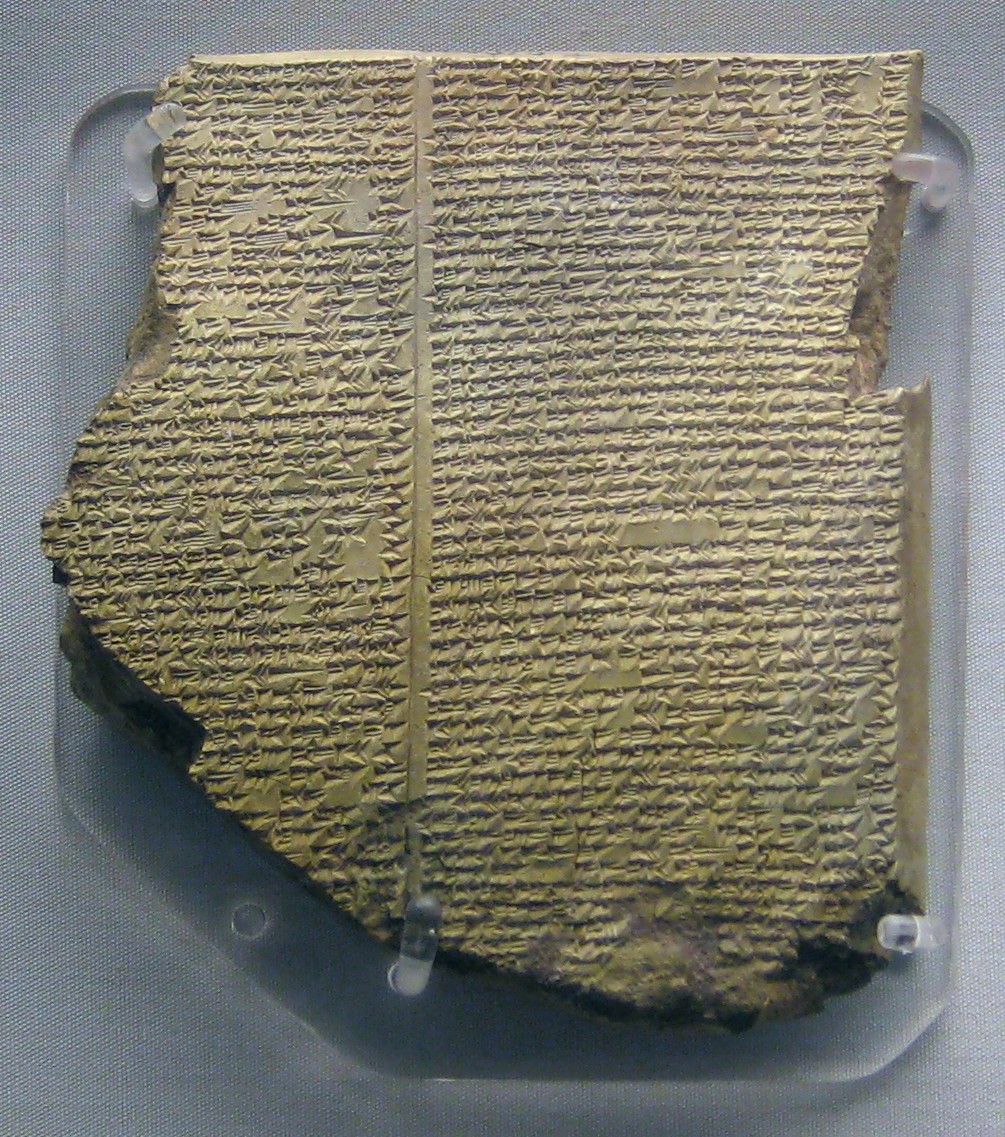 The Flood Tablet, seventh century BCE · Nineveh, Library of Ashurbanipal · British Museum K.3375 · Image released under CC0. Image record; CC0 terms.

Why the flood happens
Genesis explicitly describes human wickedness and a world filled with violence (6:5, 11–13). Noah is characterized as righteous within this account. The flood belongs to the narrative’s treatment of corruption, judgment, and the preservation of life.
The frequently repeated explanation that noisy humanity kept Enlil awake comes from Atrahasis. There, growing human numbers and clamor form part of the sequence of divine attempts to reduce the population. Gilgamesh XI recounts the gods’ decision to send a flood without explicitly restating that motive. Reading the two together can illuminate their relationship, but should not put an unstated explanation into the mouth of the later narrative.
It is also misleading to say that Gilgamesh has no ethical reflection. Ea challenges the indiscriminate destruction and urges a more proportionate response to wrongdoing. The gods’ regret and disagreements are part of the story. Genesis’s moral framing is distinctive, but the contrast is not simply morality on one side and meaningless cruelty on the other.
Remembering the disaster
Genesis 9 extends a covenant to Noah’s descendants and living creatures, with the bow as its sign. The promise concerns the future of life beyond Noah’s household.
Gilgamesh also includes a divine act of remembrance: the great goddess invokes her lapis-lazuli necklace in connection with remembering the flood. This is not the same as Genesis’s covenant, but it is a relevant comparison. Utnapishtim and his wife receive an exceptional destiny, while Gilgamesh’s wider quest continues to confront the limits of human life. Comparing endings requires attending both to shared motifs and to their different narrative roles.
Resemblance, relationship, and evidence
Scholars investigate literary dependence as well as the wider circulation of flood traditions. “A shared tradition” does not exclude adaptation through written sources, and “dependence” does not mean that two works have identical messages. The precise routes and stages of transmission remain matters for argument.
Alexander Heidel’s comparative study remains a landmark in the history of this discussion: first published in 1946, revised in 1949, and reprinted in the Phoenix edition of 1963. It should be read alongside later editions and scholarship, such as Andrew George’s work on Gilgamesh. For a Bible study, the strongest comparison begins with accurate details and allows each text to ask its own questions about destruction, survival, and life after catastrophe.
Sources and further reading
- British Museum, Flood Tablet K.3375.
- Andrew George, The Epic of Gilgamesh: A New Translation (Penguin, 1999), Tablet XI.
- W. G. Lambert and A. R. Millard, with M. Civil, Atra-ḫasīs: The Babylonian Story of the Flood (Clarendon Press, 1969).
- Alexander Heidel, The Gilgamesh Epic and Old Testament Parallels, 2nd ed. (University of Chicago Press, 1949).
- Genesis 6–9.
Explore original-language and historical context for sermon preparation at Didymus Lab.
Comments
Leave a comment
Comments are reviewed before being published. Only your name and comment are stored — no personal data collected.
You might also like
Bible, Actually
Noah's Ark Loaded Seven Pairs of Clean Animals, Not Just Two of Every Kind
Genesis 6 says two of every kind, but Genesis 7 immediately specifies seven pairs of clean animals. The two instructions sit side by side in the text. Understanding why reveals something important about how the Bible was formed.
Bible, Actually
Job's Monsters: Animals, Myth, and the Limits of Human Power
Job’s creatures invite both animal and mythic readings. Ugaritic parallels illuminate Leviathan without settling every detail.
Bible, Actually
Eden, Royal Gardens, and Sanctuary Symbolism
Royal gardens and sanctuary vocabulary illuminate Eden. They support a scholarly reading, not an explicit title of priest-king for Adam.
Loading comments…