Bible, Actually
John 7:53–8:11: The Story That Wasn't in the Earliest Manuscripts
“Let him who is without sin among you be the first to throw a stone at her” (John 8:7, ESV). Few sentences in the Gospels have traveled further or lodged more deeply in the moral imagination of Western civilization. The story of the woman caught in adultery — the accusers who melt away one by one, Jesus writing in the dirt, the quiet exchange that follows — is among the most humanly resonant narratives in the entire New Testament. It is also absent from the earliest Greek manuscripts of the Gospel of John.
 Rembrandt van Rijn · The Woman Taken in Adultery, 1644 · Public Domain · National Gallery, London. An artist’s imaginative reconstruction of the scene; the painting predates modern manuscript scholarship by two centuries.
What the Manuscripts Show
The two earliest surviving Greek manuscripts of the Gospel of John are Papyrus 66 (P66, ca. 200 CE) and Papyrus 75 (P75, ca. 175–225 CE), both discovered in Egypt and representing the Alexandrian text tradition. In both manuscripts, John 7:52 is followed directly by John 8:12. The passage we know as John 7:53–8:11 — the pericope adulterae, as scholars call it — is simply not there.
The two great fourth-century codices, Codex Sinaiticus (ℵ) and Codex Vaticanus (B), also lack the passage. Codex Vaticanus contains a notable detail: it places an umlaut mark (¨) in the margin at John 7:52, a scribal device indicating awareness that a textual variant exists at this point. The scribe who copied the Vaticanus knew that other manuscripts included something here that his exemplar did not. This is not a copyist’s error — it is a deliberate editorial notation.
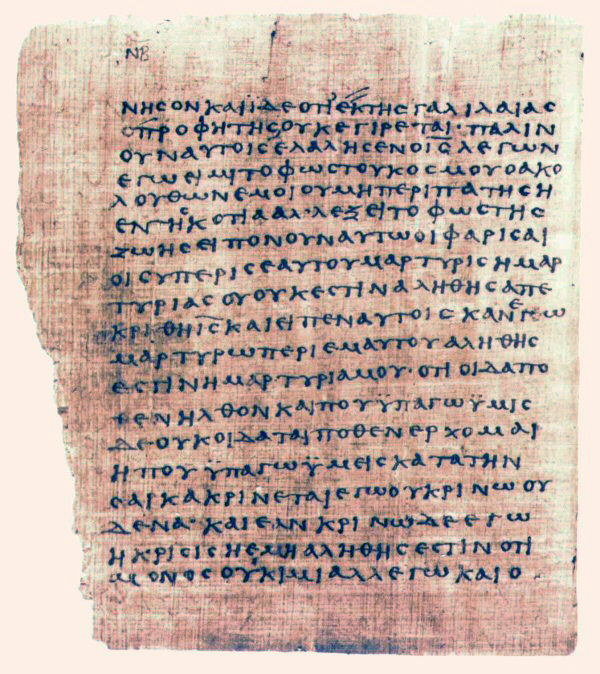 Anonymous · Papyrus 66 (Bodmer Papyri), ca. 200 CE · Public Domain · Bibliotheca Bodmeriana, Geneva. In this manuscript, John 7:52 is followed immediately by 8:12; the pericope adulterae is absent.
The Problem of Floating Location
Beyond its absence from the early manuscripts, the passage has a characteristic that further complicates claims to Johannine originality: its location is unstable across manuscript traditions.
Most later Greek manuscripts insert it after John 7:52, which is where it appears in modern Bible translations. But the manuscripts of Family 13 (the Ferrar group) place it after Luke 21:38. Some manuscripts insert it after John 7:36; others after John 21:25. A passage anchored to the original composition of a book does not typically float across four different locations in the manuscript tradition. Instability of location is one of the standard indicators that a passage was added to the textual stream from an independent source.
Bruce M. Metzger’s A Textual Commentary on the Greek New Testament (2nd ed., 1994) — the standard reference for text-critical decisions behind the United Bible Societies’ Greek New Testament — addresses the passage at pages 187–189. The critical apparatus of NA28 and UBS5, the editions used for virtually all modern Bible translations, encloses the entire passage in double brackets [[John 7:53–8:11]]. Double brackets are the critical apparatus’s notation for material “regarded as later additions to the text, but which are of evident antiquity and importance” — meaning: not in John’s original, but too deeply embedded in the tradition to remove.
Style and Vocabulary
In addition to the manuscript evidence, linguists have noted that the vocabulary and style of John 7:53–8:11 differ somewhat from the rest of the Fourth Gospel. Several words in the passage appear nowhere else in John but are at home in Luke. This has led a number of scholars to suggest the story may have originated in a Lukan-tradition stream before being attached to John. The synoptic character of the story — its concern with scribes and Pharisees testing Jesus, its setting in the temple during the Feast of Tabernacles — fits the general pattern of Synoptic controversies more naturally than Johannine narrative style.
What the Evidence Does Not Show
Textual criticism works in a narrow lane. It addresses whether a passage belongs in a given book as the author originally composed it. It does not, by itself, determine whether the events described occurred or whether the story preserves authentic Jesus tradition.
The early church father Papias (ca. 60–130 CE), writing around the turn of the second century, is reported by Eusebius (Ecclesiastical History 3.39.17) to have known a story about “a woman accused of many sins before the Lord.” Whether this refers to the pericope adulterae or a related but distinct tradition is uncertain, but the reference indicates that stories of this type circulated in the early church from a very early date.
Jennifer Knust and Tommy Wasserman’s 2019 Princeton University Press study To Cast the First Stone: The Transmission of a Gospel Story traces the manuscript history of the passage in extraordinary detail. Their research shows that the story was cherished in Christian communities from early on, copied in various forms, and eventually absorbed into the manuscript tradition of John at different points and by different scribal hands. What they document is not fabrication but transmission — a story that the church valued and kept alive through centuries of copying.
Reading It Well
None of this means the passage should be cut from sermon preparation or dismissed from personal reading. What it does mean is that the passage warrants a different reading posture than surrounding text. Its origins are not in John’s compositional act; it arrived in the manuscript stream from elsewhere. Whether it preserves a genuine memory of Jesus is a historical question that textual criticism cannot decide.
Modern translations typically signal this with a footnote or a bracketed note such as “The earliest manuscripts do not include 7:53–8:11.” Reading that note carefully — understanding that it reflects a two-hundred-year tradition of manuscript scholarship rather than a contemporary decision to remove a beloved text — is part of reading the New Testament seriously. The story of the woman caught in adultery may not be Johannine by origin. It has, nonetheless, been part of Christian scripture for more than fifteen centuries. Both facts belong to the honest reading of John 8.
References
- Bruce M. Metzger, A Textual Commentary on the Greek New Testament, 2nd ed. (Deutsche Bibelgesellschaft/United Bible Societies, 1994), pp. 187–189
- Jennifer Knust and Tommy Wasserman, To Cast the First Stone: The Transmission of a Gospel Story (Princeton University Press, 2019)
- Eusebius of Caesarea, Ecclesiastical History 3.39.17
- John 7:53–8:11, NA28/UBS5 double-bracket notation
Comments
Leave a comment
Comments are reviewed before being published. Only your name and comment are stored — no personal data collected.
You might also like
Bible, Actually
“Only Begotten” or “One and Only”? Reading Monogenēs in Context
John 3:16’s monogenēs raises questions about Greek usage, translation, and theology. Its meaning cannot be settled by splitting the word apart.
Bible, Actually
Luke 23:34: Why Some Manuscripts Omit Jesus’s Prayer of Forgiveness
“Father, forgive them” has an ancient but divided manuscript history. What do the witnesses and the brackets in Greek editions mean?
Bible, Actually
Did Mark Intend to End at “They Were Afraid”?
Some early manuscripts end Mark at 16:8. The longer ending is ancient, but its history leaves a second question about Mark’s own ending.
Loading comments…