Bible, Actually
How Many Magi? What Matthew 2 Actually Says About the Wise Men
Every Christmas pageant has exactly three wise men. They carry gold, frankincense, and myrrh, enter in order, and wear the names Caspar, Melchior, and Balthasar on their programs. The tradition is so settled that few people think to check it against the text. But Matthew 2 — the only Gospel that mentions the Magi — does not say three.
 Codex Sinaiticus, Matthew 1:1–2:5 (4th century) · Public Domain. One of the earliest and most significant Greek manuscripts of the New Testament.
What the Text Does and Does Not Say
Matthew 2:1 introduces the visitors with a single word: μάγοι (mágoi), the Greek plural. That plural tells us there were at least two. It tells us nothing about whether there were three, four, eight, or twelve. The number is simply not given.
Raymond E. Brown, in his landmark commentary The Birth of the Messiah, traces how the number “three” became standard. The inference runs as follows: the text names three gifts — gold, frankincense, and myrrh — therefore there must have been three gift-bearers. Brown notes that this reasoning appears in the Western church from the third century onward, but it was not universal. The Eastern church tradition often counted twelve Magi, following a different interpretive logic.
Early Christian Art Shows the Variation
The visual record confirms that the “three” convention was not settled in the earliest period.
 Hieronymus Bosch · The Adoration of the Magi, c. 1470–1475 · Public Domain. A late-medieval rendering after the “three” tradition had become firmly established in Western Christianity.
The catacombs offer earlier evidence. In the Domitilla Catacomb in Rome, a third- or fourth-century fresco depicts the Adoration of the Magi with a number of figures that does not consistently match three. Other catacomb paintings similarly vary.
 4th-century Rome, Domitilla Catacomb · Adoration of the Magi (from Joseph Wilpert, Die Malereien der Katakomben Roms, pl. 116, 1903) · Public Domain.
By the sixth century, the Basilica of Sant’Apollinare Nuovo in Ravenna shows three Magi in mosaic — and that sixth century date is significant, because it coincides with the first appearance of the names.
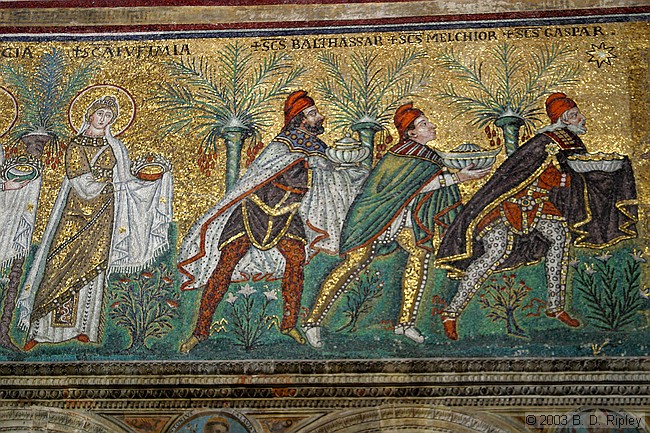 Sant’Apollinare Nuovo, Ravenna, mosaic (c. 6th century) · Public Domain. The names Caspar, Melchior, and Balthasar are labeled above the figures.
When Did the Names Appear?
Nowhere in Scripture. Brown’s commentary establishes that the names Caspar (or Gaspar), Melchior, and Balthasar enter the manuscript tradition in Greek texts from roughly the sixth century. They are not recorded in Matthew, not in any other canonical Gospel, not in any New Testament letter. They are a tradition — a long-lived and widely received one — but tradition rather than text.
This matters not because tradition is necessarily wrong, but because conflating tradition with biblical content makes it harder to read the text on its own terms.
What Matthew Was Actually After
Matthew’s interest in the Magi story runs deeper than the question of how many there were. The word μάγοι refers to wise men or astrologers from the East — Mesopotamia or Persia, by most scholarly readings. They are Gentiles. And they have come to worship the one born king of the Jews.
This is the weight-bearing point of the narrative. Matthew’s infancy account (chapters 1–2) consistently moves toward a single idea: the Messiah who fulfills Israel’s scriptures is also the one to whom the nations will come. The Magi narrative carries that theme. Their number is incidental to the story’s purpose; their identity as Gentile seekers is not.
A Reading Suggestion
Open Matthew 2:1–12 and read it without the pageant overlay. Notice what the text specifies (wise men from the East, three types of gifts, a star, a house in Bethlehem) and what it leaves open (how many men, when exactly they arrived relative to the birth, their precise place of origin). The story that remains is stranger and more theologically freighted than the tidy version the tradition has handed down — and worth sitting with on its own terms.
References
- Raymond E. Brown, The Birth of the Messiah: A Commentary on the Infancy Narratives in Matthew and Luke, new updated ed. (Anchor Bible Reference Library; Doubleday, 1993)
- Matthew 2:1–12, Greek text (μάγοι as unspecified plural)
Comments
Leave a comment
Comments are reviewed before being published. Only your name and comment are stored — no personal data collected.
You might also like
Bible, Actually
The Star of Bethlehem: An Ancient Question, an Unsettled Debate
Origen, Kepler, and modern astronomers proposed different accounts of Matthew’s star. Their theories require distinctions as well as curiosity.
Bible, Actually
“Only Begotten” or “One and Only”? Reading Monogenēs in Context
John 3:16’s monogenēs raises questions about Greek usage, translation, and theology. Its meaning cannot be settled by splitting the word apart.
Bible, Actually
What 1 Timothy Actually Says About the Love of Money
1 Timothy 6:10 warns against love of money. Its missing Greek article alone does not settle the English choice between “a root” and “the root.”
Loading comments…