Bible, Actually
The Siloam Inscription: A Construction Crew's Note from 701 BC
Second Kings 20:20 closes its summary of Hezekiah’s reign with a single line: “The rest of the acts of Hezekiah and all his might and how he made the pool and the conduit and brought water into the city, are they not written in the Book of the Chronicles of the Kings of Judah?” A parallel note in 2 Chronicles 32:30 specifies the direction: Hezekiah “closed the upper outlet of the waters of Gihon and directed them down to the west side of the city of David.” Neither verse pauses to describe what the engineering actually looked like, or what it cost, or what it felt like when it was finished.
In 1880, a teenager exploring the inside of that tunnel found a six-line Hebrew inscription on the wall that answered the last question.
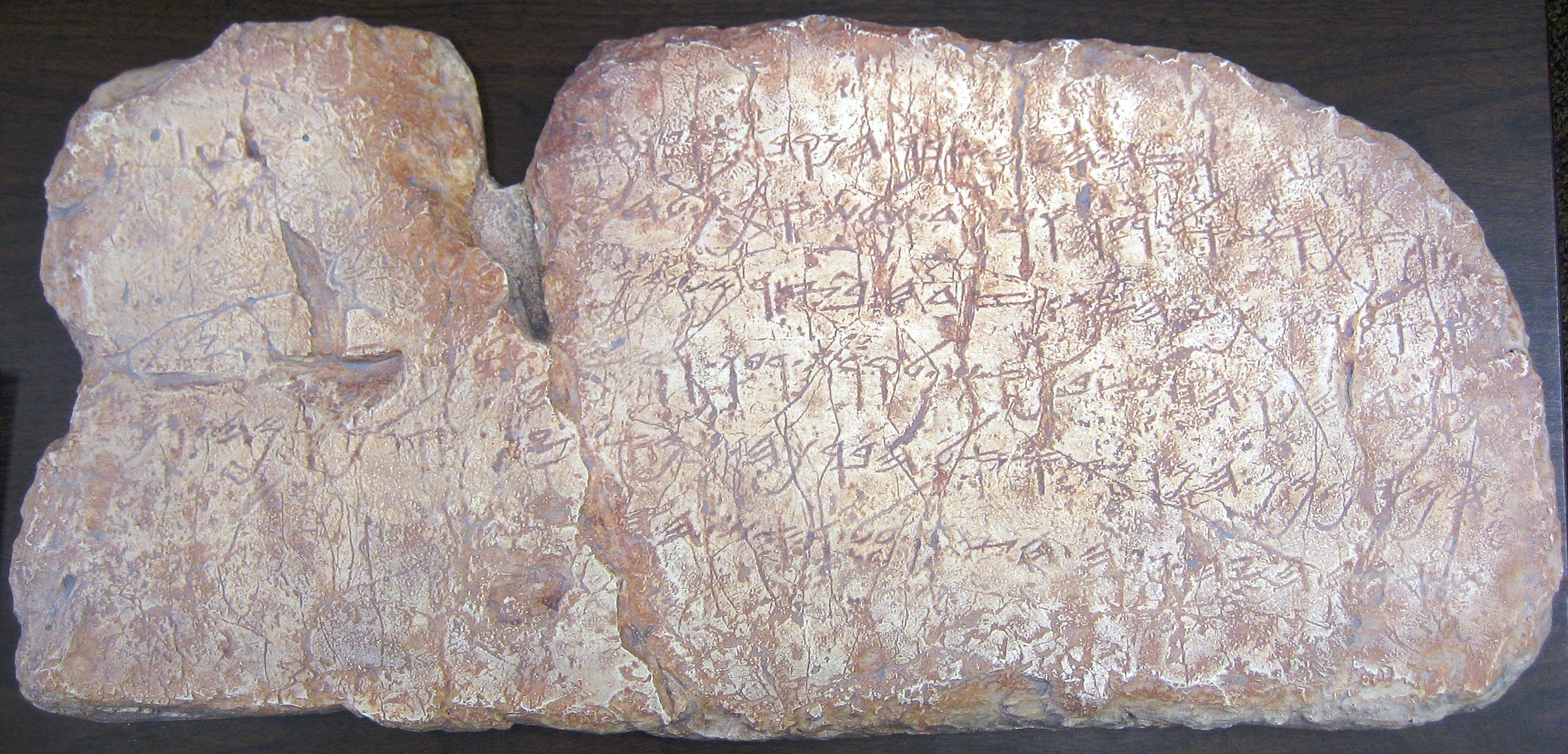 Early cast reproduction of the Siloam Inscription · Public Domain. The inscription was discovered in 1880; the original stone slab was removed in 1890 and transported to Istanbul, where it remains in the Istanbul Archaeological Museum.
The Problem Hezekiah Was Solving
The immediate context matters. By 701 BC, the Assyrian king Sennacherib had begun his campaign against Judah. Second Kings 18–19 narrates the crisis in detail. Before Jerusalem could face a siege, Hezekiah needed to address a vulnerability that any competent military adversary would exploit immediately: the city’s main water source, the Gihon Spring, lay outside the eastern wall in the Kidron Valley. An enemy controlling the spring could starve the city of water without firing a single arrow.
Hezekiah’s solution was to cut through the bedrock beneath the City of David and redirect the Gihon’s flow to a pool inside the city walls — what the New Testament would later call the Pool of Siloam (John 9:7). The completed tunnel runs approximately 533 meters, bending in an S-curve through the limestone, with an average height just under two meters. It descends a careful gradient to carry water by gravity from the spring to the pool. Modern engineers, working with precise instruments and laser-guided boring equipment, still find the accomplishment notable.
“The Tunnel Is Through”
The inscription the teenager found in 1880 is not a royal dedication carved in the name of the king. It is a first-person account — apparently by the workers themselves — of the moment the two digging teams broke through to each other.
The text begins in mid-sentence because the upper portion of the inscription was damaged, but what survives conveys the scene: the workers could hear each other’s pickaxes through the rock from opposite directions; they oriented toward the sound; and finally the stone gave way. The inscription’s climax is brief and exuberant: the tunnel was through, the pickaxes had met, and the water flowed from the spring to the pool, a distance of 1,200 cubits.
That figure — 1,200 cubits — corresponds closely to the tunnel’s measured length of roughly 533 meters. The inscription did not inflate the achievement.
Gary A. Rendsburg and William M. Schniedewind, writing in the Israel Exploration Journal in 2010, examined the inscription’s linguistic and epigraphic features in detail and concluded that they are consistent with late eighth-century BC Jerusalemite Hebrew. Their analysis aligns with earlier radiocarbon dating of organic material from the tunnel’s plaster. The standard reference corpus for such inscriptions, edited by Dobbs-Allsopp, Roberts, Seow, and Whitaker (Yale University Press, 2005), places the Siloam Inscription among the most significant Hebrew texts from the monarchic period.
What the Inscription Does and Does Not Confirm
Archaeology enthusiasts sometimes describe inscriptions like this one as “proof” of biblical accuracy, a framing worth resisting. The inscription confirms that around the time the Bible says Hezekiah ruled Jerusalem, someone cut a sophisticated tunnel through solid rock and was proud enough of the feat to leave a written record. It confirms that the people who built it had the literacy, the craft vocabulary, and the emotional investment to commemorate the moment in prose. Those are significant confirmations, but they are different from verifying the theological claims of the biblical narrative.
What the inscription does, more precisely, is fill in the human texture that the biblical account deliberately leaves out. Kings and Chronicles measure a reign by its theological faithfulness and military outcomes. The Siloam Inscription speaks from below the throne room — from the underground, from the guys swinging the pickaxes — and its perspective is one that royal histories rarely preserve.
An Object’s Afterlife
The stone was removed from the tunnel wall in 1890 by Ottoman authorities and sent to Constantinople, where it has remained ever since in the Istanbul Archaeological Museum. A replica is displayed near the Pool of Siloam in Jerusalem. The original stone — a piece of the tunnel wall that someone thought important enough to carve — is now physically farther from Jerusalem than it has been at any point in the 2,700 years since it was cut.
Second Kings 20:20 gave the project one sentence. The workers gave it six lines of Hebrew. The project itself has given Jerusalem a functioning water channel that tourists can still walk through today.
References
- F. W. Dobbs-Allsopp, J. J. M. Roberts, C. L. Seow, and R. E. Whitaker, Hebrew Inscriptions: Texts from the Biblical Period of the Monarchy with Concordance (Yale University Press, 2005)
- Gary A. Rendsburg and William M. Schniedewind, “The Siloam Tunnel Inscription: Historical and Linguistic Perspectives,” Israel Exploration Journal 60.2 (2010): 188–203
- 2 Kings 20:20; 2 Chronicles 32:30, Masoretic Text
Comments
Leave a comment
Comments are reviewed before being published. Only your name and comment are stored — no personal data collected.
You might also like
Bible, Actually
Hezekiah's Royal Seal: A Clay Impression Found After 2,700 Years
In 2009, excavations at the Ophel south of Jerusalem's Temple Mount yielded a clay seal impression bearing an ancient Hebrew inscription: 'Belonging to Hezekiah, [son of] Ahaz, King of Judah.' It is the first royal seal impression from an Israelite or Judahite king to be recovered from a controlled archaeological excavation.
Bible, Actually
The Silver Scrolls That Took Three Years to Unroll — and Turned Out to Be Scripture
In 1979, a teenage volunteer at a Jerusalem dig found two tiny, corroded silver scrolls. What they contained — a blessing echoing Numbers 6:24-26 — made them the oldest known biblical text ever recovered.
Bible, Actually
The Nuzi Tablets Were Supposed to Prove the Patriarchal Age. Here's What Actually Happened.
Clay tablets unearthed in Iraq in the 1920s seemed to confirm Genesis customs like adoption and household gods as genuine 2nd-millennium BC practice. Scholars later walked much of that claim back.
Loading comments…