Bible, Actually
The Serpent in Genesis 3 Is Not Called Satan
Ask most churchgoers what the serpent in Genesis 3 is, and the answer comes quickly: Satan. The identification is so deeply embedded in Christian interpretive tradition that many readers assume it is written into the Genesis text itself. It is not. Reading Genesis 3 carefully — attending to what the Hebrew actually says and what the narrative does not provide — opens up a more nuanced question: how and when did the serpent become Satan?
What Genesis 3 Actually Says
Genesis 3:1 introduces the creature this way: “Now the serpent was more crafty than any other wild animal that the Lord God had made.” The Hebrew word used is נָחָשׁ (nachash) — “serpent” or “snake.” Throughout the Hebrew Bible, this word consistently means exactly that: the bronze serpent of Numbers 21, the serpent in Amos 9:3, the snake of Proverbs 30:19. There is no qualifying phrase in Genesis 3 that identifies this creature as a supernatural adversary. No name, no title, no parenthetical explanation.
This is not a claim that the broader biblical witness denies a connection between the serpent and Satan. That connection is present in Scripture — but in a different location than Genesis 3. Identifying where it appears, and tracing when the connection was made, is what careful biblical reading requires.
Nachash — What the Text Says, and What It Doesn’t
The nachash speaks, reasons, and successfully misleads the woman — details that clearly mark it as something extraordinary within the story. A reader might legitimately infer supernatural agency behind this creature. But the text does not say so. It presents the serpent as a creature among creatures, distinguished by cunning rather than by ontological category.
The distinction matters because conflating the text with its interpretation can obscure what the text is actually claiming. Genesis 3, taken on its own terms, raises the question of evil’s origin without resolving it. The serpent appears, acts, and then receives a curse. Its ultimate identity is left undefined in the narrative.
The Serpent-Satan Identification in Second Temple Literature
Scholarly consensus places the development of the serpent-Satan identification in the Second Temple period (roughly 6th century BCE to 1st century CE). This was the era of Jewish apocalyptic literature, when questions about the origin and nature of evil received sustained theological attention, and when diverse answers competed for acceptance.
The text most frequently cited as the first evidence of the serpent-Satan connection is Wisdom of Solomon 2:24: “through the devil’s envy death entered the world.”
 Unknown artist · Solomon, Sirach, and Lady Wisdom (manuscript illustration of Second Temple wisdom literature) · CC0 1.0.
However, Jason M. Zurawski has challenged this reading directly. In “Separating the Devil from the Diabolos: A Fresh Reading of Wisdom of Solomon 2.24” (Journal for the Study of the Pseudepigrapha 21.4 [2012]: 366–399), he argues that the term diabolos in this verse need not refer to the Eden serpent at all. The word means “slanderer” or “accuser” — and whether it identifies the serpent of Genesis 3 depends on an inference the text itself does not make explicit. Zurawski’s reading suggests that the verse’s connection to Eden is a matter of later interpretation layered onto the passage, not something the author of Wisdom necessarily intended.
This does not settle the question either way. But it establishes that the Wisdom of Solomon 2:24 argument for a first-century-BCE serpent-Satan identification is genuinely debated, not simply assumed.
A Competing Tradition: The Fallen Angels
What makes the Second Temple evidence especially interesting is that the serpent-Satan identification was not the only way Jewish thinkers of the period explained the entry of evil into the world.
 Unknown author · P. Chester Beatty XII, leaf 3, verso (Greek papyrus containing 1 Enoch) · Public domain.
First Enoch and Jubilees develop a different explanation, rooted in Genesis 6:1–4: the “sons of God” who took human wives and produced the Nephilim. In these texts, evil entered through the rebellion and corruption introduced by fallen angelic beings — a narrative quite distinct from the Eden serpent tradition. Neil Forsyth’s The Old Enemy: Satan and the Combat Myth (Princeton University Press, 1987) traces how these competing genealogies of evil eventually interacted and, in some strands, merged.
The existence of two different frameworks for understanding evil’s origin in the same period is significant. It tells us that Second Temple Jewish theology did not hold a single, uniform view on the subject — and that what later became the dominant Christian interpretation (Eden serpent = Satan) was one option among several during the formative centuries.
Where the Identification Becomes Explicit in Scripture
If Genesis 3 leaves the serpent’s identity open, Revelation closes it. Twice, with unmistakable language:
Revelation 12:9: “The great dragon was thrown down, that ancient serpent, who is called the Devil and Satan, the deceiver of the whole world.”
Revelation 20:2: “He seized the dragon, that ancient serpent, who is the Devil and Satan.”
The phrase “that ancient serpent” (ho ophis ho archaios) is a deliberate backward reference to Genesis 3. The Revelation author explicitly connects the Eden serpent with the devil and Satan — providing, within the New Testament canon, the identification that Genesis itself does not give.
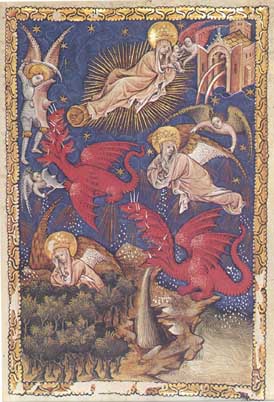 Unknown Flemish artist · Flemish Apocalypse, chapter 12 (c. 14th century illuminated manuscript) · Public domain.
This is how inner-biblical interpretation works: a later text takes an earlier text and supplies a reading, a connection, an identification. Revelation does this with Genesis 3. The result is canonical — it is part of what Scripture says. But recognizing that it is a later interpretive move, rather than original content of Genesis 3, changes how we read both texts.
Two Claims, Different Statuses
To summarize what can be said with confidence and what remains in play:
Definitive: Genesis 3 does not use the word “Satan.” The creature is introduced as nachash, a serpent, one of the wild animals God made. No Genesis text identifies this creature as the devil or a supernatural adversary.
Contested: Exactly when and through what literary trajectory the serpent-Satan identification developed in Second Temple Judaism — whether Wisdom of Solomon 2:24 counts as the earliest evidence, and what that text’s diabolos actually refers to — remains actively debated.
Canonically settled: Revelation 12:9 and 20:2 explicitly identify “that ancient serpent” with the devil and Satan. Within the biblical canon, this is where the identification is made.
Elaine Pagels’s The Origin of Satan (Random House, 1995) situates this development in the social and theological context of early Jewish and Christian communities, showing how the figure of Satan served specific narrative and community-defining functions. Reading Genesis 3 with awareness of this interpretive history does not undermine either Genesis or Revelation — it sharpens our understanding of how biblical interpretation itself works across the canon.
Eden also contains the artist’s world
Dürer’s 1504 Adam and Eve surrounds the biblical figures with animals. The Metropolitan Museum identifies the cat, rabbit, ox, and elk with the four temperaments of medieval thought. The engraving brings an inherited understanding of human nature into its Eden. Museum entry.
Genesis 3 does not spell out that symbolic scheme. The print interprets while it illustrates. Its value for reception history is precisely this added layer: what did an artist make visible, and which parts might viewers later remember as Scripture itself? Such questions help us read Genesis alongside Revelation without erasing their different formulations.
References
- Jason M. Zurawski, “Separating the Devil from the Diabolos: A Fresh Reading of Wisdom of Solomon 2.24,” Journal for the Study of the Pseudepigrapha 21.4 (2012): 366–399.
- Elaine Pagels, The Origin of Satan (New York: Random House, 1995).
- Neil Forsyth, The Old Enemy: Satan and the Combat Myth (Princeton: Princeton University Press, 1987).
- Genesis 3:1; Wisdom of Solomon 2:24; Revelation 12:9; 20:2.
Comments
Leave a comment
Comments are reviewed before being published. Only your name and comment are stored — no personal data collected.
You might also like
Bible, Actually
The Forbidden Fruit Wasn't an Apple — Genesis Never Says What It Was
Genesis never names the fruit Eve ate. The West pictured an apple for over a millennium; East Asia, including Korea, pictured a peach. Here's where both traditions actually come from — and why the text itself doesn't care.
Bible, Actually
The Millennium Was Already Debated in the Early Church
Justin and Irenaeus expected an earthly millennium. Augustine helped establish another reading, but neither position began with unanimous agreement.
Bible, Actually
Did Babylon Have a Sabbath Too? Sorting Out šapattu and Shabbat
Babylonian full-moon observances, royal taboo days, and the biblical weekly Sabbath are related questions—but not the same institution.
Loading comments…