Bible, Actually
The Heavenly Witnesses of 1 John 5:7 Were Added Centuries After the Original
Open the King James Bible to 1 John 5:7 and you find one of the most explicitly Trinitarian sentences in all of Scripture: “For there are three that bear record in heaven, the Father, the Word, and the Holy Ghost: and these three are one.” It reads like a verse a systematic theologian would write if asked to summarize the doctrine of the Trinity in a single sentence.
The problem is that it appears in no Greek New Testament manuscript before the sixteenth century.
 Codex Sinaiticus, 4th century — the oldest complete Greek New Testament manuscript. The passage at 1 John 5:7–8 contains no trace of the so-called Comma Johanneum. British Library collection. Public Domain.
What the Comma Johanneum Is
Textual scholars use a Latin label for the disputed clause: the Comma Johanneum, or “Johannine Comma.” It refers specifically to the phrase “the Father, the Word, and the Holy Ghost: and these three are one” — the explicitly Trinitarian portion that appears in the traditional KJV text at 1 John 5:7 and in Korean versions derived from that tradition.
Bruce M. Metzger’s Textual Commentary on the Greek New Testament (2nd ed., Deutsche Bibelgesellschaft / United Bible Societies, 1994) is the standard reference. Metzger is unambiguous: the Comma Johanneum does not appear in any Greek manuscript copied before the sixteenth century. The Latin manuscript tradition shows traces from the fourth century onward — likely originating as a marginal gloss that was eventually incorporated into the text — but the transfer of this reading into Greek manuscripts is a much later phenomenon.
Erasmus and the Manufactured Manuscript
When Desiderius Erasmus (c. 1466–1536) produced his landmark critical edition of the Greek New Testament in 1516, the Comma was absent. He had examined the available Greek manuscripts and found no trace of it. His 1519 second edition likewise omitted it. The backlash was significant: critics accused him of suppressing a text that supported the doctrine of the Trinity.
Then a Greek manuscript arrived from Ireland. Scholars know it today as Codex Montfortianus (MS 61), dated to around 1520. Erasmus included the Comma in his 1522 third edition based on this manuscript — but his commentary notes his suspicion that the Greek showed signs of being a retranslation from the Latin rather than an independent Greek witness.
Later scholarship confirmed the suspicion. Codex Montfortianus was in all likelihood produced specifically in response to Erasmus’s challenge — a back-translation from the Latin Vulgate tradition, crafted to supply the missing Greek witness he had said was necessary. The evidence includes the manuscript’s anomalous text type, features characteristic of Latin-to-Greek translation, and the suspicious timing of its appearance. Grantley McDonald traces the manuscript’s production and the Comma’s reception history in detail in Biblical Criticism in Early Modern Europe: Erasmus, the Johannine Comma, and Trinitarian Debate (Cambridge University Press, 2016).
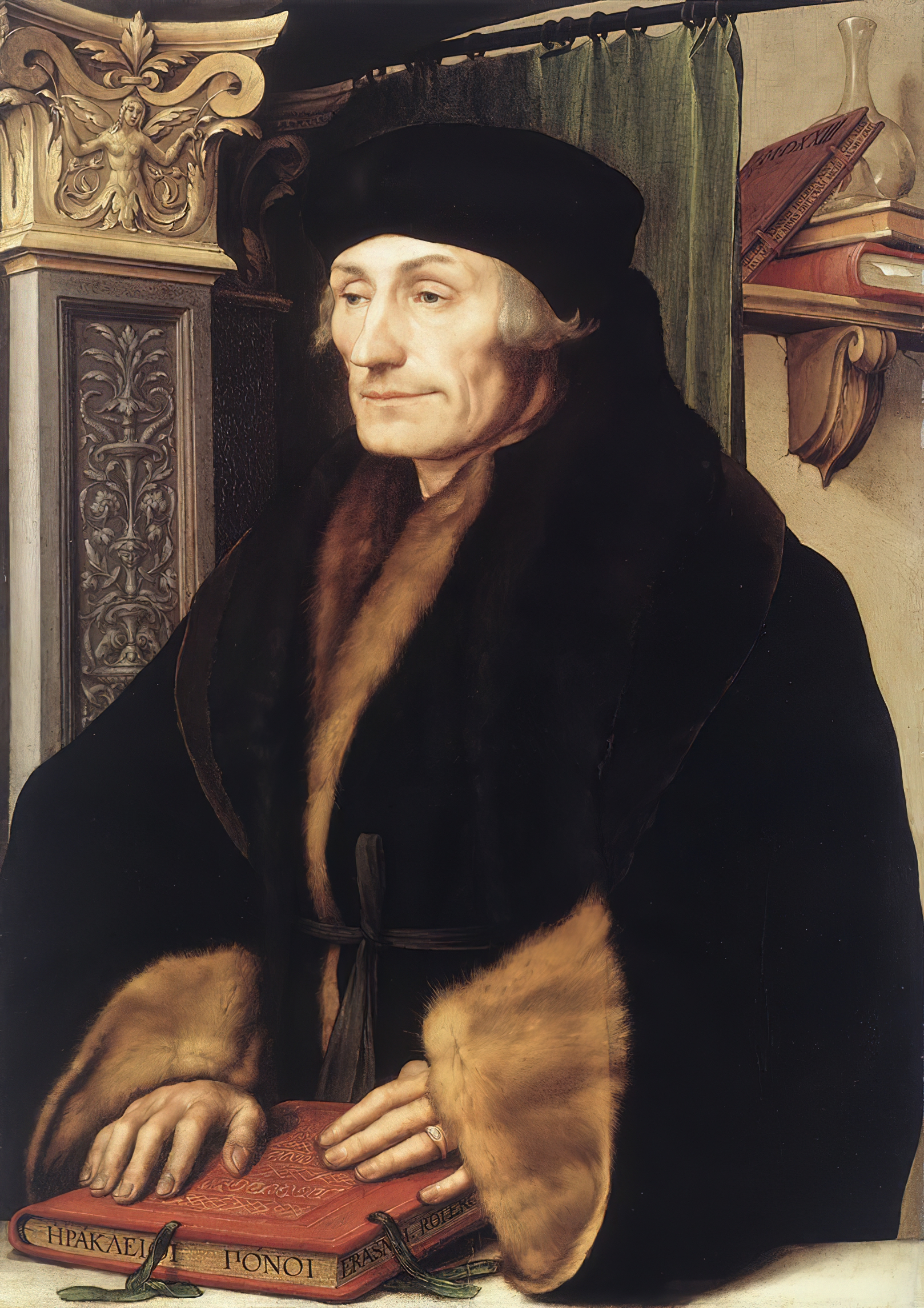 Hans Holbein the Younger · Erasmus · 1523 · Kunstmuseum Basel · Public Domain. Painted while Erasmus was actively editing successive editions of his Greek New Testament.
Where This Leaves the Text — and the Doctrine
The critical editions in standard scholarly use today — NA28 (Nestle-Aland 28th edition) and UBS5 (United Bible Societies 5th edition) — do not include the Comma Johanneum in the main text. English Bibles that retain it, including the King James Version, ultimately trace this reading to Erasmus’s 1522 concession to pressure, itself based on a manuscript that almost certainly did not preserve an ancient independent reading.
None of this damages the doctrine of the Trinity. The doctrine is not built on a single verse but on a convergence of independent texts: the threefold baptismal formula of Matthew 28:19, the Pauline benediction of 2 Corinthians 13:13 (“the grace of the Lord Jesus Christ and the love of God and the fellowship of the Holy Spirit”), the language of John’s prologue, and multiple other passages. The Comma Johanneum adds nothing that is not already established by texts of unimpeachable manuscript standing.
What the Comma’s history actually illustrates is the texture of how the New Testament reached us. The canon was transmitted through centuries of scribal copying, translation, and — occasionally — interpolation. Textual criticism is the discipline that traces those layers, distinguishing earlier readings from later additions with the same methods used to authenticate any historical document. The Comma Johanneum is one of the most instructive examples of how a well-intentioned marginal note can travel from a Latin manuscript into a printed Greek text, and remain in widespread circulation for four centuries.
References
- Bruce M. Metzger, A Textual Commentary on the Greek New Testament, 2nd ed. (Deutsche Bibelgesellschaft / United Bible Societies, 1994), pp. 647–649
- Grantley McDonald, Biblical Criticism in Early Modern Europe: Erasmus, the Johannine Comma, and Trinitarian Debate (Cambridge University Press, 2016)
Comments
Leave a comment
Comments are reviewed before being published. Only your name and comment are stored — no personal data collected.
You might also like
Bible, Actually
Luke 23:34: Why Some Manuscripts Omit Jesus’s Prayer of Forgiveness
“Father, forgive them” has an ancient but divided manuscript history. What do the witnesses and the brackets in Greek editions mean?
Bible, Actually
Did Mark Intend to End at “They Were Afraid”?
Some early manuscripts end Mark at 16:8. The longer ending is ancient, but its history leaves a second question about Mark’s own ending.
Bible, Actually
666 or 616? The Ancient Debate About the Beast’s Number
Papyrus 115 reads 616 in Revelation 13:18. The variant is ancient, and Nero’s name offers a plausible explanation—but not a conclusive solution.
Loading comments…