Bible, Actually
What 'No Temptation You Can't Bear' Was Actually About
It shows up at hospital bedsides, at funerals, in conversations about job loss or financial collapse. “No temptation has overtaken you that is not common to man. God is faithful, and he will not let you be tempted beyond your ability, but with the temptation he will also provide the way of escape, that you may be able to endure it” (1 Corinthians 10:13, ESV). It’s one of the most quoted verses in pastoral care — shorthand for “God won’t give you more than you can handle.”
But what was Paul actually writing about when he used the Greek word peirasmos (πειρασμός) in this sentence? Read in its own paragraph, the answer is narrower than the verse’s popular use suggests.
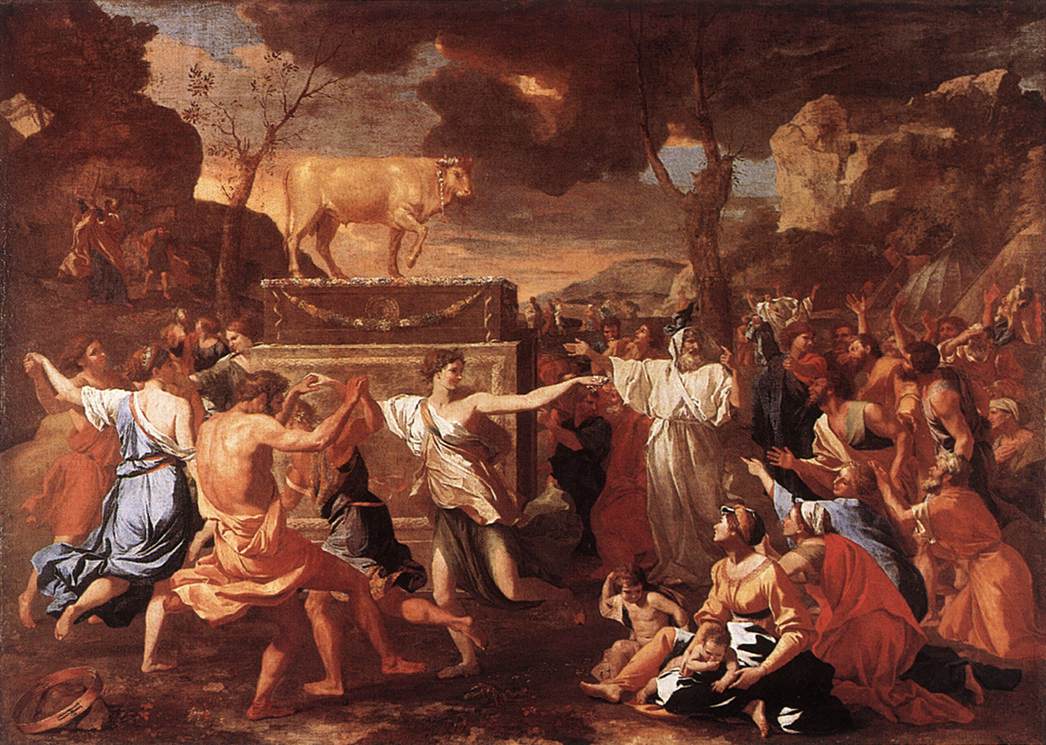 Nicolas Poussin, The Adoration of the Golden Calf, c. 1634 · National Gallery, London · Public Domain. The scene Paul has in view when he warns the Corinthians in 10:7 not to become idolaters “as some of them did,” quoting Exodus 32. Image record.

What Comes Right Before It
Verse 13 doesn’t stand alone. It closes out an argument Paul has been building since the start of chapter 10. He reminds the Corinthians that the wilderness generation of Israel was “under the cloud” and passed through the sea, ate the same spiritual food and drank the same spiritual drink (10:1-4) — “nevertheless, with most of them God was not pleased, for they were overthrown in the wilderness” (10:5).
Then Paul lists exactly how they failed: “Do not be idolaters as some of them were; as it is written, ‘The people sat down to eat and drink and rose up to play’” (10:7, quoting Exodus 32’s golden calf episode). “We must not indulge in sexual immorality as some of them did, and twenty-three thousand fell in a single day” (10:8). “Nor grumble, as some of them did, and were destroyed by the Destroyer” (10:10). Paul draws the conclusion in verse 11: “Now these things happened to them as an example, but they were written down for our instruction, on whom the end of the ages has come.”
Verse 12 applies the warning directly: “Let anyone who thinks that he stands take heed lest he fall.” Verse 13 follows immediately after that. Read as a continuous paragraph, the most natural sense of “temptation” in verse 13 is the same kind of thing just catalogued — temptation toward the specific sins of idolatry, sexual immorality, and grumbling against God.
What Peirasmos Can Mean
The Greek noun peirasmos has a real range in the New Testament. It can describe trials or hardships that come from outside — James 1:2’s “trials of various kinds” is often read this way. It can also describe temptation to sin, as in the Lord’s Prayer’s “lead us not into temptation” (Matthew 6:13) or Jesus’ instruction to the disciples in Gethsemane, “watch and pray that you may not enter into temptation” (Matthew 26:41). The word itself doesn’t settle the question; context does.
Fee’s NICNT commentary and Thiselton’s NIGTC commentary are standard resources for studying this passage. The contextual case can also be followed directly in the text: Paul’s warning in 10:12 and reassurance in 10:13 lead into “flee from idolatry” in 10:14. A trial may include pressure toward unfaithfulness; the important distinction is between that setting and a promise that every quantity of suffering will match an individual’s capacity.
Read this way, the promise in the second half of the verse — that God will “provide the way of escape, that you may be able to endure it” — isn’t a guarantee of relief from illness, grief, or financial ruin. It’s a promise that when a specific temptation to sin presents itself, God provides a way to resist it rather than fall as the wilderness generation fell.
Does That Mean the Comfort Was Misplaced?
None of this means the countless pastoral moments where this verse has brought comfort in the midst of grief or illness were wrong to draw on it. If the words genuinely steadied someone in a hospital room, that comfort is real and shouldn’t be dismissed. But knowing the original context sharpens what, exactly, the verse is promising. Paul isn’t offering a general principle that God calibrates the amount of suffering he allows to match what we can bear. He’s promising something more specific: that God remains faithful when temptation to sin presents itself, and that faithfulness includes a way through.
Once that narrower scope is clear, it also becomes easier to see where Scripture actually does speak more directly to suffering itself — Paul’s own reflections on hardship and endurance in Romans 5 and 2 Corinthians 1 and 4, for instance. Getting 10:13 right doesn’t take anything away from the broader biblical confidence that God is present in suffering. If anything, reading each passage for what it actually says makes the comfort Scripture offers more durable, because it’s built on solid ground rather than a single verse stretched past its original claim.
Didymus Lab builds this kind of contextual reading into every sermon-prep report it generates. Explore more at Didymus Lab.
References
- Gordon D. Fee, The First Epistle to the Corinthians, NICNT (Grand Rapids: Eerdmans, 1987; rev. ed. 2014)
- Anthony C. Thiselton, The First Epistle to the Corinthians, NIGTC (Grand Rapids: Eerdmans, 2000)
- 1 Corinthians 10:1–14, with commentary, Working Preacher.
Comments
Leave a comment
Comments are reviewed before being published. Only your name and comment are stored — no personal data collected.
You might also like
Bible, Actually
The Forbidden Fruit Wasn't an Apple — Genesis Never Says What It Was
Genesis never names the fruit Eve ate. The West pictured an apple for over a millennium; East Asia, including Korea, pictured a peach. Here's where both traditions actually come from — and why the text itself doesn't care.
Bible, Actually
The Star of Bethlehem: An Ancient Question, an Unsettled Debate
Origen, Kepler, and modern astronomers proposed different accounts of Matthew’s star. Their theories require distinctions as well as curiosity.
Bible, Actually
Who Is My Neighbor? Leviticus and the Good Samaritan
Leviticus commands love for neighbors and resident aliens. Jesus’ Samaritan parable asks who acts as a neighbor across a hostile boundary.
Loading comments…