Painters Interpret Scripture
Painting the Word ⑬ Jan van Eyck — The Ghent Altarpiece and Symbolism in Disguise
At the center of a green meadow, a lamb stands on an altar. Blood flows from its chest into a chalice. From every direction, a crowd in wildly different dress — Old Testament patriarchs and prophets, apostles, martyrs, hermits, pilgrims — converges along paths cut through the grass, all walking toward the lamb. Every blade of that grass, every petal, is rendered with the precision of a botanical field guide. The whole meadow is, in effect, one enormous theological diagram. This installment of Painting the Word turns to the Flemish painter Jan van Eyck.
Who Was van Eyck
Jan van Eyck (c. 1390-1441) settled in Bruges after 1425, working as court painter to Philip the Good, Duke of Burgundy. He did not invent oil painting, but he perfected the technique of building up light and texture through successive translucent layers of oil pigment to a degree of realism that would shape all of Northern European painting after him. The Ghent Altarpiece (formally titled Adoration of the Mystic Lamb) was begun by Jan’s brother, Hubert van Eyck, who died in 1426 leaving it unfinished; Jan completed the twelve-panel work in 1432. A Latin inscription on the frame — its authenticity debated but traditionally accepted — credits Hubert, “greater than whom no one was found,” with beginning the work, and Jan, “second in art,” with finishing it.
The Text — Revelation 7:9-17
The central panel visualizes a vision seen by the apostle John.
“After this I looked, and there before me was a great multitude that no one could count, from every nation, tribe, people and language, standing before the throne and before the Lamb… For the Lamb at the center of the throne will be their shepherd; he will lead them to springs of living water.” (Revelation 7:9, 17)
Reading the Painting — A Vision Rendered as Realism
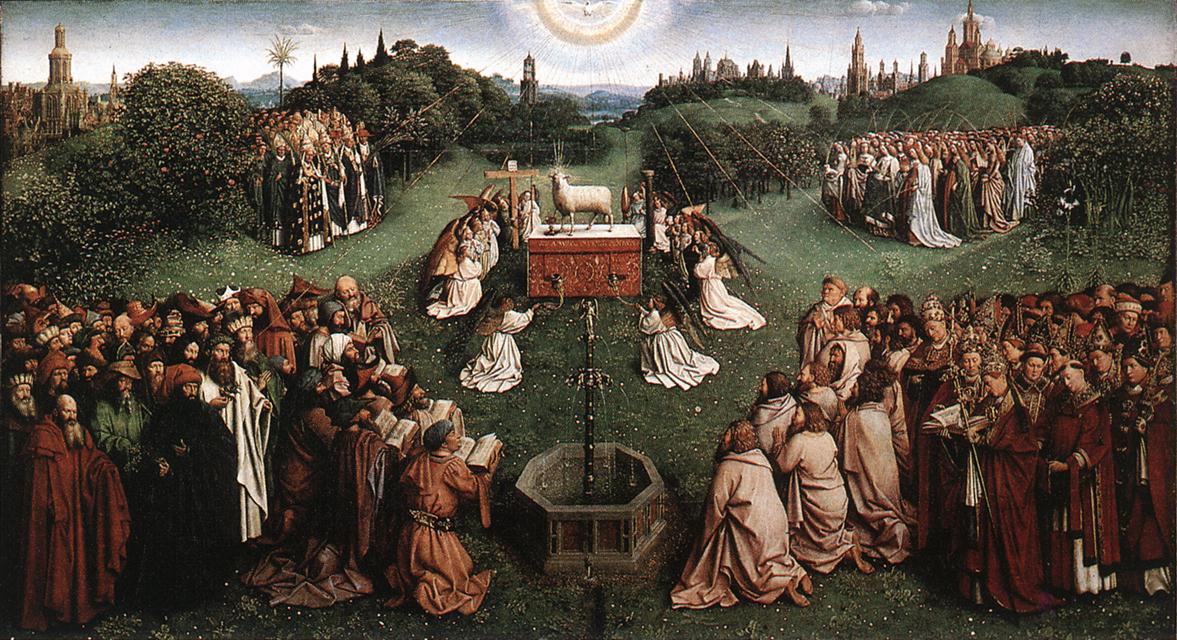 Jan van Eyck (with Hubert van Eyck), Ghent Altarpiece, central panel, Adoration of the Lamb, 1432, oil on panel, 134.3 × 237.5 cm — Saint Bavo Cathedral, Ghent. Public domain (Wikimedia Commons, PD-Art/PD-old-100-expired; the two painters died in 1441 and 1426 respectively).
John’s vision itself is transcendent and unseeable, yet van Eyck sets it down inside a startlingly specific, observable natural world. Recent botanical surveys of the meadow have identified a substantial number of the plants as painted precisely enough to name the species. The figures converging on the lamb from left and right are sorted into distinct groups — Old Testament patriarchs and prophets, virtuous pagans, apostles, martyrs, hermits, pilgrims — a visual taxonomy of Revelation’s own phrase, “every nation, tribe, people and language.” Notably, recent scholarship has proposed that one face among the hermits carries features resembling van Eyck’s own self-portrait — a quiet suggestion that salvation is not only a matter for ancient figures long dead, but for the fifteenth-century painter who made the image himself. The lamb’s blood, flowing from the altar, runs down into the Fountain of Life below, rendered with the same close observation van Eyck brings to an actual carved stone fountain.
Theological Reading — Symbolism in Disguise
The art historian Erwin Panofsky, in his 1953 study, proposed the concept of “disguised symbolism” to describe the painting of van Eyck and his generation of early Flemish artists. His argument runs roughly as follows: where medieval painting had signaled meaning through explicit, legible signs — halos, schematic backgrounds, gilded settings — the painters of van Eyck’s generation used their newly acquired capacity for naturalistic representation to hide those same symbols inside ordinary natural objects and everyday things. On this reading, every specific plant, every detail of the fountain, every fall of light in the Ghent meadow carries doctrinal weight, while presenting itself, on the surface, as nothing more than precisely observed nature.
The art historian Craig Harbison, in his 1991 study, revises Panofsky’s framework, arguing that van Eyck’s realism should not be understood simply as symbolism in hiding, but as realism itself functioning as a kind of “play” — an active device that keeps the viewer moving back and forth between the visible, physical world and the theological meaning beyond it. Read either way, the painting does the same work. It pulls Revelation’s transcendent vision down into a natural world so tangible you could reach out and touch the grass, insisting that the Lamb’s shepherding of the redeemed multitude is not a distant, otherworldly event, but something unfolding here, in the same ground the fifteenth-century faithful of Ghent stood on when they looked at this altarpiece.
Coming Next
The next installment turns to the Florentine painter Sandro Botticelli, where Neoplatonism and biblical iconography intersect.
Works Cited
English-language
- Erwin Panofsky, Early Netherlandish Painting: Its Origins and Character (Harvard University Press, 1953) — the foundational study proposing the concept of “disguised symbolism”
- Craig Harbison, Jan van Eyck: The Play of Realism (Reaktion Books, 1991) — a study revising Panofsky’s framework to read van Eyck’s realism itself as a theological device
The image above is a public-domain (PD-Art) scan hosted on Wikimedia Commons. Both works listed above are real, standard scholarly studies. No Korean-language academic source could be reliably verified for this installment, so that section has been omitted.
Comments
Leave a comment
Comments are reviewed before being published. Only your name and comment are stored — no personal data collected.
You might also like
Painters Interpret Scripture
Painting the Word ⑮ Albrecht Dürer — The Apocalypse Woodcuts and the Terror of 1500
In 1498, Albrecht Dürer self-published a fifteen-print woodcut cycle on the Book of Revelation. The Four Horsemen shattered the static, diagrammatic tradition of earlier Apocalypse illustration with a violent sense of motion — giving visual form to the eschatological dread gripping Europe as the year 1500 approached.
Painters Interpret Scripture
Painting the Word ㉑ El Greco — The Opening of the Fifth Seal and the Mysticism of Distorted Bodies
El Greco's Opening of the Fifth Seal (c. 1608-14), painted for a Toledo hospital church, renders Revelation's martyrs receiving their white robes as a mass of nude figures wrenched past ordinary human proportion.
Painters Interpret Scripture
Painting the Word ⑳ Pieter Bruegel the Elder — The Tower of Babel and the Faces of Flemish Laborers
Bruegel's Tower of Babel (c. 1563) relocates an ancient Babylonian myth to a sixteenth-century Antwerp construction site. Through the faces of ordinary Flemish laborers hauling stone and turning cranes, he renders the story not as remote myth but as an event unfolding here and now.
Loading comments…