Bible, Actually
Sennacherib Boasted About Every City He Took — Except Jerusalem
Second Kings 19:35–36 delivers one of the most abrupt reversals in the Hebrew Bible: the Assyrian camp loses 185,000 men overnight, and Sennacherib, the most powerful king on earth, turns around and goes home. Historians reading the account have long asked the obvious question: if that is what happened, what does the Assyrian record say?
In 1830, Colonel Robert Taylor of the British East India Company acquired a hexagonal clay cylinder from the ruins of Nineveh. The object had been inscribed in cuneiform around 691 BC by Sennacherib’s scribes. Today it sits in the British Museum under the catalog number BM 91032, and it is one of the most examined documents in biblical archaeology. What it says about Jerusalem — and what it does not say — is the point.
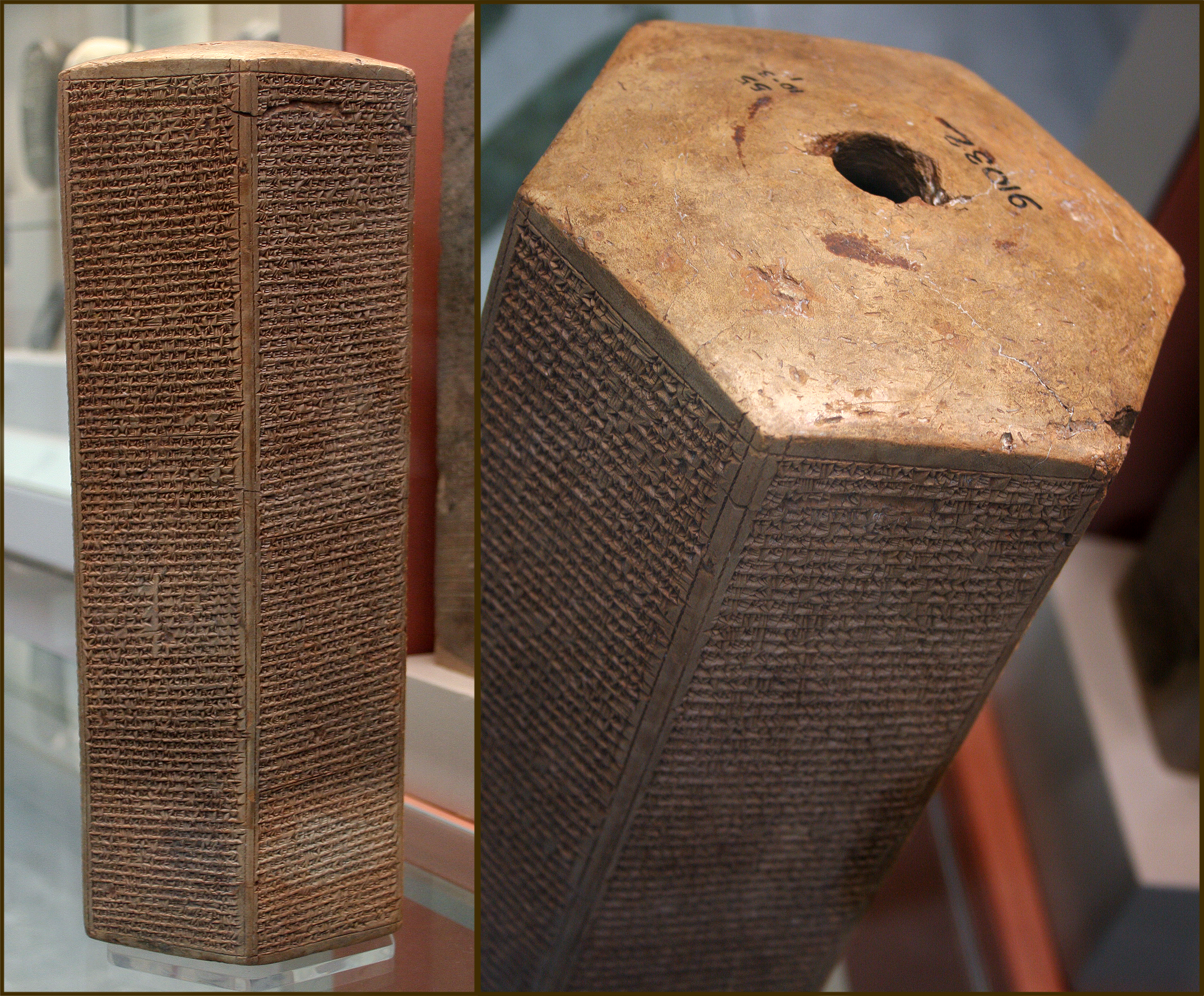 Taylor Prism · c. 691 BC · British Museum (BM 91032) · Public Domain. A hexagonal cuneiform cylinder recording Sennacherib’s military campaigns, including his 701 BC invasion of Judah.
What Sennacherib Wrote
The Taylor Prism is a royal chronicle. Its genre demands a specific kind of rhetoric: campaigns are listed, victories are catalogued, and every significant city that fell is described in a recognizable sequence: siege, capture, plunder, deportation, destruction. James B. Pritchard’s Ancient Near Eastern Texts Relating to the Old Testament (3rd edition, Princeton University Press, 1969) provides the standard English translation of the relevant section (pp. 287–288).
Regarding the Judah campaign, Sennacherib records taking forty-six fortified cities, carrying off over 200,000 inhabitants, and seizing enormous quantities of gold, silver, and other valuables. He then describes what happened to Hezekiah: “As for Hezekiah the Judean, who did not submit to my yoke, I shut him up in Jerusalem his royal city, like a bird in a cage.”
And then the pattern stops.
The Missing Entry
In every other case where Sennacherib describes the fall of a city, a predictable structure follows: conquest is announced, the king’s fate is stated, the population is deported, the city is dismantled. This structure repeats across dozens of entries in the Prism. For Jerusalem, it does not appear. After the caged-bird metaphor, the text shifts to an account of tribute Hezekiah sent — gold, silver, precious stones, his daughters, his musicians, and a long list of luxury goods — all delivered to Nineveh. Then the section closes.
Brevard S. Childs, in Isaiah and the Assyrian Crisis (SCM Press, 1967), was among the scholars who examined this gap in the context of the biblical account. The absence of a conquest narrative for Jerusalem, in a document specifically designed to magnify Assyrian victories, is what historians call an argumentum ex silentio — an argument from silence. Silence in royal propaganda is meaningful precisely because the incentive to claim success was so high.
If Jerusalem had fallen, Sennacherib would have said so. He did not say so.
What This Argument Can and Cannot Establish
The silence of the Taylor Prism is not a simple confirmation of the biblical text. Several distinctions are worth keeping.
First, the Prism confirms the historical reality of the 701 BC campaign. Sennacherib’s invasion of Judah was a real event, not a later theological invention. Second, the Prism confirms that Jerusalem was besieged. Third, the Prism does not record Jerusalem’s fall — which aligns with 2 Kings’ narrative of Sennacherib’s withdrawal.
What the Prism does not do is confirm the specific account in 2 Kings 19:35: the death of 185,000 Assyrian soldiers in a single night. That level of detail appears in no external source. The Prism records tribute from Hezekiah, which could be read as either a negotiated settlement or a face-saving exit after a failed siege. The two accounts are not necessarily incompatible, but they are also not the same account.
The more careful claim is this: the Assyrian record of the 701 BC campaign is structurally consistent with Jerusalem not having fallen, and an Assyrian king with every motive to record a conquest chose not to record one. That consistency is significant. It is not proof.
The Adversarial Witness
There is something worth noting about the Prism’s evidentiary weight that goes beyond strict historical analysis. Royal propaganda from enemy nations is among the least sympathetic possible source for corroborating the Bible’s account of its own survival. An Assyrian king had every incentive to exaggerate victories and suppress defeats. The Taylor Prism was not produced to help later readers understand 2 Kings; it was produced to magnify Sennacherib’s reputation.
When that document — in all its self-serving agenda — still cannot bring itself to claim the fall of Jerusalem, the gap it leaves is a peculiar kind of testimony.
References
- James B. Pritchard, ed., Ancient Near Eastern Texts Relating to the Old Testament, 3rd ed. (Princeton University Press, 1969), pp. 287–288
- Brevard S. Childs, Isaiah and the Assyrian Crisis (Studies in Biblical Theology, Second Series 3; SCM Press, 1967)
- 2 Kings 18:13; 19:35–36, Masoretic Text
Comments
Leave a comment
Comments are reviewed before being published. Only your name and comment are stored — no personal data collected.
You might also like
Bible, Actually
The Stone They Burned: The Mesha Stele and the 'House of Omri'
In 1868, a Moabite king's victory monument surfaced in Jordan — naming Israel's dynasty as 'the House of Omri' and containing the earliest known extra-biblical mention of YHWH. A year later, local tribesmen shattered it with fire.
Bible, Actually
The Nuzi Tablets Were Supposed to Prove the Patriarchal Age. Here's What Actually Happened.
Clay tablets unearthed in Iraq in the 1920s seemed to confirm Genesis customs like adoption and household gods as genuine 2nd-millennium BC practice. Scholars later walked much of that claim back.
Bible, Actually
Five Lines on a Potsherd: The Contested Case for the Oldest Hebrew Writing
A 2008 excavation in the Elah Valley — the setting of David and Goliath — turned up an inked ostracon that some scholars call the earliest Hebrew inscription. Others aren't convinced it's Hebrew at all.
Loading comments…