Bible, Actually
Ten Camels at the Well: The Labor Behind Rebekah's Offer
The servant of Abraham arrived at a well outside the city of Nahor after a long journey with ten camels. He stopped and prayed. The sign he asked for was specific: the right woman would not only give him a drink but would also offer to water his camels — all of them, until they had their fill (Genesis 24:13–14).
It is a detail that is easy to read past. But understanding what that offer actually entailed changes the texture of one of the most carefully told stories in the Old Testament.
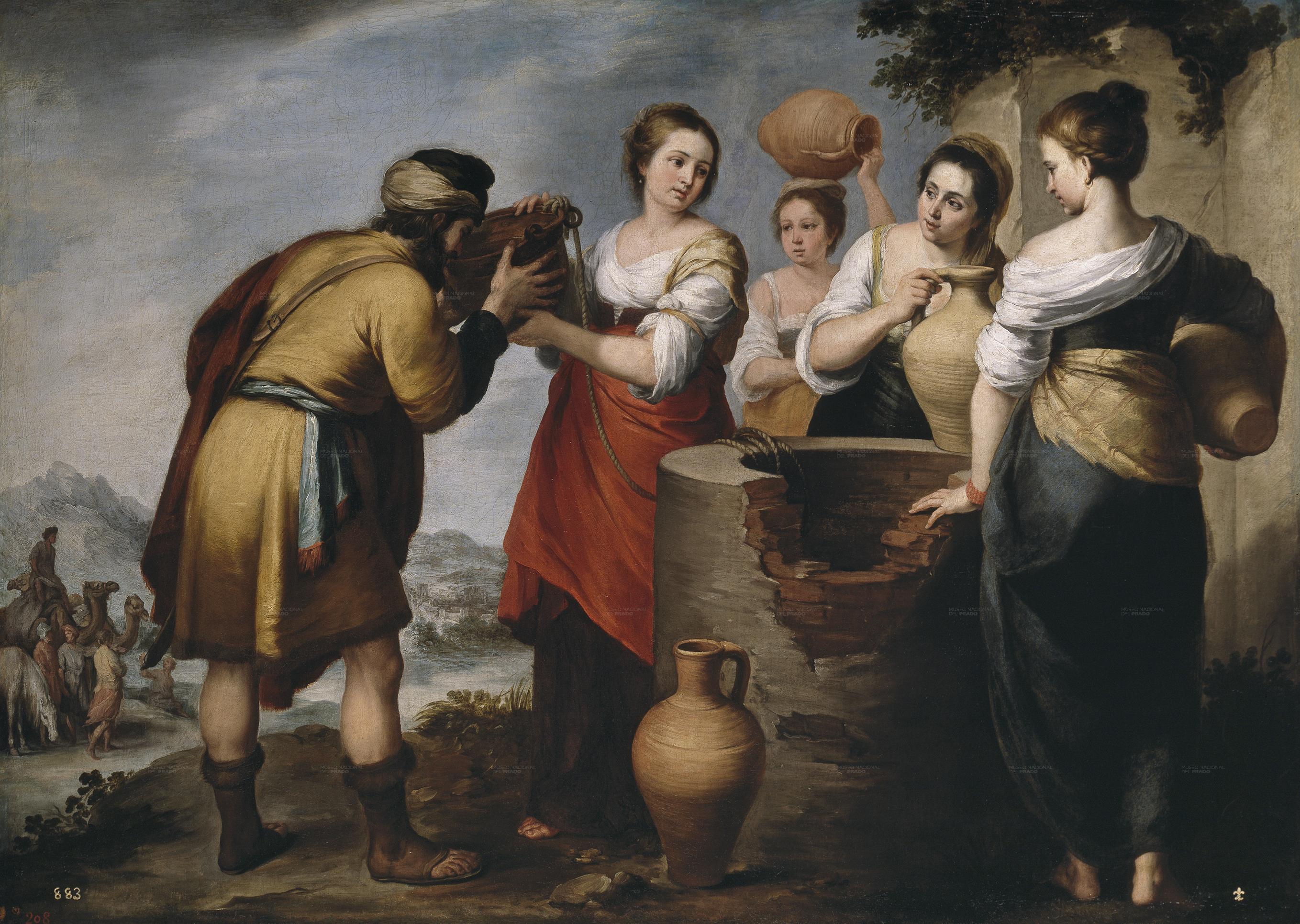 Bartolomé Esteban Murillo · Rebecca and Eliezer at the Well, c. 1660 · Public Domain.
How Much Water a Camel Actually Drinks
Camels are built for desert travel, which means they can tolerate extraordinary levels of dehydration. The foundational research on camel water balance was published in 1956 by a research team led by Bodil Schmidt-Nielsen. Their paper “Water Balance of the Camel” (American Journal of Physiology 185.1) remains a landmark study in animal physiology. According to their findings, a camel that has been traveling in the heat and lost significant body water can drink between 100 and 200 liters in a single session at a water source.
Apply that to ten camels, and the arithmetic is arresting: somewhere between 1,000 and 2,000 liters of water — one to two metric tons — would be involved if all ten consumed that amount; this is a conditional estimate, not a quantity recorded in Genesis. Such water would have to be drawn from a well using hand-carried vessels. At an ancient Middle Eastern well, that means lifting a leather bucket or clay jar, drawing it up, emptying it into a trough, and repeating the process dozens, possibly hundreds, of times. Depending on the depth of the well and the size of the vessels, this would have taken several hours.
What Rebekah Volunteered
When Rebekah arrived at the well and met the servant, she gave him a drink from her jar. Then she said: “I will draw water for your camels also, until they have finished drinking” (Genesis 24:19). The text immediately notes that she “quickly emptied her jar into the trough” and ran back to the well to draw more (v. 20).
Nobody had asked her to do this. The servant had prayed for such a response, but he had said nothing aloud to Rebekah about his camels. Her offer was entirely her own initiative — and it committed her to repeated work for a stranger and his animals.
The text is unusually attentive at this point. “The man gazed at her in silence to learn whether the LORD had prospered his journey or not” (v. 21). The watching and the silence matter. They tell us that her task took long enough for him to stand there and process what he was witnessing.
The Logic of the Prayer
Abraham’s servant had not set a trivial test. He had set one that would only be passed by someone willing to take on substantial, unsolicited labor. The camels-and-water criterion was not a magic formula; it was a character probe. The woman who would offer to water ten camels without being asked was, almost by definition, someone of unusual generosity and initiative — the kind of person who would thrive in a covenant household.
Reading Genesis 24 with This in Mind
Genesis 24 is the longest chapter in the book of Genesis — sixty-seven verses — and it is notably deliberate in its storytelling. The chapter slows down and lingers over each exchange, then has the servant retell the whole story almost verbatim when he arrives at Laban’s house. This repetition is a mark of significance in Hebrew narrative.
When you reach verse 19 and read Rebekah’s offer, pause and let the physics register. Repeated trips with water, for someone she has just met. Neither an exact tonnage nor an afternoon’s duration can be recovered from the biblical account.
That is the scale of the sign the servant had prayed for. And Rebekah gave it without being asked.
A marriage scene with labor inside it
The wood engraving after William Holman Hunt in Dalziels’ Bible Gallery connects Rebekah’s offer of water with recognition of her character and the servant’s marriage mission. The Metropolitan Museum’s account helps locate this biblical meeting within nineteenth-century religious illustration. Object record.
Return from the picture to Genesis and the jar becomes more than scenery: someone must carry the water. But Genesis supplies neither liters nor elapsed hours. Modern physiological estimates cannot establish her actual workload. Reading the chosen pictorial moment alongside the text’s repeated movements keeps both her initiative and the limits of our reconstruction visible.
Further Reading
- Bodil Schmidt-Nielsen et al., “Water Balance of the Camel,” American Journal of Physiology 185.1 (1956): 185–194.
Comments
Leave a comment
Comments are reviewed before being published. Only your name and comment are stored — no personal data collected.
You might also like
Bible, Actually
Who Is My Neighbor? Leviticus and the Good Samaritan
Leviticus commands love for neighbors and resident aliens. Jesus’ Samaritan parable asks who acts as a neighbor across a hostile boundary.
Bible, Actually
Job's Monsters: Animals, Myth, and the Limits of Human Power
Job’s creatures invite both animal and mythic readings. Ugaritic parallels illuminate Leviathan without settling every detail.
Bible, Actually
Hammurabi and Biblical Law: What 'Eye for an Eye' Shows
The parallels are real; the route of transmission is debated. Read the clauses, social distinctions, and divine commissions carefully.
Loading comments…