Bible, Actually
The New Testament Never Explains Where Demons Came From
Ask a churchgoer where New Testament demons come from, and a confident answer usually follows: they are fallen angels, or the disembodied spirits of the Nephilim — the giants born to angels and human women in Genesis 6. It is a coherent, widely taught account. It is also nowhere in the New Testament. The Gospels are remarkably specific about what demons do and how Jesus deals with them. They are entirely silent on where demons came from or what kind of beings they fundamentally are.
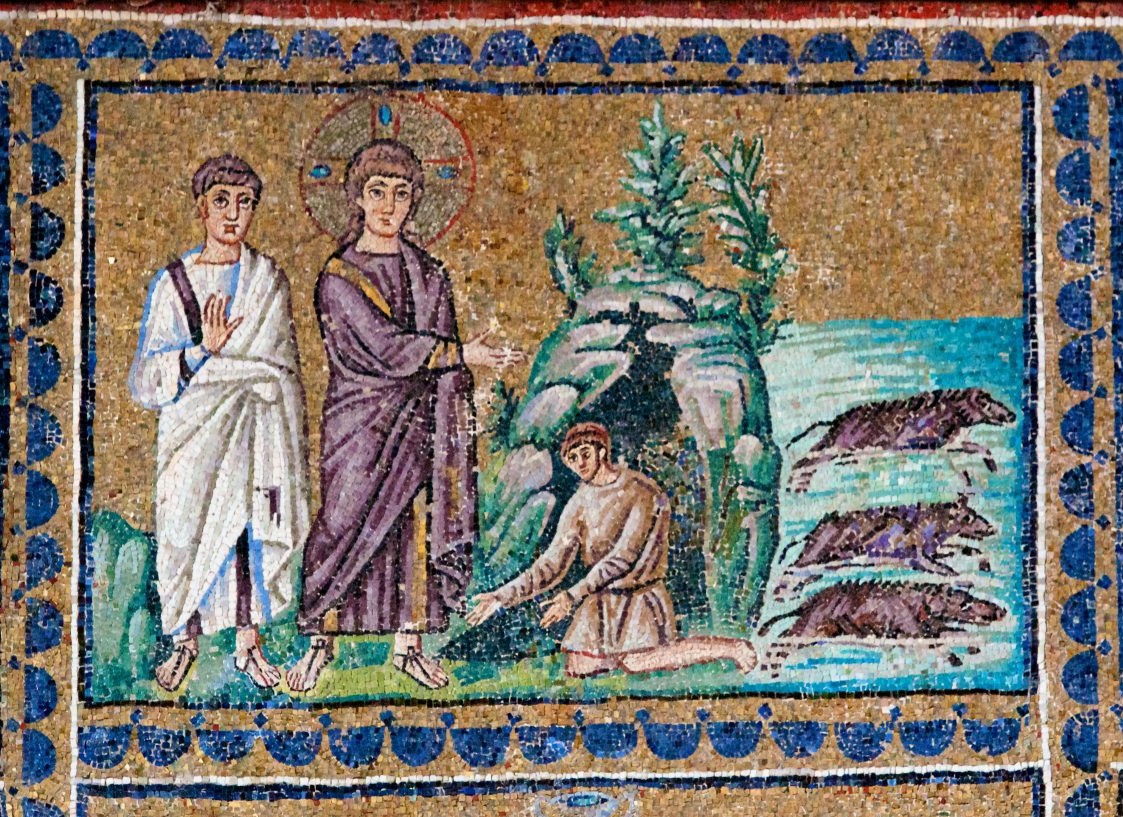 Unknown sixth-century mosaicist · Exorcism of the Gerasene demoniac, Basilica of Sant’Apollinare Nuovo, Ravenna (early 6th century) · Public domain.
The Word Daimonion
The Greek word behind the English “demon” is δαιμόνιον (daimonion), a diminutive of δαίμων (daimōn). In classical Greek, the term did not automatically denote something evil. In Plato’s Apology, Socrates describes an inner voice that warns him away from wrongdoing as his daimonion — closer to a divine guide than a malevolent spirit. In Greek religion more broadly, a daimōn was simply an intermediary spiritual power between gods and humans, morally unmarked.
The word’s negative charge in Jewish and Christian usage comes from the Septuagint. Deuteronomy 32:17 (“they sacrificed to demons that were no gods”) and Psalm 106:37 render the Hebrew shedim — foreign gods — with daimonion. Leviticus 17:7 and Isaiah 13:21 and 34:14 apply related language to seirim, “goat-demons,” tied to idolatrous worship. By the time the New Testament was written, “demon” already carried this inherited association with false gods and idolatry in Greek-speaking Judaism. Paul draws directly on this background in 1 Corinthians 10:20–21: “what pagans sacrifice they offer to demons and not to God… You cannot partake of the table of the Lord and the table of demons” (ESV) — a passage that only makes sense against Deuteronomy 32.
What the Gospels Actually Say
What the Gospel text itself asserts about demons is detailed and consistent. Demons cause convulsions, muteness, blindness, superhuman strength, and self-destructive violence (Mark 9:18–22; Mark 5:3–5). They speak and possess supernatural knowledge of Jesus’s identity: the man in the Capernaum synagogue cries out, “What have you to do with us, Jesus of Nazareth? Have you come to destroy us? I know who you are — the Holy One of God” (Mark 1:24, ESV). James 2:19 adds that “even the demons believe — and shudder.” A single person can host many at once — “My name is Legion, for we are many” (Mark 5:9). They operate under a chief, “Beelzebul, the prince of demons” (Matt 12:24). They can be relocated into animals (Mark 5:12–13), and they anticipate a future judgment they dread: “Have you come here to torment us before the time?” (Matt 8:29).
This is a substantial, textually explicit body of description. Demons appear as personal, knowing, speaking agents who fear Jesus’s authority and submit to it. The Gospels also treat “unclean spirit” (pneuma akatharton) and “demon” (daimonion) as interchangeable terms for the same reality — Mark 1 calls the same figure “a man with an unclean spirit” in verse 23 and describes Jesus “casting out many demons” in verse 34.
What the Text Never Says
For all this specificity, no Gospel passage explains where demons came from. There is no creation account for them, no statement identifying them as fallen angels, no claim that they are the disembodied spirits of the dead. Jesus confronts demons as adversaries and expels them with authority, but at no point does any Gospel author pause to explain their ontology to the reader. This is a genuine textual silence, not an oversight in modern reading — and it is a silence later Christian tradition has filled in with an explanation that, as it happens, does exist, just not in the New Testament.
Where the Explanation Actually Appears: 1 Enoch
The most detailed and influential account of demonic origins in ancient Jewish literature appears in the Book of the Watchers, the opening section (chapters 1–36) of 1 Enoch — a work composed in stages during the third and second centuries BCE, well before the New Testament.
 Unknown author · P. Chester Beatty XII, leaf 3, verso (Greek papyrus containing 1 Enoch) · Public domain.
The text expands on the terse notice in Genesis 6:1–4 about the “sons of God” and “daughters of men.” Two hundred angelic “Watchers,” led by Shemihazah and Asael, descend on Mount Hermon, take human wives, and father a race of giants who bring violence and destruction on the earth. The giants eventually destroy one another or are destroyed — but 1 Enoch 15:8–12 makes the decisive move: evil spirits proceed out of the slain giants’ bodies, and these spirits are what roam the earth afflicting and corrupting humanity until the final judgment. This is, as far as the surviving record goes, the single most influential ancient account of what a “demon” actually is.
Jubilees 10:1–14 tells a related but distinct version. After the flood, unclean spirits descended from the Watchers begin leading Noah’s grandchildren astray. Noah prays, and God orders the spirits bound — but Mastema, their chief, successfully petitions to keep a tenth of them free to test and afflict humanity with sickness until the judgment. The text explicitly frames demons as agents of disease and temptation, which lines up strikingly with what the Gospels show demons doing to the people Jesus heals.
Qumran: The Same Framework in Practice
The Dead Sea Scrolls show this was not simply a literary motif but a live framework behind actual religious practice contemporary with the New Testament. Qumran texts name Belial as the chief of evil spirits (e.g., the Community Rule, the War Scroll), and apotropaic and exorcistic compositions — 4Q510–511 (“Songs of the Sage”) and 11Q11 (“Apocryphal Psalms”) — were composed specifically to repel “spirits of the bastards,” a phrase drawing directly on the Watchers tradition’s giant offspring. First-century Judaism, in other words, was already performing exorcisms against demons understood, quite specifically, along the lines 1 Enoch lays out.
Evidence the New Testament Knew This Tradition
New Testament authors were not unaware of this material. Jude 6 refers to “the angels who did not stay within their own position of authority, but left their proper dwelling,” whom God “has kept in eternal chains under gloomy darkness until the judgment of the great day” (ESV) — language scholars widely recognize as a direct reference to the Watchers myth of Genesis 6 and 1 Enoch (2 Peter 2:4 offers a close parallel). Jude goes further still: verses 14–15 quote 1 Enoch 1:9 by name, introducing it as the prophecy of “Enoch, the seventh from Adam.”
So the New Testament demonstrably knew 1 Enoch’s Watchers tradition, and Jude even cites it as prophetic speech. But what Jude connects to that tradition is the judgment of the fallen angels themselves — not an explicit claim that the demons Jesus exorcises in the Gospels are the spirits of the giants those angels fathered. That specific equation is a plausible reconstruction modern scholars draw from the full span of Second Temple literature. It is not a claim any New Testament author makes outright.
Sorting the Claims
What the text states directly: the Gospels describe demons as personal, knowing, speaking agents who cause real affliction and who submit, with fear, to Jesus’s authority. This is explicit, repeated New Testament content.
What the text is silent on: the Gospels never explain what demons fundamentally are or how they came to exist.
What Second Temple literature states, but the New Testament does not state directly: 1 Enoch 15 and Jubilees 10 explicitly identify demons as spirits proceeding from the bodies of the antediluvian giants, and the Qumran exorcism texts show this was the operative framework of first-century Jewish demonology. Jude demonstrates New Testament familiarity with this literature but does not draw the equation itself.
None of this weakens the reality the Gospels assert — that Jesus confronts and defeats a real, personal, hostile power. It does mean that “demons are fallen angels” or “demons are the spirits of dead giants” is a claim inherited from intertestamental Judaism and later Christian synthesis, not a sentence you can point to in Matthew, Mark, Luke, or John.
References
- Archie T. Wright, The Origin of Evil Spirits: The Reception of Genesis 6:1–4 in Early Jewish Literature, WUNT 2/198 (Tübingen: Mohr Siebeck, 2005)
- George W. E. Nickelsburg, 1 Enoch 1: A Commentary on the Book of 1 Enoch, Chapters 1–36; 81–108, Hermeneia (Minneapolis: Fortress Press, 2001)
- Graham H. Twelftree, In the Name of Jesus: Exorcism among Early Christians (Grand Rapids: Baker Academic, 2007)
- Eric Sorensen, Possession and Exorcism in the New Testament and Early Christianity, WUNT 2/157 (Tübingen: Mohr Siebeck, 2002)
- 1 Enoch 15:8–12; Jubilees 10:1–14; Mark 1:23–34; 5:1–20; Jude 6, 14–15; 1 Corinthians 10:20–21
Comments
Leave a comment
Comments are reviewed before being published. Only your name and comment are stored — no personal data collected.
You might also like
Bible, Actually
The Boy Who Threw a Stone: How the Dead Sea Scrolls Were Discovered in 1947
A Bedouin teenager looking for a lost animal threw a stone into a cliff cave near Qumran in 1947. The sound of breaking pottery changed the study of the Old Testament. The story of the discovery and what the Great Isaiah Scroll tells us about biblical transmission.
Bible, Actually
The Serpent in Genesis 3 Is Not Called Satan
Genesis 3:1 introduces the creature as nothing more than the most cunning of the wild animals. The identification of the Eden serpent with Satan developed in Second Temple Jewish literature and is explicitly stated only in Revelation 12 and 20 — not in Genesis itself.
Bible, Actually
The Only Fixed Date in Paul's Life Comes from a Marble Fragment Found at Delphi
Acts 18:12 names Gallio as proconsul of Achaia when Paul stood before him in Corinth. A 1905 discovery of fragments of Emperor Claudius's letter at Delphi pins Gallio's tenure to 51–52 CE — establishing the single absolute date from which all Pauline chronology is calculated.
Loading comments…