Bible, Actually
'Not One Stone Left Upon Another': Matthew 24:2, the Destruction of 70 CE, and the Trumpeting Stone
Jesus’s prediction in Matthew 24:2 is one of the most precisely documented prophecies in the New Testament: “You see all these, do you not? Truly, I say to you, there will not be left here one stone upon another that will not be thrown down” (ESV). He was standing near the Jerusalem Temple, speaking to disciples who had just pointed out its grandeur. Within the lifetime of people who heard him — roughly forty years later — the Temple was gone.
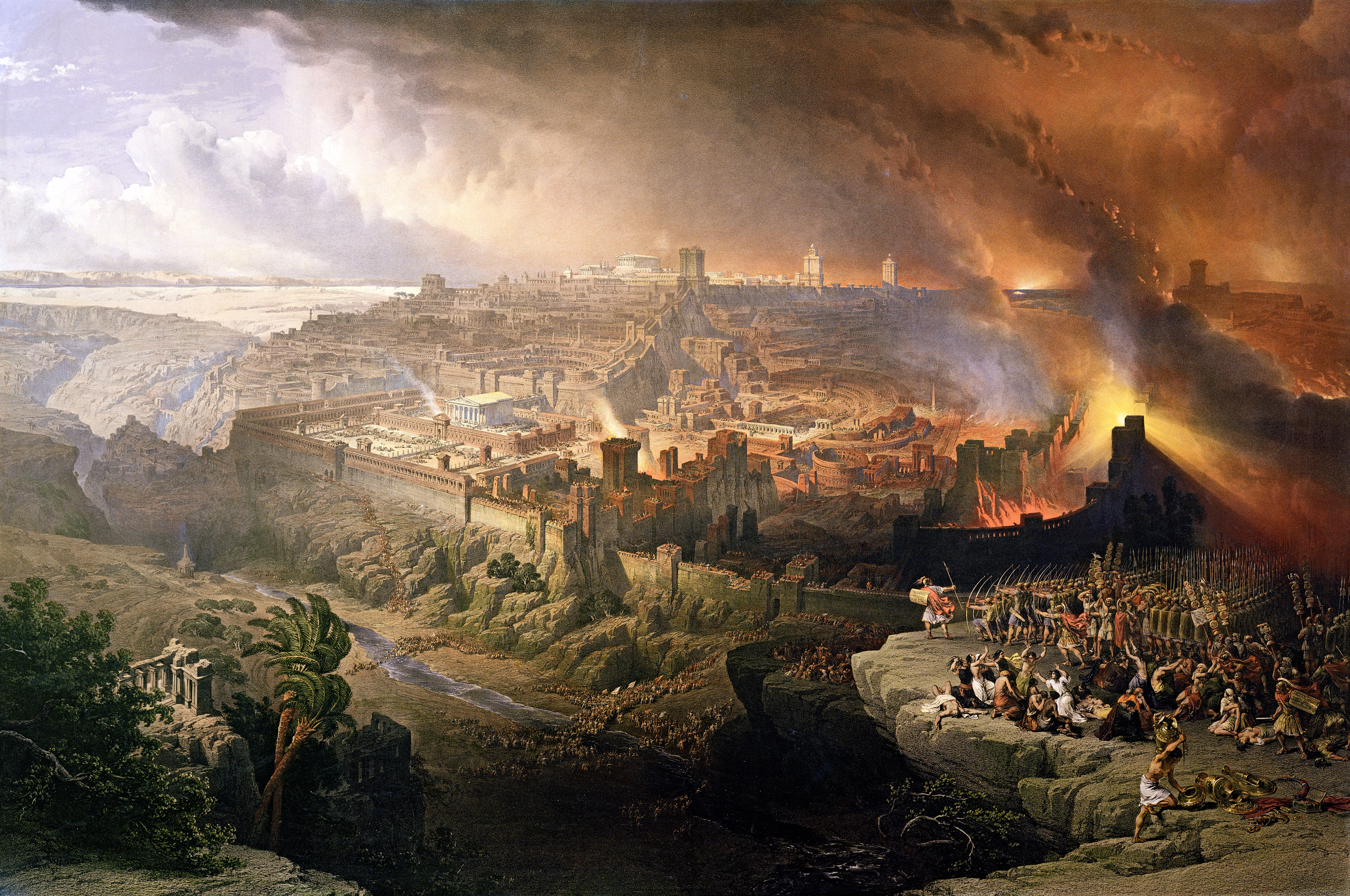 David Roberts · The Siege and Destruction of Jerusalem by the Romans Under the Command of Titus, A.D. 70, 1850 · Public Domain. A 19th-century artist’s imaginative reconstruction of the fall of Jerusalem in 70 CE.
The Destruction of 70 CE
The First Jewish–Roman War began in 66 CE with a revolt against Roman rule. Four years of military campaign culminated in the siege of Jerusalem in the summer of 70 CE. The Roman general Titus, son of the newly proclaimed Emperor Vespasian, commanded the operation.
Josephus, writing in Jewish War, provides the closest thing to an eyewitness account of the siege and the Temple’s fall. His description of the Temple fire — whether accidental or deliberate remains debated — and the collapse of the great stones into the streets below is detailed and specific. Martin Goodman’s Rome and Jerusalem: The Clash of Ancient Civilizations (2007) provides the best modern historical synthesis of the war and its causes.
The Temple Herod the Great had renovated and expanded, beginning around 20 BCE, was among the most impressive structures in the Roman world. Josephus himself calls it one of the wonders of the ancient world. The stones in its retaining walls were enormous — some measuring dozens of feet in length. When those stones came down in 70 CE, they came down onto the streets and plazas below. Some of those fallen stones are still there, preserved as they landed, in the Jerusalem Archaeological Park at the base of the Temple Mount’s southern and western walls.
A Stone with a Direction
In 1968, Benjamin Mazar began the first systematic archaeological excavation of the area immediately south and west of the Temple Mount. Among the discoveries of that excavation was a large limestone block found at the base of the Temple Mount’s southwest corner, lying in what had been a street-level plaza.
On the block’s surface, a Hebrew inscription: לבית התקיעה — le-veit ha-tekiah, “to the place of trumpeting.” A third phrase followed but was partially damaged; Mazar suggested it read “to proclaim” or “to announce.”
The block was a directional marker. It had stood at the top of a tower at the southwest corner of the Temple Mount, pointing worshipers toward the spot on that tower where a priest would stand to blow the shofar or trumpet, signaling the beginning and end of the Sabbath. Josephus confirms the practice: in Jewish War 4.582, he writes that “a priest stood ready with his trumpet to proclaim the end of the Sabbath from the top of the tower.”
The marker ended up in the street for one reason: in 70 CE, when Roman forces destroyed the Temple and its towers, this stone fell from the top of the southwest tower to the street below. There it lay for nearly two thousand years until Mazar’s excavation recovered it. The original is now in the Israel Museum in Jerusalem; a replica stands near the excavation site.
Mazar published the find in The Mountain of the Lord (Doubleday, 1975). Nahman Avigad discussed it further in Discovering Jerusalem (Thomas Nelson, 1983).
The Interpretive Complexity of Matthew 24
Matthew 24 is one of the most debated chapters in the New Testament. The Olivet Discourse it introduces mixes specific historical prediction (the Temple’s fall, the distress of “those days”) with apparently broader apocalyptic language that has generated a wide range of interpretive positions. Scholars disagree about how much of the chapter refers exclusively to 70 CE, how much extends to a future end-time horizon, and where the line between the two falls.
But for Matthew 24:2 in particular — the verse about not one stone being left on another — the major critical commentators tend to read it as a specific prediction about the Temple building itself, fulfilled in 70 CE. R.T. France, in his NICNT commentary on Matthew, treats verse 2 as a concrete prophecy about the Temple’s physical destruction, not a symbolic statement about spiritual realities. W.D. Davies and Dale C. Allison, in the ICC Matthew commentary, situate the verse similarly.
A common objection: the western retaining wall (the “Wailing Wall” or “Western Wall”) is still standing. Doesn’t that contradict “not one stone upon another”? The standard response is that the verse refers to the Temple building itself — the naos (sanctuary) and the Herodian superstructure — not to the retaining walls of the plaza surrounding it. The retaining walls were functional engineering supporting the platform; the Temple building, by contrast, was completely destroyed. The prophecy, read in this way, was precisely fulfilled.
The Physical Footprint
The Trumpeting Stone is one of a cluster of first-century finds from Jerusalem that give the New Testament’s historical setting a physical texture. The stone did not prove anything about Matthew 24:2 that scholarship did not already know from Josephus. But it changed the category of knowledge. It moved the destruction of the Temple from a well-attested historical event to something you can stand next to, read the inscription, and trace with your hand.
The stone had a function: it told a priest where to stand to signal the Sabbath. That function ended forever when Roman soldiers pushed it off the tower. It lay in a first-century street, under centuries of rubble, while the city was rebuilt above it. Benjamin Mazar’s excavation lifted it out of that rubble in 1968, and the inscription read the same as it always had: to the place of trumpeting.
References
- Benjamin Mazar, The Mountain of the Lord: Excavating in Jerusalem (Doubleday, 1975), pp. 148–152
- Nahman Avigad, Discovering Jerusalem (Thomas Nelson, 1983), pp. 128–131
- Flavius Josephus, Jewish War 4.582; 6.249–280
- Martin Goodman, Rome and Jerusalem: The Clash of Ancient Civilizations (Allen Lane, 2007)
- R.T. France, The Gospel of Matthew (NICNT; Eerdmans, 2007), pp. 893–898
- W.D. Davies and Dale C. Allison, A Critical and Exegetical Commentary on the Gospel according to Saint Matthew, vol. 3 (ICC; T&T Clark, 1997), pp. 331–336
Comments
Leave a comment
Comments are reviewed before being published. Only your name and comment are stored — no personal data collected.
You might also like
Bible, Actually
The Ossuary of Caiaphas: What a First-Century Bone Box Tells Us About the High Priest Who Tried Jesus
In 1990, a Jerusalem construction project broke open a limestone cave containing twelve first-century Jewish ossuaries. One bore the Aramaic inscription 'Joseph son of Caiaphas.' The discovery brought the high priest of the Gospel passion narrative into verifiable history — with important scholarly caveats.
Bible, Actually
The Magdala Stone and the Galilee Boat: Two First-Century Finds from Jesus's Galilee
A 2009 excavation at Magdala uncovered a first-century synagogue with a carved menorah stone. A 1986 drought exposed a first-century fishing boat nearby. Together they anchor the Gospels' Galilee in the archaeological record.
Bible, Actually
Two Pools, Two Digs: How Archaeology Vindicated John's Jerusalem Geography
John's Gospel describes a pool with 'five porticoes' and a healing at Siloam — details critics once dismissed as literary invention. Excavations in Jerusalem found both pools exactly where John said they were.
Loading comments…