Preacher Profile
How Korea's Leading Preachers Preach: Reading 43 Pulpit Styles
Every preacher steps into the pulpit holding the same Bible. No two of them preach it the same way.
Some build their sermons verse by verse, letting the argument of the text set the argument of the sermon. Some distill everything into a single sentence that stays with the congregation for a week. Some dig into Greek and Hebrew and historical background; others begin with a question from everyday life and work their way back into the text. Still others let Scripture pass through literature, liturgy, social realities, or the wounds of pastoral ministry before it reaches the pew.
Our series “How Korea’s Leading Preachers Preach” looks closely at those differences. But it is not a ranking. We are not judging who is more biblical or more gifted.
The series follows one question instead:
By what road does this preacher carry the biblical text to the congregation?
Why we wrote this series
When we learn preaching, we tend to swing between two extremes.
On one side, preaching becomes pure technique. Three points, one point, introduction, illustration, application — the forms remain, but the theology and the pastoral setting that produced those forms fade from view.
On the other side, we remember preachers only by impression. “Powerful.” “Deep.” “Accessible.” “Literary.” Those words are not useless, but they leave little you can actually carry into next week’s sermon preparation.
This series sits between those extremes. Rather than reputation or impression, it watches how the sermon actually works:
- How does the preacher hold the structure of the text?
- How far do original languages and historical background go?
- Are illustrations decoration, or part of the argument?
- Does application arrive at the end, or drive the whole sermon?
- How do the preacher’s theology and pastoral context shape the form?
Follow those questions and a “style” stops being a personality trait. It becomes a method of sermon preparation you can examine and learn from.
Forty-three preachers, six ways in
The series covers preachers who shaped the Korean pulpit over the past half century, alongside voices worth watching today — 43 in all. It is less a definitive canon than a starting point for reading the grammar of Korean preaching from several angles.
The essays fall roughly into six groups:
-
The expository tradition — Ok Han-heum, Park Young-sun, Hwa Jong-bu, Ha Yong-jo, Park Dae-young, Cho Jung-min, Song Tae-geun, Noh Jin-jun, and Jung Pil-do show how many different faces text-driven preaching can wear.
-
Three-point and hybrid structures — Lee Dong-won, Lee Chan-soo, and Kim Hyung-kook illustrate how structural clarity, congregational connection, and apologetic questioning meet inside one sermon.
-
Topical preaching and application — Cho Yong-gi, Kim Dong-ho, Lee Jung-ik, Kim Byung-sam, Hong Min-gi, and Yoo Ki-sung show how topical preaching takes hold of everyday language and pastoral agendas.
-
Inductive preaching — Kwak Sun-hee, Lee Jae-chul, and Lee Ji-woong withhold the conclusion, letting listeners discover it as they walk through the text.
-
Narrative, liturgy, and theological imagination — Kim Ki-seok and Han Hong show what language preaching gains when it passes through literature, history, and theology.
-
Hidden masters — twenty further essays introduce preachers whose pulpit grammar deserves fresh attention in today’s Korean church.
Browse the full 43-essay series
What we are trying to learn
Reading a good preacher is not about imitating a voice. What matters is seeing the preparation behind the sermon — the road by which the text reaches the congregation.
When a preacher explains a Greek word in passing, we should ask what force that word actually carries in the text. When a preacher cites scholarship, we should check whether the citation helps us read the text more honestly or simply decorates a conclusion already reached. When a preacher presses application hard, we should ask whether that application grew out of the text or arrived ahead of it.
So while the series introduces preachers, it keeps returning to the questions of sermon preparation:
- Where does this preacher’s observation of the text begin?
- Does the sermon’s movement come from the structure of the passage, or from the congregation’s questions?
- Do original languages and background material serve the sermon, or substitute for it?
- Does application grow from the text, or start from the preacher’s pastoral agenda?
- What is the strength of this method — and at what point does the strength become a weakness?
How this connects to Didymus Lab reports
Throughout the series you will see pages from Didymus Lab sermon-preparation reports. There is a reason: analyzing preaching styles always leads back to the questions of preparation.
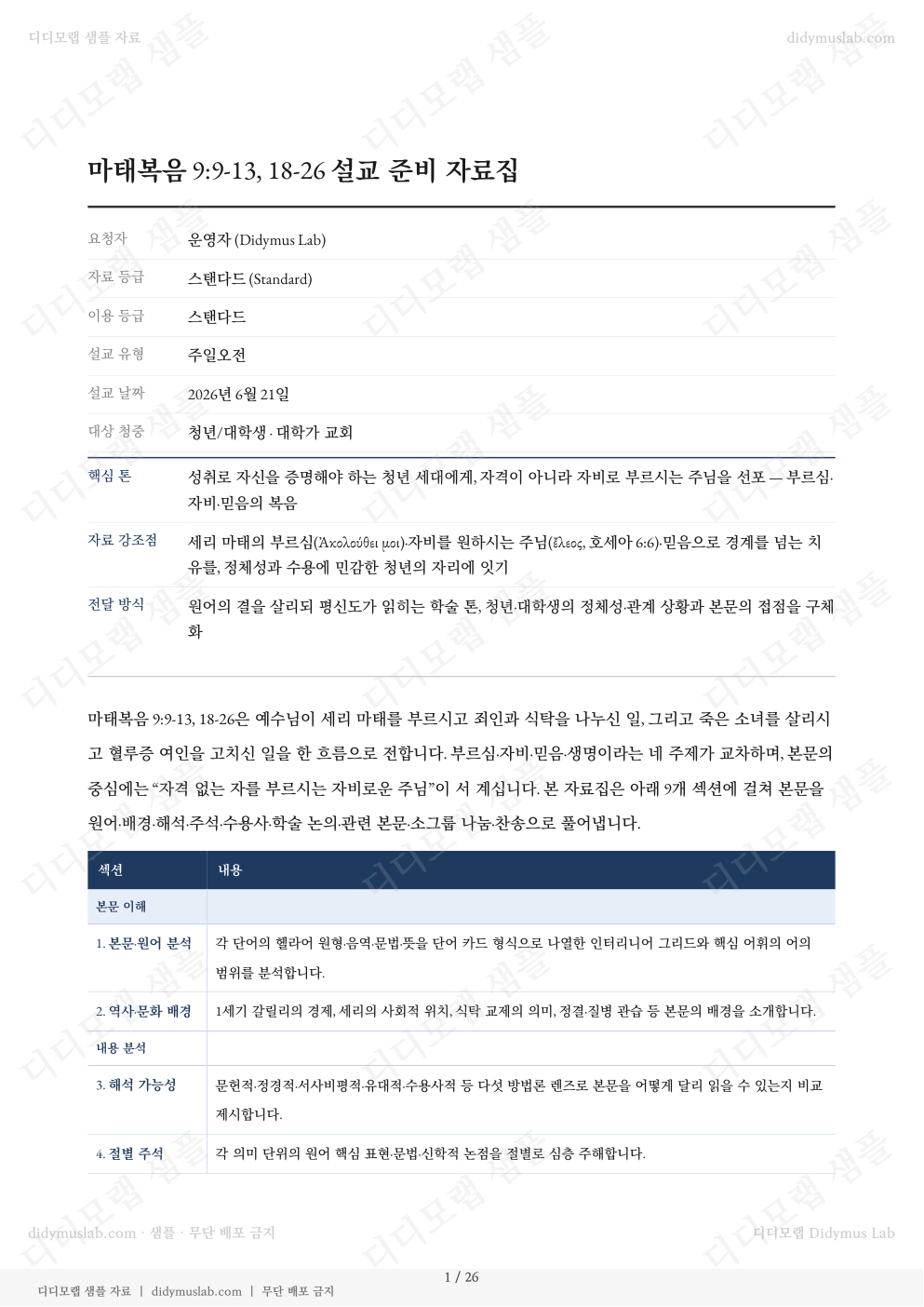
The report pages in the series are not there to grade any preacher. They illustrate questions like these:
- What should you verify before using a word study in a sermon?
- Where should scholarly discussion stop so the congregation’s language can begin?
- What keeps application-driven preaching from outrunning the text?
- How do sacred art, reception history, and historical background become tools for reading — not just sermon openers?
A suggested way to read
Do not try to read all 43 essays at once.
Start with one preacher you know well. Once the structure of the analysis is familiar, read one preacher whose method is entirely different. If you begin with Ok Han-heum’s expository preaching, try Hong Min-gi’s one-point sermons or Choi Joo-hoon’s liturgical preaching next.
The contrast sharpens the questions:
Do I take hold of the text first, or the congregation’s questions first? Am I reaching for application too quickly? Do I check the original languages enough — or explain them too much? What is the strength of my preaching, and when does that strength become a weakness?
We hope this series serves as a small map for those questions.
There has never been only one way to preach in the Korean church. Learning from good preachers is not imitating their style — it is watching how each style built a road between the text and the congregation.
Read the full series: How Korea’s Leading Preachers Preach
Comments
Leave a comment
Comments are reviewed before being published. Only your name and comment are stored — no personal data collected.
You might also like
preacher-style
Let the Text Speak: Song Tae-geun's Approach to Expository Preaching
A look at Pastor Song Tae-geun's method of consecutive expository preaching, refined over decades at the pulpit—from original-language exegesis to a unique handwriting discipline that shapes how he delivers sermons without notes.
preacher-style
Reading the Whole Bible: The Canonical Exposition of Pastor Lee Ji-woong
Lee Ji-woong of The Bible Ministry combines the inductive Bible study tradition of YWAM with canonical exposition that reads each book of Scripture as part of one unified story, delivered through immersive Bible-conference teaching.
preacher-style
Lee Dong-won's Preaching Style — Three-Point Exposition and Dramatic Narrative
An analysis of the preaching method of Lee Dong-won, founder of Jiguchon Church. How three-point expository structure, semi-inductive delivery, and dramatic illustration work together.
Loading comments…