Preacher Profile
One Theme, Taken All the Way: The Preaching of Kim Young-myung
Introduction
Together Church (더불어함께교회) is a congregation in Seoul’s Dongdaemun district, affiliated with the Nadeulmok Church Network — a missional network built around Kingdom-of-God ecclesiology, hospitality, and intentional community formation. The church runs two Sunday services along with a neighborhood library and childcare center, the footprint of an established rather than fledgling congregation. Among the pastoral staff is Kim Young-myung, who holds the dual role of worship ministry coordinator and community pastoral care (seniors). He preaches occasionally alongside the church’s lead pastor, Yoo Hae-dong, and his sermons reward attention.
Three features stand out consistently: a commitment to single-theme depth, original-language analysis delivered in plain speech, and a liturgical sensibility that surfaces most clearly in how he handles the seasons of the church year.
The Theological Soil
Together Church describes its community purpose as “transmitting the gospel of the Kingdom of God in ways suited to each stage of development, helping people toward genuine conversion.” This language — Kingdom as foundation, community as medium, transformation as direction — is not background decoration. It is the air the preaching breathes.
The Nadeulmok Network has, since its founding, situated itself as a counterpoint to institutional, program-driven church culture. The church holds two Sunday services, runs a neighborhood library and childcare center, and conducts worship in both Korean and English. A preacher shaped by this environment tends to approach the text as something that makes demands on the community rather than as content to be efficiently delivered.
One Thread, Followed Completely
The most consistent feature of Kim’s preaching is his refusal to multiply points. Where a three-point structure would move on, he stays.
In his sermon on the paralyzed man in Mark 2, the pivot point is a single phrase: “Take heart, son” (or in some Korean translations, “작은 자야” — literally “little one”). He places King James English (“son”) next to the Korean rendering, then notes that the original Greek does not require either translation — and begins to ask what it might mean that Jesus, around thirty years old at the time, addresses this man with such a term. The word becomes a window. The entire sermon moves through that window, tracking what it means to be addressed that way by this particular person in this particular moment.
The Zacchaeus sermon (Luke 19:1-9) follows the same logic. The organizing lens is seeing: what Zacchaeus wanted to see, what Jesus actually saw when he looked up into the tree, what the crowd chose to see instead, and finally what kind of sight the encounter makes available to anyone who remains stuck in the crowd’s frame. Four angles on a single question, never scattered.
Original Language and Historical Detail in Plain Speech
Kim brings textual and historical scholarship into the sermon without signaling that it is scholarship. The register stays conversational; the content does not.
On Zacchaeus, he works through the Hebrew etymology of the name — Zaccai, meaning “pure” or “clean” — and lets the irony between that name and the character’s reputation do structural work in the sermon. He then explains the Roman tax-farming system in detail: the fixed quota, the gap between the quota and what a tax collector could legally extract, the fact that the job required literacy in three languages (Aramaic, Hebrew, Latin) at a time when literacy was the mark of an elite. By the time he finishes the background, the audience has a Zacchaeus who is not simply a villain but a complex human being who made choices within a specific, constrained social structure.
What keeps this from feeling like a lecture is the delivery. “That’s genuinely impressive,” he says, having just noted that Korea’s current literacy rate is under 2% while the U.S. sits at 26%, and that a first-century tax collector needed three languages just to do his job. The comparative historical detail arrives in the voice of someone sharing something that surprised him too.
Liturgical Awareness
Kim’s role as worship ministry coordinator shapes how his sermons inhabit time — specifically the time of the church year.
In February 2025, he led a three-week series titled “The Sense of Worship”: Worship That Senses, Worship That Aches, Resistant Worship. The series does not exhort the congregation to “worship better.” It asks what worship is — what it means to sense God, to ache toward something, to worship as an act that pushes against the grain. These are questions a worship ministry coordinator carries differently than someone whose role is primarily pastoral care or teaching.
His December 2025 Advent sermon, “Turn Off the Light, Enter the Light,” sits within a church-wide series called “The Kingdom of God Waits in the Darkness.” The title is not metaphorical decoration. Advent theology — waiting in the dark, the slow arrival of light, the refusal to rush the season — structures the sermon’s movement. The liturgical frame is load-bearing, not atmospheric.
Kingdom of God as Interpretive Lens
The phrase “Kingdom of God” appears across Kim’s sermons the way a compass setting appears on a map: it does not describe the whole terrain, but it orients everything.
The Zacchaeus sermon closes with this:
“We need spiritual eyes that can see where genuine joy is, where genuine life is, where the Kingdom of God is.”
This is not a call to try harder. It is a reorientation: the question of the sermon was never really about Zacchaeus, or even about seeing, but about what kind of sight makes it possible to find the Kingdom at all. The entire sermon has been building toward that single reframing.
The early 2026 series “A Community Invited to the Path of Love” — with installments on love that overcomes fear, love walking toward completion, and community as the proof of love — extends the same logic into ecclesiology. Love is not individualized sentiment but the shape that Kingdom community takes in practice. Zacchaeus’s change after the encounter is evidence of exactly this.
A Summary
Kim Young-myung’s preaching can be characterized as: single-theme depth driven by Kingdom-of-God theology, with original-language and historical analysis delivered in accessible conversational register, shaped throughout by a liturgical attentiveness to the rhythms and symbols of the church year.
In practice:
- Structure: Single-theme pursuit — one question or concept tracked through multiple angles without multiplying major points
- Emphasis: Kingdom of God as interpretive lens, not tagline; community ethics (love, the defeat of fear) as Kingdom expression
- Original language: Hebrew and Greek engaged directly, with translation comparisons used to surface textural detail in the text
- Historical background: Cultural and historical context (tax systems, literacy rates, ancient architecture) explained in thorough but colloquial speech
- Liturgical sensibility: Church-year seasons and their symbols built into the structure of the sermon, not added as decoration
For preachers interested in how Kingdom theology, liturgical practice, and close textual reading can be integrated in a local-church context — without academic overhead — Kim’s accessible body of work at Together Church offers a working model.
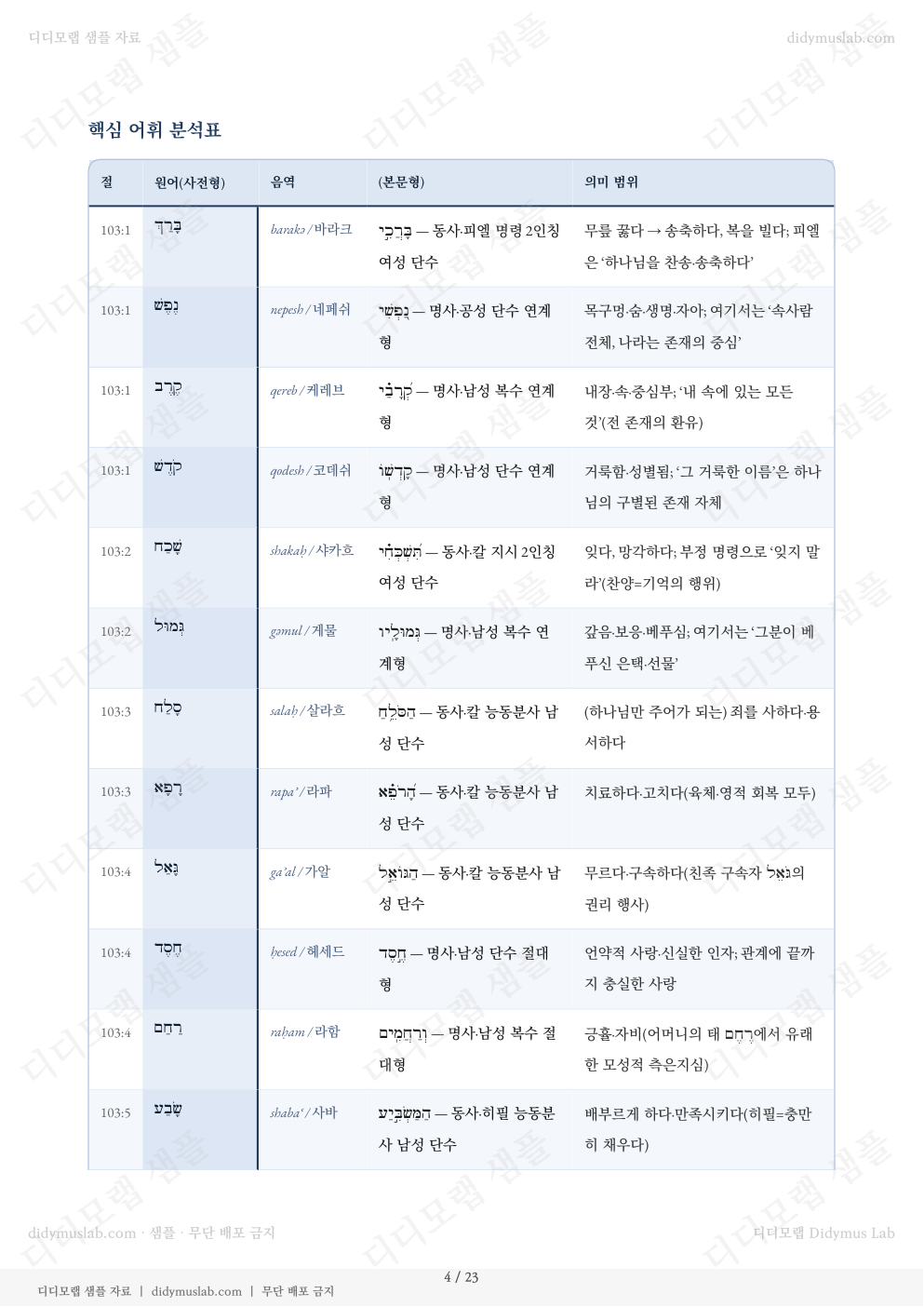
For preachers preparing this kind of single-theme, word-driven sermon, the Didymus Lab report’s keyword section is the most direct starting point: it opens up the range of meaning a single original-language word carries and shows where translations diverge, which is exactly the raw material Kim builds an entire sermon around.
For the kind of dense historical background Kim brings to a passage — tax systems, literacy rates, the mechanics of first-century Roman administration — a follow-up research report that tracks one historical thread beyond the passage itself is a useful companion tool. The follow-up research sample on patronage in Romans shows what that deeper, single-thread historical dig looks like in practice — the same kind of work Kim does when he reconstructs the Roman tax-farming system behind Zacchaeus’s profession.
Sources
- Together Church YouTube channel: youtube.com/c/togetherchurch
- Together Church official website: together.nadulmok.org
- Nadeulmok Church Network: nadulmok.org
- Staff ministry listing, Together Church: together.nadulmok.org/?page_id=7098
- Ministry recruitment posting (2025): ttgu.ac.kr — church self-description quoted
Know a hidden master? If you know an excellent preacher who hasn’t been covered by research or press but deserves recognition, send us a tip at didymus@didymuslab.com.
Comments
Leave a comment
Comments are reviewed before being published. Only your name and comment are stored — no personal data collected.
You might also like
preacher-style
Preaching as Communion: Kim Young-bong on Spiritual Formation and the Liturgical Pulpit
How Kim Young-bong, senior pastor of the Washington Korean UMC Koinonia and author of Prayer of Communion, shapes his book-series exposition around spiritual formation, liturgical form, and question-driven delivery.
preacher-style
Ji Sung-up's Preaching Style — Setting the World's Way Against God's Way
Pastor Ji Sung-up of Sanseong Church (Daejeon) preaches Exodus, the Beatitudes, the fruit of the Spirit, and the Lord's Prayer as sustained series that run to completion, structuring each sermon around a contrast between the world's way and God's way before translating the biblical narrative into a present-day principle of faith.
preacher-style
Kim Sang-ho's Preaching Style — From Life's Questions to Gospel Resolution
Pastor Kim Sang-ho of Mokdong Youngshin Church begins his sermons by naming the tensions his congregation already carries — and ends by showing how the gospel reframes them. An analysis of thematic-expository preaching shaped by pastoral transparency.
Loading comments…