Preacher Profile
Preaching as Communion: Kim Young-bong on Spiritual Formation and the Liturgical Pulpit
Preaching as Communion: Kim Young-bong on Spiritual Formation and the Liturgical Pulpit
Senior pastor of Korean United Methodist Church of Koinonia (Washington/Virginia) and author of Prayer of Communion
Three axes for reading Kim’s work:
- Structure: Book-series expository — sustained sequential runs through James, Hebrews, Jeremiah, and Exodus, converging thematically on spiritual formation rather than verse-by-verse annotation
- Emphasis: Spiritual formation and a theology of prayer — communion with God as the repeated destination of each expository run
- Methodology: Liturgical framing (UMC responsive formula, the church calendar), question-driven openings rooted in current events, rich historical and etymological background
The Preacher and His Context
Kim Young-bong completed a B.A. in business administration at Chungnam National University before pursuing theology at Methodist Theological University in Seoul (M.Div.), Southern Methodist University’s Perkins School of Theology (STM), and McMaster University in Canada, where he earned a Ph.D. in New Testament Studies. He taught New Testament at Hyupsung University before moving to pastoral ministry, serving as senior pastor of the Washington Korean United Methodist Church from 2005 to 2016 before founding and leading the Korean United Methodist Church of Koinonia in Northern Virginia — where he remains today. He also directs the Ministry Mentoring Institute for Korean-American pastors.
In Korean church reading culture, his name is most immediately associated with Prayer of Communion (사귐의 기도, IVP, 2002), a book that redefines prayer not as petition or discipline but as intimate fellowship with God. The book has been in continuous print for over two decades, and its theological premise — that communion with God is the organizing center of Christian spirituality — shapes his preaching at every level.
Sequential Exposition as the Structural Frame
Kim’s preaching is built on book-series exposition. A survey of the Koinonia church’s YouTube channel shows him working through James, Hebrews, Jeremiah, Exodus, and John’s Gospel in sustained sequential runs. The commitment is to staying in the text: the congregation walks through a biblical book together, week by week, rather than moving from topic to topic.
The experience of sustained immersion is something he names directly. After completing two months in Jeremiah, he told his congregation:
“Our long journey through Jeremiah has ended. Only two months have passed, but many of you may have felt it was much longer — especially those of you who are newer to daily Scripture meditation. It must have felt like grueling daily training.”
This is not expository preaching as rapid coverage. Kim treats the sustained encounter with a difficult biblical book as itself a formative experience — the congregation learns patience, disorientation, and reorientation alongside the text. The structural commitment to sequential exposition is inseparable from his larger concern with formation.
What distinguishes his approach from classical verse-by-verse commentary is the convergence point. Rather than working through the linguistic or grammatical details of each unit, he draws the passage toward a thematic destination: prayer, communion with God, the practice of neighbor love, or the formation of holy community. The skeleton is expository; the destination is spiritual formation.
The Liturgical Register
A defining feature of Kim’s preaching is its liturgical register. Every sermon begins with a formal Scripture introduction — “Today God gives us the Word from [book] [chapter]:[verse]” — followed by a public reading, which closes with the responsive formula: “This is the Word of the Lord — Amen.” This is recognizably the UMC tradition of congregational response, a practice drawn from the ecumenical liturgical renewal movement and designed to position the biblical text not as the preacher’s material but as a shared communal reception.
The church calendar structures the preaching year. His Lent opening sermon is an example of how historical and liturgical explanation work together:
“The word Lent originally meant spring or the lengthening of daylight. Because Jesus was crucified at Passover — which falls in spring — the common noun for spring, Lent, became a proper noun for the season of preparation. Lent means we prepare by meditating on Christ’s suffering and death so that Easter morning may be fully celebrated and fully felt. Its three keywords are repentance, self-discipline, and the practice of love.”
The congregation gets etymology, liturgical history, and a theological rationale in one movement. This is how Kim integrates academic learning into a pastoral register: not as a credentials display but as depth-giving background for a worship practice the congregation is actually observing.
The Theological Center: Communion and Formation
The theological center Kim returns to is spiritual formation — the slow, interior transformation that happens when a person is genuinely open to God in prayer. Hebrews 5:7, which describes Jesus praying “with loud cries and tears” to the one who could save him from death, functions for Kim as the paradigm of what prayer actually is: not the management of a petition queue but the full exposure of the self to God.
His extensive writing on prayer — Prayer of Communion, Prayer Anthology for the Prayer of Communion, The Most Dangerous Prayer: The Lord’s Prayer, and Meditations on the Seven Last Words — represents the same project pursued in literary rather than homiletical form. These are not devotional accessories to his preaching; they are the written form of the same theological conviction that drives his pulpit work.
The pastoral corollary is that spiritual formation always moves outward. His exposition of James 1:27 — “pure and undefiled religion is to care for orphans and widows in their distress, and to keep oneself unstained by the world” — draws out both dimensions: the interior discipline of resisting worldly contamination and the exterior practice of neighbor love. Formation without social expression is incomplete; Kim is consistent on this point across multiple sermon series.
Question-Driven Openings and Contemporary Anchors
The individual sermon’s progression is governed by what might be called a Socratic method: Kim opens with a question or observation the congregation already feels, then works through that question toward a biblical answer. The opening material is consistently drawn from contemporary life.
A Christmas sermon on Matthew 25 opened with a global statistic: roughly 150 of the world’s 200-plus countries celebrate Christmas in some form. A Hebrews sermon began with the story of Kamala Harris describing her summer job at McDonald’s during the 2024 U.S. presidential campaign — before turning to the passage on Christ learning obedience through suffering. Both openings do the same structural work: they establish a human question (What does this global celebration mean? What does suffering actually teach?) and then direct that question toward the biblical text.
He is equally willing to name the congregation’s obstacles directly. Introducing Jeremiah, he compared the difficulty of tracking unfamiliar Hebrew names to his own teenage experience of abandoning Tolstoy’s Resurrection because of the impenetrable Russian names. The moment is disarming: the pastor who spent a Ph.D. studying New Testament confesses he found Tolstoy hard. The message is that distance from a difficult text is a normal human experience, not a spiritual failure — and that the sermon will help navigate it together.
Background Without Foregrounding Greek and Hebrew
Kim’s Ph.D. training in New Testament does not surface in the form of extended word studies or original-language forays. His use of academic background is more often historical and theological. An exposition of James on the perpetual virginity of Mary included a careful, non-polemical comparison between the Catholic theological reasoning (the concern to protect Mary’s honor) and the Protestant reading (that Paul’s letters mention Jesus’s brothers, indicating a normal marriage between Mary and Joseph after Jesus’s birth). The treatment is fair to both traditions; the goal is clarity, not scoring a denominational point.
This pattern holds across his preaching: the Lent etymology, the early church calendar, the political context of Jeremiah’s oracles against Jehoiakim — historical depth is deployed to give congregational life inside the world of the text, not to demonstrate scholarly currency. Original languages are present in the background, but they do not drive the pulpit argument.
For preachers preparing in the book-series exposition style Kim practices, Didymus Lab reports offer a matching kind of support: the section-by-section commentary tracks the sequential unit Kim is working through, while the historical and cultural background section supplies the kind of contextual grounding he integrates into every major series. The academic discussion section provides leads for the theological depth Kim moves toward as each series converges on its formational theme.
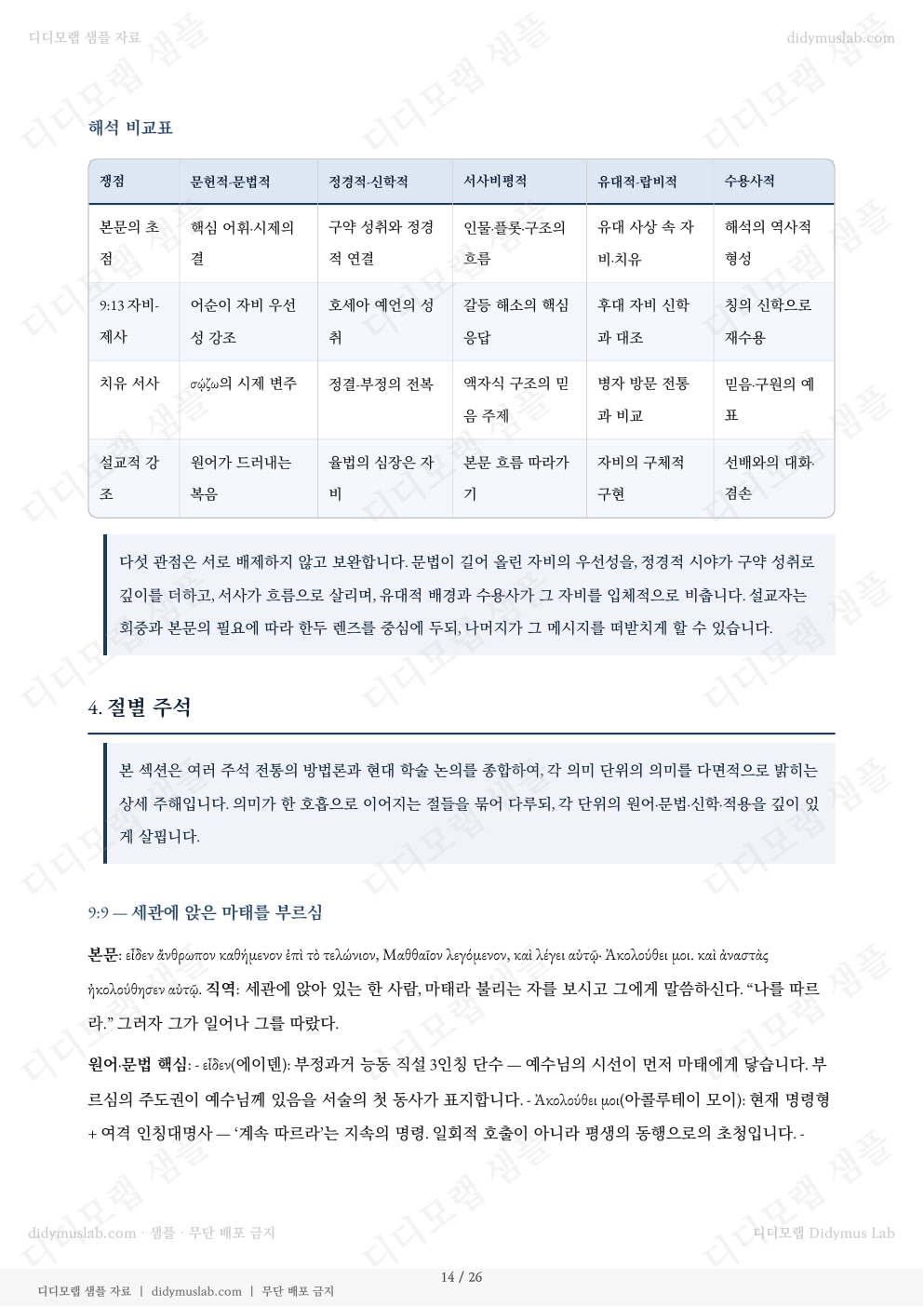
For sermons built around a single doctrinal article for a liturgical season — Easter, Lent — rather than a passage’s sequential argument, a doctrine-focused report tackling one theological topic directly is a useful companion. The doctrine report sample on the Apostles’ Creed, Article 5 (the resurrection) shows the same kind of etymological and historical grounding Kim brings to his Lent sermons, but built around a creedal article rather than a liturgical-season passage.
Sources
- Kim Young-bong. Prayer of Communion (사귐의 기도). IVP, 2002. Aladin
- Kim Young-bong. The Preacher’s Week (설교자의 일주일). Blessed People (복있는사람).
- Kim Young-bong. The Most Dangerous Prayer: The Lord’s Prayer (가장 위험한 기도, 주기도). IVP.
- Kim Young-bong. The Hidden God (숨어 계신 하나님). IVP.
- Korean United Methodist Church of Koinonia YouTube channel. Accessed 2026-07-18.
- KCJ Interview — Senior Pastor of Washington Koinonia and Director of Ministry Mentoring Institute
- Kyobo Books — Kim Young-bong author profile
- Washington Koinonia — Church History
Comments
Leave a comment
Comments are reviewed before being published. Only your name and comment are stored — no personal data collected.
You might also like
preacher-style
Preaching by the Church Calendar: The Liturgical Method of Pastor Choi Joo-hoon
An analysis of the preaching methodology of Pastor Choi Joo-hoon of Jungang Lutheran Church — lectionary-based liturgical preaching, theological communication through art iconography, and the public extension of the priesthood of all believers.
preacher-style
One Passage, One Week: The Sequential Preaching of Lee Jae-chul
An analysis of Lee Jae-chul's homiletical method — sequential preaching through one or two verses at a time, a color-coded manuscript system for original-language integration, and the triad of intellect, faith, and life.
preacher-style
The Conclusion Can Wait: Kwak Sun-hee and the Korean Inductive Sermon
Kwak Sun-hee, founding pastor of Somang Church, pioneered inductive preaching in Korea. This profile traces his method — withholding the conclusion to make listeners fellow travelers — alongside his theological commitments to application, testimony, and the Holy Spirit.
Loading comments…