Bible, Actually
How Big Was Nazareth? Archaeology and the Village Jesus Called Home
“Can anything good come out of Nazareth?” Nathanael’s question in John 1:46 has long been read as a mark of regional snobbery. But once you look at what archaeology and ancient sources tell us about first-century Nazareth, the dismissal starts to sound less like bias and more like an honest assessment of the village’s standing in Galilee.
 Israel Zeller / Pikiwiki Israel · Old Nazareth · CC BY 2.5. The visible archaeological remains beneath the Church of the Annunciation help anchor the scale of the ancient settlement.
The Village That Didn’t Make the Lists
The first thing to notice about Nazareth in ancient sources is its absence. The Old Testament never mentions it. Josephus — who wrote at length about Galilee, having served as its military commander — does not include Nazareth in his accounts of the region. Early rabbinic literature likewise passes over it.
Jonathan L. Reed, in Archaeology and the Galilean Jesus, treats this silence as evidence. Nazareth simply was not a place that registered in the administrative, military, or literary records of the period. It sat off the main routes, away from the centers of Galilean political life. The administrative capital of Galilee, Sepphoris, lay roughly six kilometers to the northwest; Herod Antipas’s new city of Tiberias sat on the western shore of the Sea of Galilee. Nazareth was a hill village somewhere between these centers and none of them.
What the Excavations Show
The archaeological footprint matches the literary silence. Reed’s analysis of the excavated remains — domestic structures, olive presses, storage pits, and rock-cut tombs — leads him to estimate the first-century population of Nazareth at approximately 200 to 400 people. That is not a town. It is the kind of village where most adults know most other adults, where life is organized around extended family groupings, and where nothing much happens that gets written down elsewhere.
More recent fieldwork introduces some revision to the lower end of that estimate. Ken Dark’s study of the Sisters of Nazareth Convent site, which covers a Roman-period, Byzantine, and Crusader occupation sequence in central Nazareth, suggests the ancient settlement may have extended somewhat further than earlier surveys indicated. Dark’s conclusion does not overturn the basic picture — Nazareth was not a significant center by any ancient measure — but it nuances the floor of the population range.
What neither Reed nor Dark disputes is the social irrelevance of Nazareth in the context of first-century Galilee. Whether the number is closer to 200 or 400, the community was small enough to be unmentioned and obscure enough to prompt the question Nathanael asked.
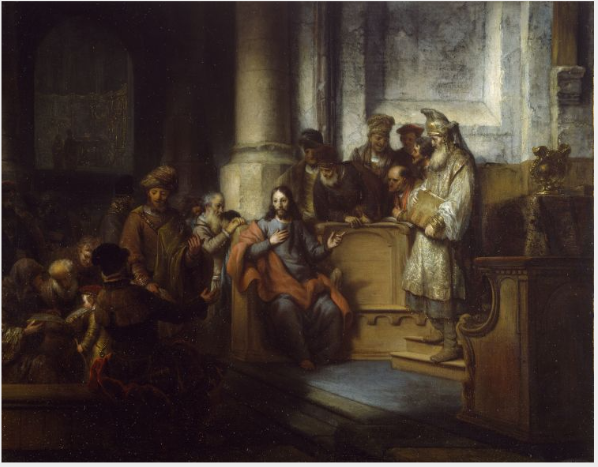 Gerbrand van den Eeckhout · Christ in the Synagogue at Nazareth, 1658 · Public Domain. A devotional painting, not an archaeological reconstruction of the first-century building.
Reading John 1:46 Again
With this in mind, Nathanael’s response to Philip deserves a second look. Philip announces that he has found the one Moses and the prophets wrote about — Jesus of Nazareth, son of Joseph. Nathanael’s reply — “Can anything good come from Nazareth?” — is usually treated as the setup for a lesson about not judging by appearances. And it functions that way in the narrative. But it also functions as a geographically realistic question.
Nazareth was not the kind of place from which significant figures emerged. It had no prestige, no military history worth noting, no connection to the major events in Israelite memory. A Galilean hearing “from Nazareth” would not think of a center of learning or a city of consequence. He would think of a small village in the hills.
Philip’s answer is famously brief: “Come and see” (John 1:46). No argument, no defense of Nazareth’s honor — just an invitation to direct encounter. And Nathanael comes. By verse 49, he has moved from skepticism to confession: “Rabbi, you are the Son of God! You are the King of Israel!”
The Point of the Smallness
There is something worth pausing over in the fact that the story begins in a village too small to appear in any ancient record. Not Sepphoris, not Jerusalem, not Alexandria. A settlement of a few hundred people in the hills of Galilee, unmentioned in the scriptures that shaped the community’s identity, unremarkable by any standard the ancient world used to measure places.
The Fourth Gospel seems to know what it is doing with this detail. The one who is described in the Prologue as the Word through whom all things were made is introduced in chapter 1 as coming from Nazareth. The smallness of the origin is part of the story, not an embarrassment to be explained away.
“Come and see” remains the only appropriate response to that combination.
References
- Jonathan L. Reed, Archaeology and the Galilean Jesus: A Re-examination of the Evidence (Trinity Press International, 2000)
- Ken Dark, The Sisters of Nazareth Convent: A Roman-Period, Byzantine, and Crusader Site in Central Nazareth, Palestine Exploration Fund Annual (Routledge, 2020)
Comments
Leave a comment
Comments are reviewed before being published. Only your name and comment are stored — no personal data collected.
You might also like
Bible, Actually
Peter's House at Capernaum: Three Centuries of Accumulating Memory over One First-Century Room
Matthew 8:14 records Jesus healing Peter's mother-in-law in a Capernaum house. Archaeological excavations beginning in 1968 found a first-century room with distinctive plastering and early graffiti, later converted into a house-church, and finally commemorated with a fifth-century octagonal Byzantine church — all precisely centered on that room.
Bible, Actually
The White Synagogue at Capernaum Was Built 400 Years After Jesus
The gleaming limestone synagogue ruins at Capernaum are among the most photographed sites in the Holy Land. But the visible building dates to the 4th–5th century Byzantine era. Beneath it, excavators found a black basalt foundation and first-century pottery — the actual synagogue of Jesus's Galilean ministry.
Bible, Actually
The Missing Verb in 'Wives, Submit to Your Husbands'
P46 and Vaticanus omit a verb in Ephesians 5:22. The shorter text links the verse to 5:21, while its theological implications remain debated.
Loading comments…