Painters Interpret Scripture
Painting the Word ⑫ Fra Angelico — The Annunciation and a Silence at the Top of the Stairs
At the top of the staircase leading to the second floor of the Convent of San Marco in Florence, a single fresco fills the wall directly ahead: the angel Gabriel and Mary, enclosed within one plain loggia. No gilding, no elaborate architecture, no secondary figures filling out a narrative. Beneath the image runs a short Latin inscription urging whoever passes before the image of the intact Virgin not to let an Ave go unspoken. It is not an instruction to keep silent, but a prompt to interrupt the footsteps of friars climbing these stairs and turn them toward prayer. This installment of Painting the Word moves back to the Renaissance and Mannerist era, turning to the Dominican friar-painter Fra Angelico.
Who Was Fra Angelico
Fra Angelico (born Guido di Pietro, c. 1395-1455) entered the Dominican convent at Fiesole in the early 1420s, taking the religious name Fra Giovanni da Fiesole. His reputation for piety during his lifetime was such that after his death he came to be known by the epithet “the Angelic Friar” (Fra Angelico, Beato Angelico); he was beatified by Pope John Paul II in 1982. Around 1438, when Cosimo de’ Medici funded the architect Michelozzo’s rebuilding of the Convent of San Marco, Fra Angelico — himself a friar of that same community — was given the task of frescoing its cloister, chapter house, and roughly forty individual cells where the friars lived and prayed. This was not commissioned decoration for outside patrons or public display; it was an unusually intimate project, made for the daily devotional use of his own brothers in religion.
The Text — Luke 1:26-38
The scene of Gabriel appearing to Mary to announce the conception of Jesus is among the most frequently painted subjects in the entire Christian visual tradition.
“The angel said to her, ‘Do not be afraid, Mary; you have found favor with God. You will conceive and give birth to a son, and you are to call him Jesus.’ … ‘I am the Lord’s servant,’ Mary answered. ‘May your word to me be fulfilled.’ Then the angel left her.” (Luke 1:30-31, 38)
Reading the Painting — A Bare Loggia, a Request for Silence
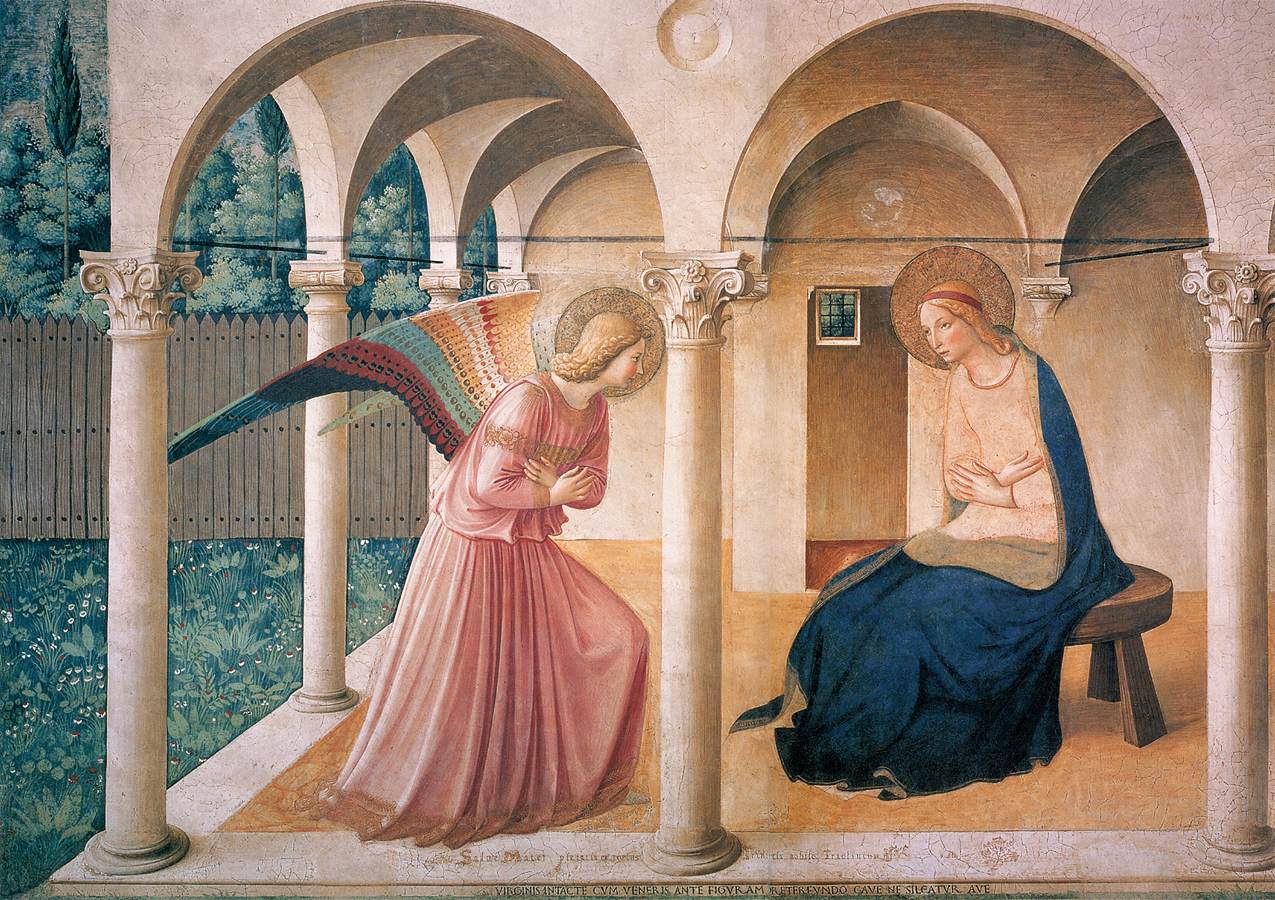 Fra Angelico, The Annunciation, c. 1440-45, fresco, north corridor of the second floor, Convent of San Marco, Florence, facing the top of the dormitory staircase. Public domain (Wikimedia Commons, PD-Art, artist died 1455).
Fra Angelico’s San Marco Annunciation stands in sharp contrast to his own earlier altarpiece Annunciations at Cortona and Madrid (Prado), which include elaborate arched columns, a background scene of the Expulsion from Eden, and lavish gilding. Here there is only a modest colonnade, a wooden stool where Mary sits, and a plain wall pierced by a single barred window behind her. Gabriel kneels slightly, arms crossed over his chest; Mary answers with almost the identical gesture, the two figures’ postures mirroring each other in near-perfect symmetry. The palette, too, is severely restrained — the figures’ garments and the plastered wall behind them sit within nearly the same narrow range of tone. The fresco is positioned exactly at the eye level of a friar who has just reached the top of the stairs, so that anyone climbing to the dormitory would meet this scene multiple times a day, every day.
Theological Reading — A Fresco Painted for Prayer, Not for Narrative
The art historian Georges Didi-Huberman, in a 1990 study (published in English translation in 1995), argues that the San Marco fresco cycle must be read within the frame of scholastic theology — particularly the writings of Albertus Magnus and Thomas Aquinas that Angelico, as a devout fifteenth-century Dominican, would have meditated on daily. For Didi-Huberman, these frescoes are not narrative paintings meant to “show” an event to a viewer; they are deliberately simplified exercises in what he calls dissemblance — a mode of painting that leads the mind past representation itself, toward the mystery of the Incarnation that no picture can fully capture. Stripping away decorative background and secondary narrative, on this reading, is not a technical limitation but a theological choice: painting relinquishing its own representational power so that it might point, instead, toward what exceeds representation.
A Korean-language study from Ewha Womans University examines the same fresco’s background — architectural elements such as the loggia and garden that appear nowhere in the biblical text itself — as biblical-theological symbols, reading details like the threshold, the columns, and the floor as devices that convey the mystery of God becoming human. Both readings point toward the same conclusion: what Fra Angelico removed from this image (splendor, narrative detail, ornament) is as theologically deliberate as what he kept (a silent loggia, two mirrored gestures). For the friar who paused here daily, this was not a picture to admire but a place to pray, and to answer, alongside Mary: “May your word to me be fulfilled.”
Coming Next
The next installment turns to the Flemish painter Jan van Eyck and the intricate symbolic system built into the Ghent Altarpiece.
Works Cited
English-language / French-language
- Georges Didi-Huberman, Fra Angelico: Dissemblance and Figuration, trans. Jane Marie Todd (University of Chicago Press, 1995; French original 1990) — the key study reading the San Marco frescoes through scholastic theology and contemplative practice
Korean-language
- Oh Eun-a, “An Iconographic Study of Fra Angelico’s Annunciation” [프라 안젤리코 〈수태고지〉 도상연구] (Master’s thesis, Ewha Womans University Graduate School, 2003)
The image above is a public-domain (PD-Art) scan hosted on Wikimedia Commons. All works listed above are real, standard scholarly studies and theses.
Comments
Leave a comment
Comments are reviewed before being published. Only your name and comment are stored — no personal data collected.
You might also like
Painters Interpret Scripture
Painting the Word ⑭ Sandro Botticelli — The Mystic Nativity and a Painter Who Turned Away from Neoplatonism
Sandro Botticelli's only signed work, the Mystic Nativity (c. 1500-01, National Gallery, London), carries a Greek inscription at its top in which the one-time favorite of Florence's Neoplatonist humanists turns instead to the apocalyptic timetable of Revelation, after Savonarola's sermons upended his career.
Painters Interpret Scripture
Painting the Word ⑩ Georges de La Tour — Joseph the Carpenter and Light Passing Through a Child's Hand
In Georges de La Tour's Joseph the Carpenter (c. 1642, Louvre), what actually illuminates the scene isn't the candle itself but the light passing straight through the boy Jesus's cupped hand. Read alongside seventeenth-century French devotion to the mysteries of Christ's life, this installment reads what La Tour imagines into the silence of Nazareth.
Painters Interpret Scripture
Painting the Word ⑨ Velázquez — Supper at Emmaus and Revelation in the Kitchen
In his early twenties, Velázquez painted Christ's revelation at Emmaus as a small scene glimpsed through a hatch behind a kitchen maid. Read alongside early-seventeenth-century Seville's debates over the conversion of enslaved Africans, this installment asks whose eyes the painting means to open.
Loading comments…