Painters Interpret Scripture
Painting the Word ⑨ Velázquez — Supper at Emmaus and Revelation in the Kitchen
In the corner of a kitchen, a young Black servant girl stands among dishes on a table, head bowed, lost in some unreadable thought. The event the painting is actually named for — the risen Christ revealing himself to two disciples as he breaks bread — is visible only through a small opening in the wall at the upper left, barely large enough to register. Why would Velázquez shrink the scene his title announces down to a corner of the canvas? This installment of Painting the Word turns to the Spanish court painter Diego Velázquez.
Who Was Velázquez
Diego Rodríguez de Silva y Velázquez (1599-1660) was born in Seville and trained as an apprentice in the workshop of Francisco Pacheco, a painter and humanist. Before he was twenty, Velázquez had already pioneered a genre rare in Spanish painting at the time: the bodegón, an intensely realistic kitchen or tavern scene combining still life with everyday figures preparing or eating food. Kitchen Maid with the Supper at Emmaus sits exactly at the intersection of that secular genre and sacred narrative painting, and is counted among his earliest surviving works, dated to around 1617-18. The following year he married Pacheco’s daughter Juana, and in 1623 he was summoned to Madrid to become court painter to King Philip IV, a post he held for the rest of his life.
The Text — Luke 24:30-31
The risen Jesus walks the road to Emmaus with two disciples, but they fail to recognize him. Everything changes at the table.
“When he was at the table with them, he took bread, gave thanks, broke it and began to give it to them. Then their eyes were opened and they recognized him, and he disappeared from their sight.” (Luke 24:30-31)
The Greek verb behind “their eyes were opened” (διηνοίχθησαν οἱ ὀφθαλμοί) is the pivot of the whole passage — the two disciples had been walking beside Jesus the entire time, but recognition itself only opens at the moment the bread is broken.
Reading the Painting — A Servant in the Foreground, Revelation in the Background
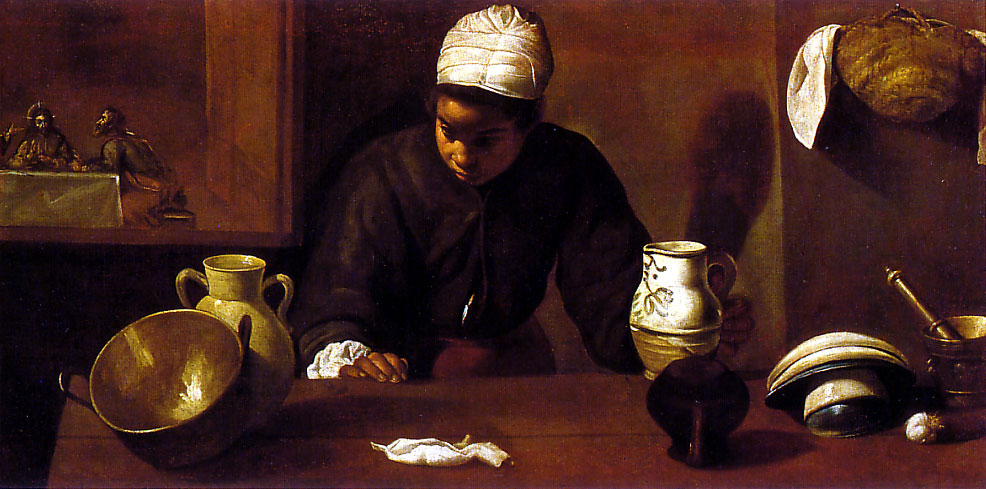 Diego Velázquez, Kitchen Maid with the Supper at Emmaus, c. 1617-18, oil on canvas, 55 × 118 cm — National Gallery of Ireland, Dublin. Public domain (Wikimedia Commons, PD-Art/PD-old-100-expired, artist died 1660).
More than three-quarters of the canvas belongs to a young Black kitchen maid at work, standing before a table set with jars, dishes, and a few cloves of garlic, her face rendered with the strong side-lighting and unflinching naturalism typical of Pacheco’s workshop — not idealized, but a face one might plausibly have passed on a Seville street. The event the title announces, Christ breaking bread before his disciples, is compressed into a small rectangular opening in the wall at the upper left — possibly a serving hatch through which food passed between rooms, possibly a framed picture hanging on the wall; art historians remain divided on which. The biblical scene in the background was only rediscovered during a 1933 cleaning, having been obscured for decades under grime and varnish, so that the painting had long been read simply as a kitchen genre scene with no religious content at all.
A closely related second version with the same composition and figure but no biblical scene in the background — The Kitchen Maid, now in the Art Institute of Chicago — also survives. Which version came first, and whether both are autograph works by Velázquez himself, remains a live debate among scholars. But in the Dublin version at least, it is clear that Velázquez (or his workshop) deliberately layered a sacred narrative onto what would otherwise be pure secular genre painting.
Theological Reading — Whose Eyes Are Opened
The art historian Tanya J. Tiffany (University of Wisconsin-Milwaukee), in a 2008 article in Art History, places this painting inside the specific historical context of early-seventeenth-century Seville. The city was one of Spain’s largest ports for the slave trade, and its clergy were engaged in active theological debate over the conversion and “spiritual illumination” of enslaved Africans — an uncomfortable rhetoric, by modern standards, that tried to connect the darkness of skin with the possibility of the soul’s salvation. Tiffany reads the painting’s very composition as a visual staging of that debate: what dominates the canvas is the face of a nameless Black girl, while behind her, through a small opening, light is “opening” in another sense — the moment the disciples’ eyes are opened to recognize Christ.
In Luke’s text, it is the two disciples at Emmaus whose eyes are opened. But Velázquez’s composition quietly relocates that question to the foreground, to the maid standing directly in front of us. Is she looking toward the scene behind her, or turned away from it? Her bowed head and unreadable expression refuse to settle the question — and that very ambiguity pulls into the open a question Counter-Reformation theologians were themselves wrestling with: to whom does light, and salvation, actually come, and by what path? Before he had turned twenty, Velázquez had already painted a picture that, by placing biblical revelation at the margin rather than the center, asks who revelation is actually for, and who it passes by.
Coming Next
The next installment turns to Georges de La Tour, a painter from Lorraine in France, whose single-candle chiaroscuro illuminates an unusually human Holy Family scene of Joseph the carpenter.
Works Cited
English-language
- Jonathan Brown, Velázquez: Painter and Courtier (Yale University Press, 1986) — the standard scholarly monograph on the artist
- Tanya J. Tiffany, “Light, Darkness, and African Salvation: Velázquez’s Supper at Emmaus,” Art History 31, no. 1 (2008): 33-56 — the key study connecting this painting to Seville’s debates over the conversion of enslaved Africans
Korean-language
- Janine Baticle, Velázquez [벨라스케스 — 인상주의를 예고한 귀족화가], Korean trans. (Sigongsa, Découvertes Gallimard series, 1999)
The image above is a public-domain (PD-Art) scan hosted on Wikimedia Commons. All works listed above are real, standard scholarly studies.
Comments
Leave a comment
Comments are reviewed before being published. Only your name and comment are stored — no personal data collected.
You might also like
Painters Interpret Scripture
Painting the Word ⑩ Georges de La Tour — Joseph the Carpenter and Light Passing Through a Child's Hand
In Georges de La Tour's Joseph the Carpenter (c. 1642, Louvre), what actually illuminates the scene isn't the candle itself but the light passing straight through the boy Jesus's cupped hand. Read alongside seventeenth-century French devotion to the mysteries of Christ's life, this installment reads what La Tour imagines into the silence of Nazareth.
Painters Interpret Scripture
Painting the Word ⑧ Rubens — The Elevation of the Cross and the Theater of Counter-Reformation Scripture
Rubens's Elevation of the Cross (1610-11) puts the viewer at a low vantage point, as if seated in the front row, watching muscular figures heave the cross upright. Read alongside the fact that Rubens later designed real triumphal arches and stage sets, this installment reads the staging of Counter-Reformation biblical painting.
Painters Interpret Scripture
Painting the Word ⑭ Sandro Botticelli — The Mystic Nativity and a Painter Who Turned Away from Neoplatonism
Sandro Botticelli's only signed work, the Mystic Nativity (c. 1500-01, National Gallery, London), carries a Greek inscription at its top in which the one-time favorite of Florence's Neoplatonist humanists turns instead to the apocalyptic timetable of Revelation, after Savonarola's sermons upended his career.
Loading comments…