Painters Interpret Scripture
Painting the Word ⑯ Albrecht Dürer — Self-Portrait and the Image of Christ, on the Edge of Blasphemy
Eyes staring straight out at the viewer. A face in near-perfect bilateral symmetry. A right hand raised toward the chest, fingers resting lightly on a fur collar, in a gesture close to a blessing. Framed by dark curls falling to the shoulders and a fur-trimmed coat, the figure reads, at first glance, almost as an icon of Christ. But beside it, in his own hand, the painter left a Latin inscription: “I, Albrecht Dürer of Nuremberg, painted myself thus, with undying colors, at the age of twenty-eight years.” This is not Christ. It is a self-portrait. This installment of Painting the Word returns to Albrecht Dürer for a second time, turning to the relationship between his self-portraits and the image of Christ.
Breaking a Convention Reserved for Christ Alone
Where the previous installment’s Apocalypse woodcuts established Dürer as an independent artist-publisher, the Self-Portrait at 28 (1500) reveals most directly how he understood himself as a subject. In medieval painting, depicting a figure frontally, in perfect bilateral symmetry, with eyes meeting the viewer’s gaze head-on, was a convention reserved almost exclusively for icons of Christ (and, in limited cases, certain saints). Ordinary portraits were painted in profile or three-quarter view, a visual line drawn between sacred frontality and human likeness. In this painting, Dürer breaks that convention outright — rendering his own face in a frontal, symmetrical composition nearly indistinguishable, at first look, from a contemporary icon of Christ. It is the last, and most radical, of the three oil self-portraits he painted.
The Text — Genesis 1:27
The theological question this self-portrait poses traces back to the opening chapter of Genesis.
“So God created mankind in his own image, in the image of God he created them; male and female he created them.” (Genesis 1:27)
Reading the Painting — A Human Face Wearing Christ’s
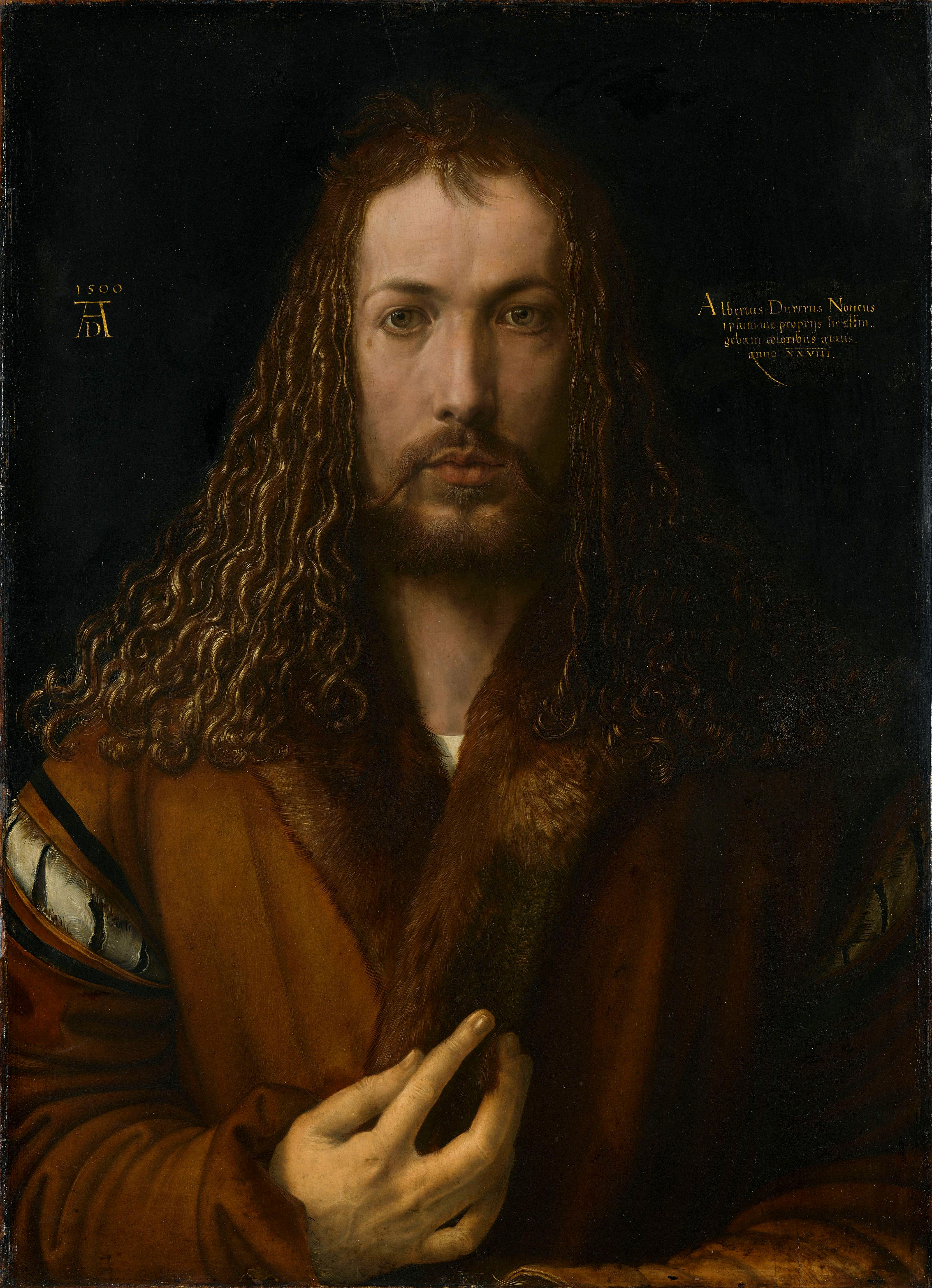 Albrecht Dürer, Self-Portrait at 28, 1500, oil on lime panel, 67.1 × 48.9 cm — Alte Pinakothek, Munich. Public domain (Wikimedia Commons, CC0 1.0 Universal, artist died 1528).
Dürer sits frontally against a plain dark ground, in perfect left-right symmetry. His dark curling hair falls to his shoulders, his eyes sit in deep, shadowed sockets, and his right hand is raised toward his chest, fingers just touching the fur of his collar — a gesture that echoes, almost precisely, the blessing hand of Christ in devotional icons. In the upper corners, his monogram “AD” appears beside the Latin inscription, which describes the work as rendered in “undying colors” (coloribus… proprijs) — a claim of pride in oil paint’s capacity to fix his likeness beyond the reach of time. Where a painter had previously been a craftsman rendering the faces of patrons or saints, here Dürer makes himself the sole subject of the painting, and in doing so, forces the viewer to look directly at his own act of self-creation.
Theological Reading — Blasphemy, or a Theology of the Image
The art historian Joseph Leo Koerner, in his 1993 study, treats this self-portrait as the founding moment of the entire German Renaissance self-portrait tradition, and argues that Dürer’s decision to overlay his own face with the iconography of Christ was not simple arrogance but a carefully worked theological argument. On Koerner’s reading, the logic Dürer draws on is the doctrine of the image in Genesis itself: if humanity is made in the image of God, and if Christ is “the image of the invisible God” (Colossians 1:15), then painting one’s own face in the pictorial language reserved for Christ’s icon is not a usurpation of divinity but a visual confirmation of the image of God already inscribed in every human being. At the same time, Koerner reads the painting as a claim about Dürer’s own status as an artist — just as the Creator formed humanity in his own image out of nothing, the painter forms an image out of pigment and panel, and through that analogy Dürer theologically justifies his own act of making. On this account, the self-portrait stands as one of the most dramatic surviving instances of how, on the eve of the Reformation, an artist’s self-understanding could be built directly out of theological language.
Coming Next
The next installment turns to the Italian painter Michelangelo Buonarroti, beginning a two-part treatment with the ceiling of the Sistine Chapel.
Works Cited
English-language
- Joseph Leo Koerner, The Moment of Self-Portraiture in German Renaissance Art (University of Chicago Press, 1993) — the standard study analyzing Dürer’s 1500 self-portrait as the founding moment of the German Renaissance self-portrait tradition
The image above is a public-domain (CC0, Public Domain Dedication) scan hosted on Wikimedia Commons. The work listed above is a real, standard scholarly study. No Korean-language academic journal article specifically addressing this self-portrait could be reliably verified for this installment, so that section has been omitted.
Comments
Leave a comment
Comments are reviewed before being published. Only your name and comment are stored — no personal data collected.
You might also like
Painters Interpret Scripture
Painting the Word ⑮ Albrecht Dürer — The Apocalypse Woodcuts and the Terror of 1500
In 1498, Albrecht Dürer self-published a fifteen-print woodcut cycle on the Book of Revelation. The Four Horsemen shattered the static, diagrammatic tradition of earlier Apocalypse illustration with a violent sense of motion — giving visual form to the eschatological dread gripping Europe as the year 1500 approached.
Painters Interpret Scripture
Painting the Word ⑳ Pieter Bruegel the Elder — The Tower of Babel and the Faces of Flemish Laborers
Bruegel's Tower of Babel (c. 1563) relocates an ancient Babylonian myth to a sixteenth-century Antwerp construction site. Through the faces of ordinary Flemish laborers hauling stone and turning cranes, he renders the story not as remote myth but as an event unfolding here and now.
Painters Interpret Scripture
Painting the Word ㉖ Eugène Delacroix — Jacob Wrestling with the Angel and Romanticism's Unfinished Struggle
Commissioned in 1849 and pursued intensively after 1854, Delacroix's Jacob Wrestling with the Angel at Saint-Sulpice translated a rarely painted Genesis 32 scene into the bodily drama of Romanticism. Eve Kliman traces the mural's visual sources.
Loading comments…