Preacher Profile
Won Yu-kyung: Preaching Through Paradox and Integrated Worship
A Community Born in the Pandemic
In 2021—when most congregations were shutting their doors or retreating to online formats—Won Yu-kyung founded POD Church in Gangnam, Seoul. POD stands for Parade Of David, drawn from 2 Samuel 6, where David brought the ark of the covenant to Jerusalem, stopping every six steps to offer sacrifice. Within a year, Sunday attendance surpassed two thousand. Today the congregation numbers around three thousand, with over ninety percent of members in their twenties and thirties.
Won’s background is as much worship leader as preacher. After completing a B.A. at Seoul Women’s University and an M.Div at Torch Trinity Graduate University, she spent sixteen years at Onnuri Church—beginning as a worship singer and leader, advancing to associate minister and then associate pastor. During seven of those years, she led a youth community that grew from seventy-six to twenty-five hundred members. According to Christian Daily, the late Pastor Ha Yong-jo, founder of Onnuri Church, held her worship leadership in such high regard that he directly assigned her to multiple ministry roles. This trajectory explains why her preaching cannot be understood apart from her sense of worship as a whole.
The Sermon Begins With a Diagnosis
Line up a run of Won’s sermon titles and a pattern surfaces immediately: “Rejection, Isolation, Rivalry, and Misplaced Love—What’s Actually Wrong?” (Genesis 29, October 2025); “For Those Trapped in Guilt and Painful Memory” (Hosea 2, November 2025); “Those Who’ve Lost Confidence, and So Lost Themselves” (2 Samuel 24, October 2025); “When You’ve Done Your Best and It Still Feels Like Nothing” (Isaiah 49, June 2026); “Don’t Run—Stand There: Failure, Loss, Wounds, Grief, Fear, Trauma” (Acts 1, June 2025). Whether the text is Old or New Testament, the title does the same job first: it names, in concrete words, an emotional state the congregation is likely already carrying.
This diagnostic framing isn’t decoration—it’s the sermon’s blueprint. The message translates that feeling into a theological category, then works through a biblical figure or event to reverse it. Rather than leading with a doctrinal theme or the text’s own heading (“the Suffering Servant,” say), Won lets the congregation’s self-diagnosis be the door the sermon walks through.
Structure: Three or Four Points Converging on One Paradox
Won’s sermons typically unfold in three or four points, each a self-contained argument that nonetheless converges on a single conclusion. A 2023 sermon on Solomon’s request in 1 Kings 3 shows the pattern clearly: (1) the decisive context—Solomon’s burnt offerings at Gibeon as an act of total devotion; (2) the grace premise—Solomon’s very existence, born out of the aftermath of David and Bathsheba’s restoration; (3) the “headpin” request—asking only for wisdom, which draws every other blessing with it. All three converge on one claim: only a request made for the sake of calling, not self-interest, gets answered.
Her 2024 sermon on Noah (Genesis 6–8) uses four points instead: pursuing what doesn’t change, the spiritual condition of a corrupt age, reinterpreting the 120 years (not mere labor, but God’s patience running alongside Methuselah’s own lifespan), and the repeated, concrete obedience the ark required. In her New Testament preaching, this convergence sometimes stretches across a series rather than a single sermon. Over three consecutive weeks in June 2025, she moved through Acts 1–2 as “Stand There” → “The Wrong Question Is Your Prison” → “The Difference Between Having Life and Not”—the same convergent logic distributed across multiple Sundays instead of compressed into one.
What Actually Opens the Text: Reconstructing a Character’s Psychology
The tool that actually opens a passage in Won’s preaching is not original-language exegesis—it’s a close reconstruction of a biblical character’s inner life and situational logic. This holds across both Testaments and is, by a wide margin, her most consistent method.
In the Jacob–Rachel–Leah narrative (Genesis 29), she translates Leah’s sense of exclusion and Rachel’s rivalry directly into the vocabulary of modern relationships. In the Abraham–Ishmael story (a 2024 New Year message), Ishmael’s birth becomes “a spiritual failure born of excessive zeal and impatience,” and the thirteen years of silence that follow become “a season of exponential growth.” In 2 Kings 13 (2022), King Jehoash’s decision to strike the ground only three times with the arrows is read as a psychological diagnosis of “a life that settles for half-measures.” On the New Testament side, a 2025 sermon on 2 Timothy 4 reconstructs Paul’s interior state as he writes what will be his final letter from prison, and a 2025 sermon on Matthew 3 narrates the thirty years before Jesus’ baptism as “an intensely active season of preparation.” The instrument at work is not a lexicon but an imaginative rewriting of a character’s emotional and decision-making process into language a contemporary listener recognizes as their own.
Original-Language Observation: An Exception, Not a Method
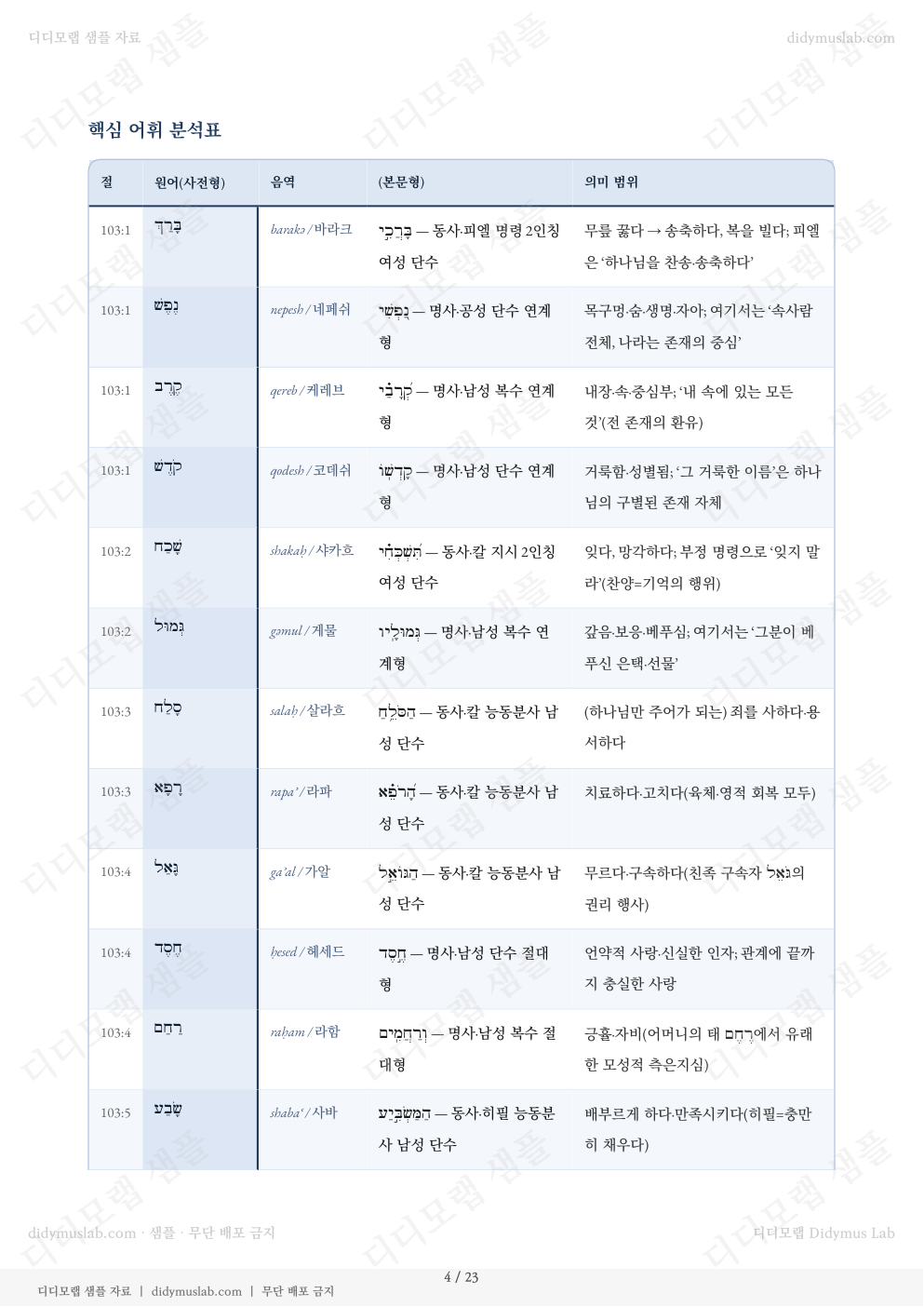
This isn’t to say Hebrew or Greek exegesis never appears. A 2023 sermon on Exodus 2 (reported by Mission News) builds its central argument on a single lexical fact: the “basket” that carries the infant Moses and Noah’s ark share the same Hebrew word—תֵּבָה (tevah)—used nowhere else in the Hebrew Bible. From that rare coincidence she draws a paradox: the most dangerous place turns out to be the safest place.
Across the wider sample of her sermons, though, this is closer to the exception than the rule. No New Testament sermon surveyed shows Greek exegesis functioning as a load-bearing argument, and even in most of her Old Testament preaching, character psychology and historical reconstruction do the work that original-language analysis might otherwise do. Original-language observation, in other words, is a tool she reaches for when the text happens to offer that kind of coincidence—not the architecture holding the whole sermon up.
This is exactly where a Didymus report’s keyword analysis earns its keep: when a rare word like tevah links two passages, the preacher can check its usage and context before deciding whether the connection is strong enough to carry a paradox. For a preacher whose center of gravity is narrative reconstruction rather than philology, catching that rare moment—rather than building a method around it—is what matters.
Reframing the Wrong Question
A distinct structural pattern recurs especially often in her New Testament preaching: she first exposes a character’s question as resting on a false premise, then lets Jesus’ response dismantle that framing rather than simply answer it. Her sermon on Acts 1:6–11 (“The Wrong Question Is Your Prison,” June 2025) treats the disciples’ question—“Lord, will you at this time restore the kingdom to Israel?”—as itself a prison, arguing that freedom comes not from a better answer but from a better question. Her sermon on John 9:1–11 (May 2026) turns on the same move: the disciples ask “why” this man was born blind, and Jesus’ answer redirects the question from why to for what purpose.
This structure dovetails with the diagnostic titles discussed above. The congregation’s feeling is named first; then that feeling is shown to rest on a wrong question (“why me? why this?”); then the question is redirected toward identity and calling.
Paradox Embodied in Secular Images
Paradoxical reversal functions as a structural principle in Won’s preaching, not a rhetorical flourish. But the images that make her paradoxes tangible tend to come less from nature and more from secular reference points her young-adult congregation immediately recognizes. Her Abraham sermon reaches for a swimming lesson—“you move forward by relaxing and holding a slow, precise form”—as an image for how God works. Her Solomon sermon borrows the bowling term “headpin”: hit the one thing precisely, and everything else falls into place behind it. Her Noah sermon opens by quoting Jeff Bezos on what won’t change in ten years, using it as a launching point for what doesn’t change at all. Her 2026 sermon on Acts 16 puts “a blocked road, a closed door, a canceled plan”—straight out of career-and-job-search vocabulary—into the sermon’s own subtitle, laying Paul’s Macedonian vision directly over a young adult’s experience of a derailed career path.
What these images do is make an abstract paradox something a listener can feel in a specific, everyday scene—a pool, a bowling alley, a job application, a blocked road—rather than merely understand as a concept.
Essential Imbalance: A Self-Described Method
In a 2026 interview with Christian Times (U.S. edition), Won described her preaching philosophy in her own words: “Rather than seeking balance between the Word and cultural relevance, pursue the essential. In a sense, this is closer to a thorough imbalance concentrated on the Word.”
The phrase “essential imbalance” captures the method precisely. If the diagnostic title and the secular image are the door a listener walks through, the room on the other side is always the theological question the text itself is asking. She is not indifferent to her audience—the diagnostic titles and swimming-lesson analogies prove otherwise—but she distinguishes between designing for connection and designing for accommodation, and consistently chooses the former. That POD Church draws a predominantly young, urban congregation through this Word-centered intensity, rather than through the cultural-accessibility strategies many churches favor for that demographic, is an observation she lets stand largely without comment.
Worship Integration: Designing the Whole Service
Won’s preaching cannot be analyzed apart from her approach to worship design. She doesn’t treat the sermon as a self-contained unit sitting inside a service; she designs preaching, music, prayer, and physical space together, as a single whole—what a 2023 Kookmin Ilbo interview calls a “worship artisan” approach. Her sixteen years as a worship leader supply the practical vocabulary for this. The theological anchor is a recurring trio of terms: God’s glory, his presence, and revival—language she repeats across sermons and lets shape the atmosphere of the service itself, not just its content. She describes revival’s essence as “a burning thirst for God and pure love, like David’s,” tying that language directly back to the Parade of David the church takes its name from.
Identity and Destiny: The Youth Theological Axis
In the same Christian Times interview, Won named the two questions organizing her youth ministry: Identity (“Who am I?”) and Destiny (“What am I living for?”). These recur as the final destination of her preaching regardless of Testament. The unnoticed, thirty-year-old Jesus of Matthew 3 becomes an image of identity awaiting its calling; the Pentecost of Acts 2 becomes an image of the power to carry that calling out; Paul in 2 Timothy 4 becomes an image of a calling completed. Whatever the text, a sermon that opens with a felt diagnosis eventually arrives back at these same two questions.
Same Text, Different Congregation — Need Over Exegesis
Won has returned to the same passage years apart with a completely different angle. 2 Kings 13:14–19 was preached in 2022 as “Do you have desperation?”; Nehemiah 13 was preached at Onnuri in 2020 as “Facing a Recurring Problem,” then again at POD Church in 2025 as “Have I Actually Failed?” Rather than fixing a passage’s meaning to a single exegetical reading, she resets the angle of entry to whatever the congregation needs at that particular moment. This suggests her preparation runs less from exegesis toward application and more from a felt present need back into the text, searching for the scene that speaks to it.
The Method Confirmed in Print
Her 2023 book Six Steps (Kyujang Publishing) distills this whole approach. The title comes from 2 Samuel 6:12–15, where David stops every six steps to offer sacrifice while moving the ark. Its organizing question isn’t “How do we achieve revival?” but “How do we love? How do we worship?” It appeared on the Christian bestseller lists of both GodPeople Mall and Kyobo Bookstore in 2023.
Her follow-up, The Place Where Faith Falls, works through twelve recurring areas of spiritual weakness—anxiety, misunderstanding, deficiency, attachment, suffering, bitterness—moving from diagnosis toward God’s guidance, with the same paradox running through every chapter: the place where faith falls is exactly where it rises again. It’s the same movement as her sermon titles, just bound between covers.
Summary
Won Yu-kyung’s preaching starts from a title that names a felt emotion precisely, uses close psychological reconstruction of biblical characters—not original-language exegesis—as its central interpretive tool, and embodies its paradoxes in secular, sensory images rather than abstract argument. Original-language observation is an exception she reaches for when the text happens to allow it, not the pillar holding the method up. Delivered across three or four points, or stretched over a multi-week series, the whole structure converges on what she herself calls “essential imbalance”—a deliberate tilt toward the text’s demands over the audience’s preferences—and is inseparable from her design of the worship service as a whole. That this tilt is exactly what draws such a strong response from young adults is a paradox her own sermons would recognize.
Know a hidden master? If you know an excellent preacher who hasn’t been covered by research or press but deserves recognition, send us a tip at didymus@didymuslab.com.
Comments
Leave a comment
Comments are reviewed before being published. Only your name and comment are stored — no personal data collected.
You might also like
preacher-style
Nam Bin's Preaching Style — 'BETTER' Theology for the Hongdae Generation
Pastor Nam Bin of Newsong Church (Hongdae, Seoul) has built a distinctive preaching grammar that moves from Korean daily life — industrial revolutions, delivery apps, celebrity one-liners — to the gospel's central claims. This profile draws on transcripts from ten sermons.
preacher-style
Ji Sung-up's Preaching Style — Setting the World's Way Against God's Way
Pastor Ji Sung-up of Sanseong Church (Daejeon) preaches Exodus, the Beatitudes, the fruit of the Spirit, and the Lord's Prayer as sustained series that run to completion, structuring each sermon around a contrast between the world's way and God's way before translating the biblical narrative into a present-day principle of faith.
preacher-style
Kim Sang-ho's Preaching Style — From Life's Questions to Gospel Resolution
Pastor Kim Sang-ho of Mokdong Youngshin Church begins his sermons by naming the tensions his congregation already carries — and ends by showing how the gospel reframes them. An analysis of thematic-expository preaching shaped by pastoral transparency.
Loading comments…