Preacher Profile
Kim Seo-taek: The Expository Preacher Whose Scholarship Becomes Story
Kim Seo-taek: The Expository Preacher Whose Scholarship Becomes Story
Emeritus Pastor, Daegu Dongbu Church — a preacher who buried the commentary so the congregation could find the story
“Expository preaching is difficult,” Kim Seo-taek once observed, “but it is precisely because God’s voice is transmitted directly that fundamental transformation happens.” This is as compact a statement of his homiletical conviction as he has offered in public: the power lies in the text itself, not in the preacher’s embellishment of it. The preacher’s job is to get out of the way — or more precisely, to do enough invisible scholarly work beforehand that the text can speak in the congregation’s native register.
Kim was born in 1955 and followed an unusual educational path to ordained ministry: an engineering degree from Seoul National University, graduate work in business administration, and then a Master of Divinity at Chongshin Theological Seminary (the seminary of the Presbyterian Church of Korea, Hapdong). He founded Disciples’ Church (제자들교회) in Seoul in 1989 and served there for eleven years before accepting a call to Daegu Dongbu Church as its third senior pastor in 2000. Over the next twenty-five years, he completed expository preaching through all sixty-six books of the Bible and saw the sermons published in more than 150 volumes. In 2024 he was installed as emeritus pastor.
Three axes for reading Kim’s work:
- Structure: Sequential verse-by-verse exposition — working through the text in units, but delivering it as vivid narrative reconstruction
- Emphasis: The connection between text and lived experience; putting congregants inside the biblical world rather than analyzing it from the outside
- Methodology: Classical commentary study in the study; narrative story in the pulpit — a deliberate translation between two modes
Sermon Architecture: Sequential Expository with Narrative Delivery
Kim’s method sits firmly within the expository tradition. He describes the difference between exegetical preaching and expository preaching this way: “Exegetical preaching talks all the way down to the leaves. Expository preaching sees the forest and the trees.” The distinction matters: commentary-level verse analysis happens in preparation, but what the congregation hears is a sermon shaped around the larger textual movement.
What is distinctive about Kim’s delivery, as heard in sermons from his church’s YouTube channel, is the degree to which biblical scenes are reconstructed with spatial and emotional immediacy. Characters move, situations unfold, and the congregation is invited to be present rather than merely informed. Direct citation of Hebrew or Greek terms is not a prominent feature of his pulpit style, nor is explicit attribution to Calvin, Luther, or other theologians by name. The text does the work; the scholarship disappears into the delivery.
He matched the form of a given service to its audience. Sunday morning sermons, aimed partly at newer believers, centered on the Gospels. Sunday afternoon services addressed doctrinal themes through the Epistles. Wednesday and Friday services went deeper into wisdom literature and the prophets. The assignment of form to context was deliberate.
The Emphatic Core: Application-Shaped Interpretation
The phrase that best captures Kim’s homiletical priority is “interpretation that carries application” (적용이 있는 해석). Exegetical work that stays in the commentary register — accurate but untethered to the congregation’s actual life — is, for Kim, incomplete. The pastoral question has to enter early.
His mechanism for this is what he calls the pre-note (프리노트): before composing the sermon, he writes out biblical observations and theological associations from the text, but with specific congregants in mind. The pre-note is the place where the exegetical and the pastoral are held together before either one is written out fully. It is the bridge between the commentary shelf and the pulpit.
His interpretive method resists monochrome application of any single theological approach. He describes his “holistic hermeneutic” as drawing simultaneously on doctrinal, redemptive-historical, and inductive methods, calibrated to what the text needs. He compared it to an orchestra: individual instruments are distinct, but the result is a single piece of music. Reformed theology (via Chongshin’s confessional tradition) supplies the doctrinal skeleton, but the method is not rigidly shaped by any one systematic framework.
The Two Registers: What Scholarship Looks Like After It Disappears
This brings us to the most analytically interesting feature of Kim’s approach. In interviews and lectures, he speaks extensively about scholarly preparation. For his Genesis exposition, he worked primarily from the commentaries of Old Testament scholar Alders and from Calvin; he has spoken of investing seven to eight hours per sermon in preparation. The preparation is genuinely academic.
But listening to his delivered sermons, that academic labor is not audible in the conventional sense. There are no Greek word studies delivered to the congregation, no roll call of exegetes. What comes through instead is the scene: described concretely, inhabited by recognizable human characters, opening onto a world the congregation is invited to enter.
This is not a contradiction but an architecture. The scholarly work functions as unseen infrastructure — it shapes the preacher’s understanding of what is actually happening in the text — but the output is translated into the mode most accessible to the congregation. Kim himself signals the logic when he observes that children’s sermons should be in story form rather than expository form. The principle that delivery mode should be calibrated to the audience appears to operate across all of his preaching, not just for children. The sermon’s academic skeleton is present; it simply does not announce itself.
The phrase that captures this best comes from his description of preaching the Psalms: he wanted to preach sermons in which the congregation could “play freely inside the world of the Psalms.” That is a narrative aspiration — not a commentary aspiration — in the service of a thoroughly exegetical preparation.
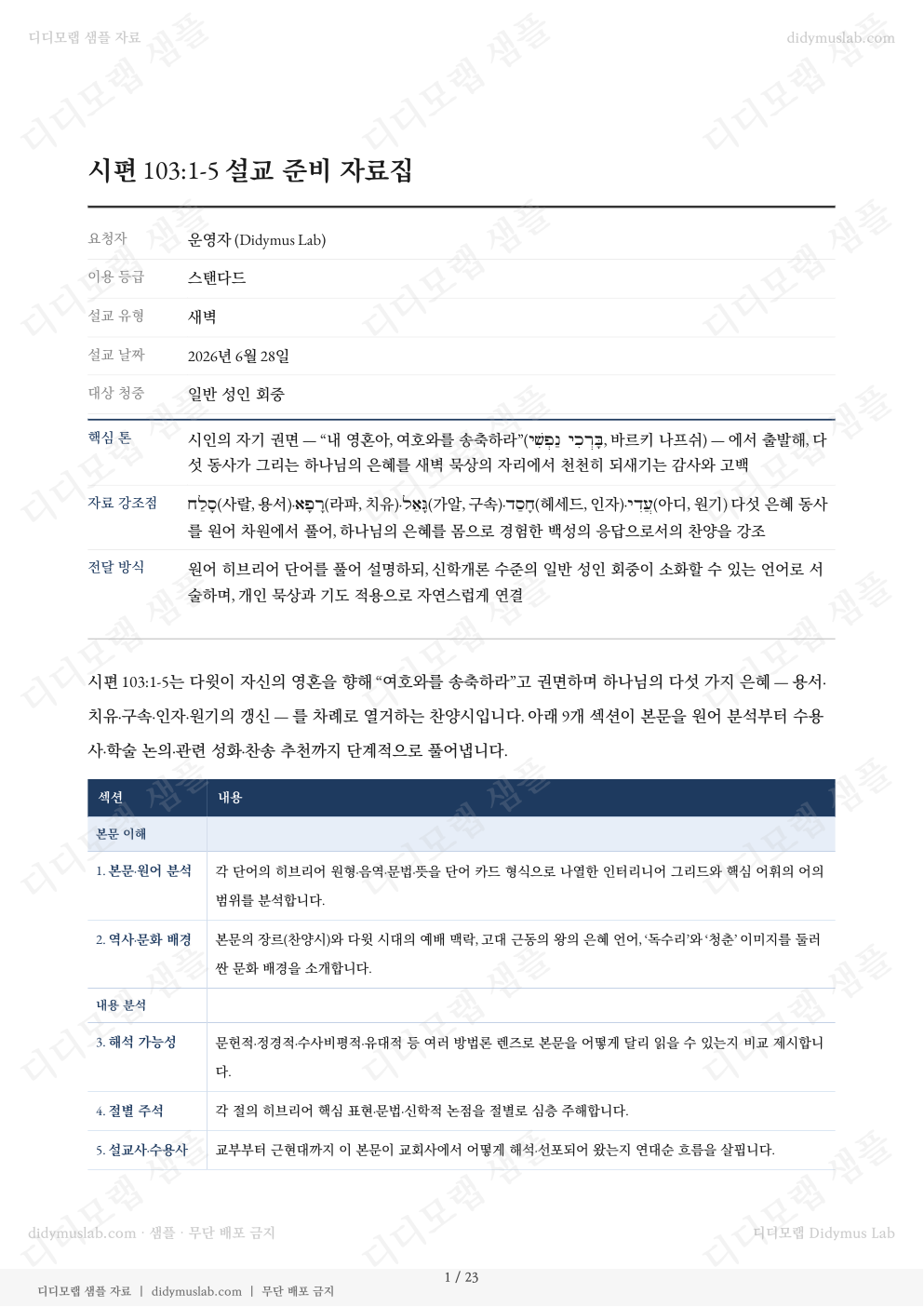
For preachers working in this mode, Didymus Lab reports pair naturally with Kim’s method: when the sermon’s delivery goal is vivid narrative reconstruction of a biblical scene rather than a display of the underlying scholarship, the report’s historical and cultural background section supplies exactly the kind of concrete material — setting, custom, social detail — that reconstruction depends on.
Sources
- Jukgan Gidok Sinmun, “Pastor Kim Seo-taek Completes Expository Preaching Through All 66 Books After 13 Years,” 2007. https://www.kidok.com/news/articleView.html?idxno=77082
- Jukgan Gidok Sinmun, “Mini-Interview — Pastor Kim Seo-taek,” 2000. https://www.kidok.com/news/articleView.html?idxno=135
- Christian Today, “Pastor Kim Seo-taek’s Pastoral Vision and Expository Preaching,” 2003. https://www.christiantoday.co.kr/news/152611
- Christian Today, “Pastor Kim Seo-taek’s Collected Sermons,” 2003. https://www.christiantoday.co.kr/news/154278
- TodayN, “Daegu Dongbu Church — Pastor Kim Seo-taek Installed as Emeritus,” 2024. http://www.todayn.net/news/articleView.html?idxno=412615
- Kim Seo-taek, Genesis Expository Sermons, 10 vols. (Duranno).
- Kim Seo-taek, Psalms Expository Sermons, 5 vols. (Duranno).
Comments
Leave a comment
Comments are reviewed before being published. Only your name and comment are stored — no personal data collected.
You might also like
preacher-style
Preaching History as Gospel: The Preaching Style of Han Hong
Pastor Han Hong of Saeroun Church blends historical scholarship with biographical narrative to craft sermons that move between past and present with unusual depth.
preacher-style
Ji Sung-up's Preaching Style — Setting the World's Way Against God's Way
Pastor Ji Sung-up of Sanseong Church (Daejeon) preaches Exodus, the Beatitudes, the fruit of the Spirit, and the Lord's Prayer as sustained series that run to completion, structuring each sermon around a contrast between the world's way and God's way before translating the biblical narrative into a present-day principle of faith.
preacher-style
Lee Sang-jun's Preaching Style — Vancouver Memories, the Theology of Reversal, and a Pulpit That Walks Together
Pastor Lee Sang-jun of 1516 Church preaches through Mark, Genesis, 1 Samuel, and 1 Timothy — different texts that share the same skeleton of craft. This piece looks at illustrations drawn from immigrant ministry, a theology of reversal in which 'God uses unexpected people,' and a conversational pulpit that pulls the congregation's own responses into the argument.
Loading comments…