Preacher Profile
Book by Book, Verse by Verse: The Preaching Style of Kim Kwan-sung
Introduction
Kim Kwan-sung serves as senior pastor of Najeunedam Baptist Church (낮은담침례교회) in Ulsan, South Korea — a city better known for its shipyards and petrochemical complexes than for contributions to Protestant homiletics. He has appeared on CBS Korea and has published several books with a genuine readership in Korean Christian circles, but he is not a nationally prominent figure in the way Seoul megachurch pastors tend to be. Among the communities that have followed Korean expository preaching closely over the past decade, however, his name carries consistent weight.
This profile focuses on what his preaching actually looks like: its structural commitments, its exegetical habits, and the pastoral logic that ties them together.
Background
Kim was born and raised in Ulsan. He studied at Korea Baptist Theological University (침례신학대학교), took a biblical exegesis program at TWIC London College in the United Kingdom, and completed an M.Div at Baekseok University Graduate School of Theology. While a student at Korea Baptist Theological University, he was selected as the top preacher at a senior chapel preaching competition — an early signal of where his interests were directed.
His pastoral career has been shaped by church planting. In 2015, he founded Haengsin Baptist Church in Goyang, Gyeonggi Province, and grew the congregation to over 400 registered members across seven years. He resigned in 2022 and returned to Ulsan to plant Najeunedam Baptist Church — a decision he made at what was, by most accounts, an unpromising moment for new church plants. Within three years, the congregation had grown to over 800 in regular attendance. The name he chose for the church, Najeunedam — literally “Low Wall” — establishes a frame that carries through to his preaching philosophy, as discussed below.
Beyond his pastoral work, Kim has a substantial publishing record. His first book, Essence Wins (본질이 이긴다, Thedream Publishing), became a bestseller in the Korean Christian market. Subsequent titles include Things You Only Know by Living Through Them (살아 봐야 알게 되는 것, Nexus Cross) and Pastoral Mentoring (목회 멘토링, Duranno, co-authored). The most notable of his collaborations is Straight Talk (직설, Duranno, 2016), a dialogue book co-authored with Park Young-sun — widely regarded as one of the most significant expository preachers in Korean Reformed circles. The book records ten conversations between the two pastors on faith, work, learning, family, and the church. It is an unusual document: a public record of theological exchange across generations, with the older pastor in the role of interlocutor rather than lecturer.
Book-Series Expository Preaching
The most structurally distinctive feature of Kim Kwan-sung’s preaching is book-series expository preaching — working through an entire book of the Bible from beginning to end, in canonical verse order, across a sustained series of Sundays. The Sunday services at Najeunedam have included an extended run through Romans, with individual sermons moving sequentially through the letter — chapters 10, 15, and others have been documented in publicly available recordings. The series format is not incidental: it is the organizing commitment.
This is worth distinguishing from two adjacent approaches. Thematic preaching selects passages to illustrate predetermined points; the text serves the idea. Looser expository preaching may work from a single book but with the preacher retaining wide discretion over which passages to address and when. Book-series expository preaching forecloses that discretion. The passage sequence is determined by the canon. Transitional texts, theologically dense sections, and structurally awkward passages cannot be skipped. The preacher must address what comes next.
The structural accountability this imposes is real. A preacher who selects texts according to preference will, over time, demonstrate those preferences by what they consistently choose and avoid. The book-series format makes that avoidance impossible. It is, in this sense, a form of submission to the text’s own logic.
Translation Comparison as Exegesis
One of the most consistently observed features of Kim’s approach to a passage is the practice of comparing multiple Korean Bible translations — laying the standard New Korean Revised Version (개역개정), the New Korean Standard Version (새번역), and the Common Translation (공동번역) side by side and attending to the places where they diverge.
For preachers trained in Greek or Hebrew, the analogous move is to read the original text alongside several vernacular translations and note where translators made different choices. Kim’s method achieves a comparable functional result through a different means. The places where Korean translations disagree mark the interpretive decisions translators faced, and those decisions illuminate the range of meaning the source text carries. By surfacing those divergence points for the congregation, the sermon allows listeners without access to the original languages to engage with the same interpretive terrain that a Greek or Hebrew reader would encounter.
There is also something methodologically honest about this approach. Rather than presenting a single authoritative reading and defending it through appeals to original-language expertise that most listeners cannot evaluate, translation comparison places the interpretive question in plain view before offering an answer. The congregation can see that a question exists before they hear how the preacher resolves it.
Single-Point Convergence
If book-series structure governs the macro-level sequence and translation comparison shapes the micro-level exegetical method, then single-point convergence describes the homiletical goal. Despite the analytical work involved in moving through a passage verse by verse, the destination of each sermon is one central claim — a single proposition or call to response that a listener can carry out of the service intact.
This is a deliberate departure from the three-point outline format that dominated twentieth-century evangelical homiletics in Korea, and from its underlying assumption that a sermon’s content should be organized into parallel memorable units. Single-point preaching assumes something different: that a congregation can genuinely respond to only one thing at a time, and that the preacher’s analytical work should culminate in a synthesis, not just an organized display of observations.
The editorial discipline this requires is real. The more detailed the verse-by-verse analysis, the harder it is to distill it into a single claim. Kim’s consistent orientation toward one-point convergence means the analytical work and the exegetical observations are not the product — they are the preparation for the product.
The Church Name and the Pastoral Philosophy
The name Najeunedam — Low Wall — is not decorative. A low wall is easy to cross. Kim has described his pastoral vision in terms of accessibility and resistance to religious formalism: “The church should be a place anyone can come to.” His first book’s title, Essence Wins, condenses the same instinct across a wider frame. What is not essential will eventually yield; the thing that lasts is the thing that was essential to begin with.
The connection between this philosophy and his preaching method is traceable. Book-series expository preaching places the preacher in service of the text’s own sequence rather than the preacher’s own thematic preferences — a structural form of the “essence over accumulation” posture. Translation comparison brings the congregation into the interpretive process rather than positioning the pulpit as the sole site of authoritative reading. Single-point convergence resists the accumulation of impressive analytical content in favor of one thing that lands.
The method and the philosophy are coherent. They point in the same direction.
Summary
Kim Kwan-sung’s preaching style can be characterized as: book-series expository preaching in the Baptist tradition, using Korean translation comparison as the primary accessible exegetical tool, with consistent orientation toward a single central message per sermon.
In practice:
- Structure: Book-series expository — one biblical book, first to last verse, in canonical order
- Exegetical method: Side-by-side Korean translation comparison to surface and communicate interpretive range
- Original language depth: Translation comparison rather than direct Greek/Hebrew analysis — the method prioritizes accessibility
- Goal: Single-point convergence — one proposition, one call to response
For preachers and students interested in how the expository tradition operates outside major urban centers and in non-Reformed evangelical contexts, Kim’s body of work at Najeunedam offers a documented, ongoing example of what this approach looks like in sustained practice.
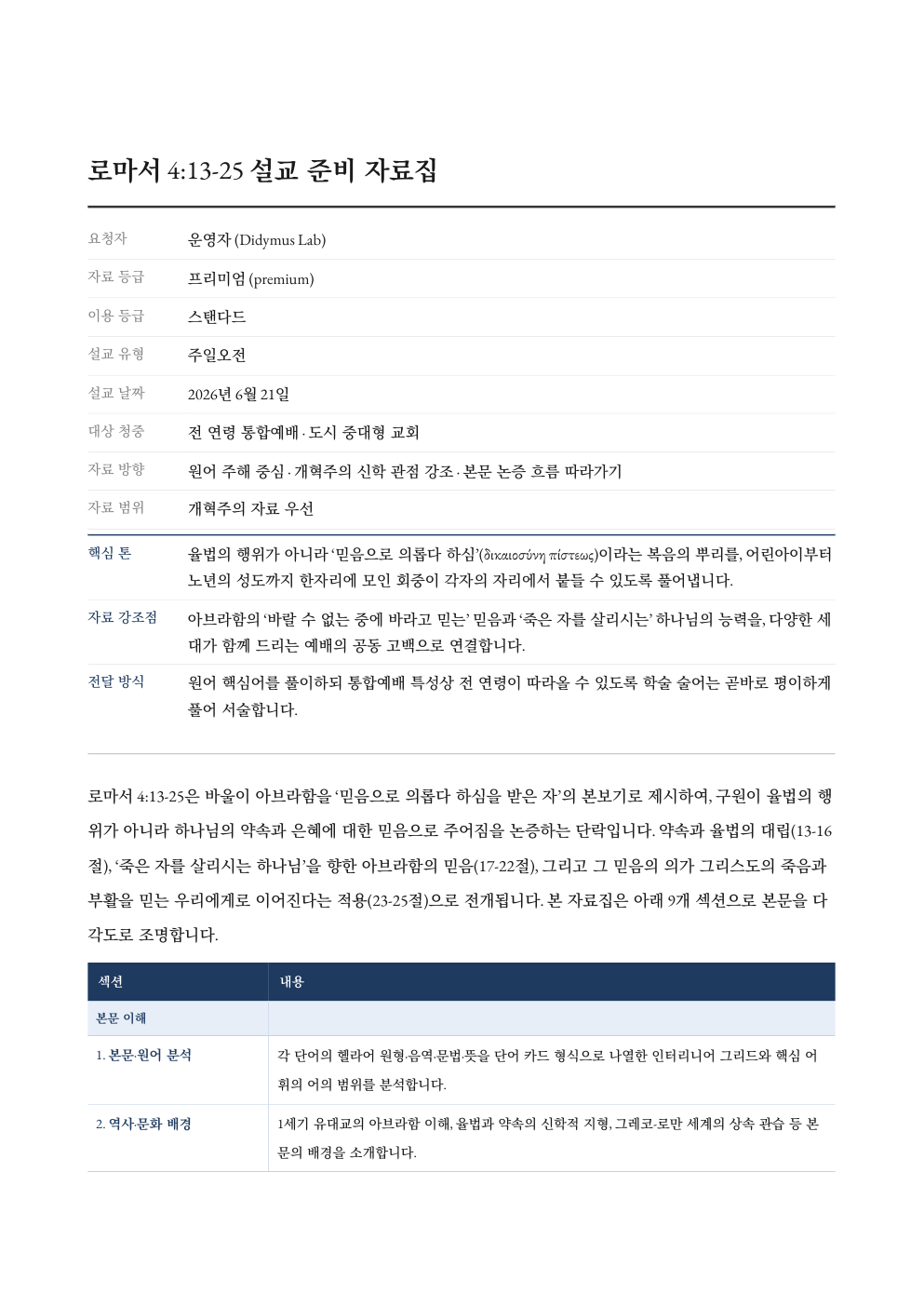
For preachers preparing a book-series expository run like Kim’s ongoing Romans series, a Didymus Lab report’s passage overview section is a useful habit to check before moving to verse-by-verse work — the preacher in this format doesn’t get to choose the text, so knowing in advance where next week’s passage sits within the book’s larger argument is where preparation has to start.
Working through Romans verse by verse also means running directly into doctrinal terrain like justification more than once. For those moments, a doctrine-focused report that takes on one theological topic head-on is a useful companion. The doctrine report sample on justification (Westminster Shorter Catechism Q33) approaches the same doctrinal ground from a different angle than Kim’s translation-comparison method — a useful second lens on the same terrain.
Sources
- Najeunedam Baptist Church official website: lowwall.org
- Najeunedam Church YouTube channel: youtube.com/channel/UCm2kV3p3f2Es2XOohDCrcnA
- News & Joy, “Church planting should be done by the most experienced”: newsnjoy.or.kr
- Duranno, Straight Talk (Park Young-sun & Kim Kwan-sung, 2016): duranno.com
- TCN Texas Christian News, profile of Najeunedam Baptist Church: texaschristiannews.com
Know a hidden master? If you know an excellent preacher who hasn’t been covered by research or press but deserves recognition, send us a tip at didymus@didymuslab.com.
Comments
Leave a comment
Comments are reviewed before being published. Only your name and comment are stored — no personal data collected.
You might also like
preacher-style
Ji Sung-up's Preaching Style — Setting the World's Way Against God's Way
Pastor Ji Sung-up of Sanseong Church (Daejeon) preaches Exodus, the Beatitudes, the fruit of the Spirit, and the Lord's Prayer as sustained series that run to completion, structuring each sermon around a contrast between the world's way and God's way before translating the biblical narrative into a present-day principle of faith.
preacher-style
Lee Sang-jun's Preaching Style — Vancouver Memories, the Theology of Reversal, and a Pulpit That Walks Together
Pastor Lee Sang-jun of 1516 Church preaches through Mark, Genesis, 1 Samuel, and 1 Timothy — different texts that share the same skeleton of craft. This piece looks at illustrations drawn from immigrant ministry, a theology of reversal in which 'God uses unexpected people,' and a conversational pulpit that pulls the congregation's own responses into the argument.
preacher-style
Lee Ho-sang's Preaching Style — Tracing the Narrative of Acts with Embedded Word Studies
Pastor Lee Ho-sang of Ulsan Church works sequentially through Acts, situating each passage inside the story's unfolding movement and weaving Greek and Hebrew etymology into the body of the sermon itself.
Loading comments…