Preacher Profile
Text, Doctrine, Life — The Expository Preaching of Kim Hyung-ik (Bethshalom Church, Gwangju)
Introduction
He is not the pastor of a megachurch, nor a broadcast preacher. Yet his podcast series of verse-by-verse biblical expositions has maintained a steady audience for over a decade, and his nine books published by Duranno, Saengmyeong-ui Malssumsa, and IVP Korea have found real readership within Korean evangelical circles. Kim Hyung-ik, senior pastor of Bethshalom Church in Gwangju, earns a place in the “Hidden Masters” chapter on exactly those terms.
The architecture of his preaching method is, at its core, simple: the Puritan triad of text → doctrine → application.
The Puritan Three-Part Structure
Kim has spoken in multiple interviews about the formative impact of reading D. Martyn Lloyd-Jones’s Studies in the Sermon on the Mount during his university years. He subsequently recognized Lloyd-Jones as a direct heir of the Puritan preaching tradition and adopted that tradition’s structural discipline as his own. What he publicly criticizes is preaching that lacks “biblical exegesis, theology, doctrine, and gospel application alike” — what he describes as the prevailing shallowness of contemporary Korean pulpits.
The Puritan three-part structure works as follows. The preacher begins by attending carefully to the text itself, tracing the author’s intention (interpretation). From that, theological and doctrinal propositions are drawn out — not imported from elsewhere but derived from the text (doctrine). Finally, those propositions are pressed toward the specific situation of the congregation gathered now (application). Maintaining this sequence, rather than reversing it or collapsing any step, is the formal commitment.
How this plays out in practice: Kim almost never begins a sermon without first reading the text in full — often in unison with the congregation. His expository series on Romans reflects the method at full stretch. In a sermon on Romans 8:1–2, he parses “no condemnation” with characteristic precision, distinguishing between two distinct senses: forensic condemnation (the legal verdict of punishment, which no longer applies to those in Christ) and existential guilt (the ongoing weight of moral accountability felt in the conscience, which the gospel also addresses). Neither distinction is an imposition on the text — both emerge from attentive reading of how Paul deploys the term, and both lead directly into pastoral application: freedom from fear of final judgment, and freedom from the psychological paralysis of accumulated guilt.
Original-language engagement surfaces where it matters. In a treatment of John 2, where people “believed in Jesus” at the Jerusalem signs, Kim draws on the Greek to illuminate why Jesus nevertheless “did not entrust himself to them” — showing that the text grammatically sets the two verbs against each other, which becomes the exegetical basis for distinguishing saving faith from a faith that is something less.
Romans, Psalms, and the Long Exposition
The scale of Kim’s expository commitment becomes visible in the Bethshalom Church YouTube channel. As of 2026, the Romans series has reached sermon 48 (Romans 8:31–39), and the Psalms exposition has reached sermon 138. These are not short thematic series. They are sustained, book-length engagements that follow the text wherever it leads, however long that takes.
Alongside the biblical expositions runs a doctrinal curriculum: the Westminster Confession of Faith (currently at lecture 19), the Apostles’ Creed, and the Heidelberg Catechism have each formed separate teaching series, interleaved with the Sunday preaching on scripture. The structure is a deliberate dual track — biblical narrative on one rail, confessional theology on the other — so that the congregation is formed in both the unfolding story of scripture and the systematic framework of Reformed orthodoxy simultaneously.
This dual-track approach is reflected directly in Bethshalom Church’s four stated core values: all-generation worship, expository preaching and doctrinal education (listed as a single inseparable unit), fellowship, and mission. That the two are joined in one line is not incidental.
Law and Gospel: The Theological Axis
Of Kim’s published books, Law and Gospel: A Journey from Bondage to Freedom (Duranno, 2018) most directly exposes the theological center of gravity in his preaching. His argument is that confusing law and gospel produces legalism, and legalism produces in the believer not the obedience that flows from love of God but the compliance that flows from fear of punishment. The pastoral consequence is severe: a congregation that has not grasped the law-gospel distinction cannot live as free people even after their justification.
This distinction surfaces throughout the sermons. In the Westminster Confession series on sanctification, he works from Leviticus 11 (“Be holy, for I am holy”) into 1 Peter 1:16 — where the apostle quotes it directly — arguing that this command belongs not to the ceremonial law abrogated in Christ but to the continuing moral demand that flows from the character of God. The argument is careful: he explicitly criticizes what he calls a “dispensationalist misreading” that assigns the Leviticus text exclusively to the old covenant and then dismisses its present claim. The law retains its proper function; the gospel provides the motive and the power to fulfill it.
A Pastor Who Teaches His Congregation to Listen
How to Listen to Sermons (Duranno, 2020) is a distinctive entry in Kim’s bibliography — perhaps unique among the Korean preachers in this series. It is not a book about how to preach but about how to listen. The implicit conviction is that expository preaching is not only the preacher’s work. If the congregation does not know how to receive a careful biblical exposition, the sermon’s effects are blunted before they begin.
This is a pastoral calculation: the formation of the listening congregation is part of the pastoral task, not only the preparation of the sermon. For a preacher who runs a Romans series of 48+ installments and expects his congregation to stay with it, the investment in congregational capacity for sustained biblical engagement is not optional.
For preachers using Didymus Lab reports as preparation tools: the historical and cultural background sections and the verse-by-verse commentary are most useful not only in sermon preparation but also in small-group settings where congregants are preparing to hear a sustained biblical exposition. What Kim’s How to Listen to Sermons models pastorally — equipping people to follow careful biblical argument — can be aided by giving them access to the same textual background material the preacher used.
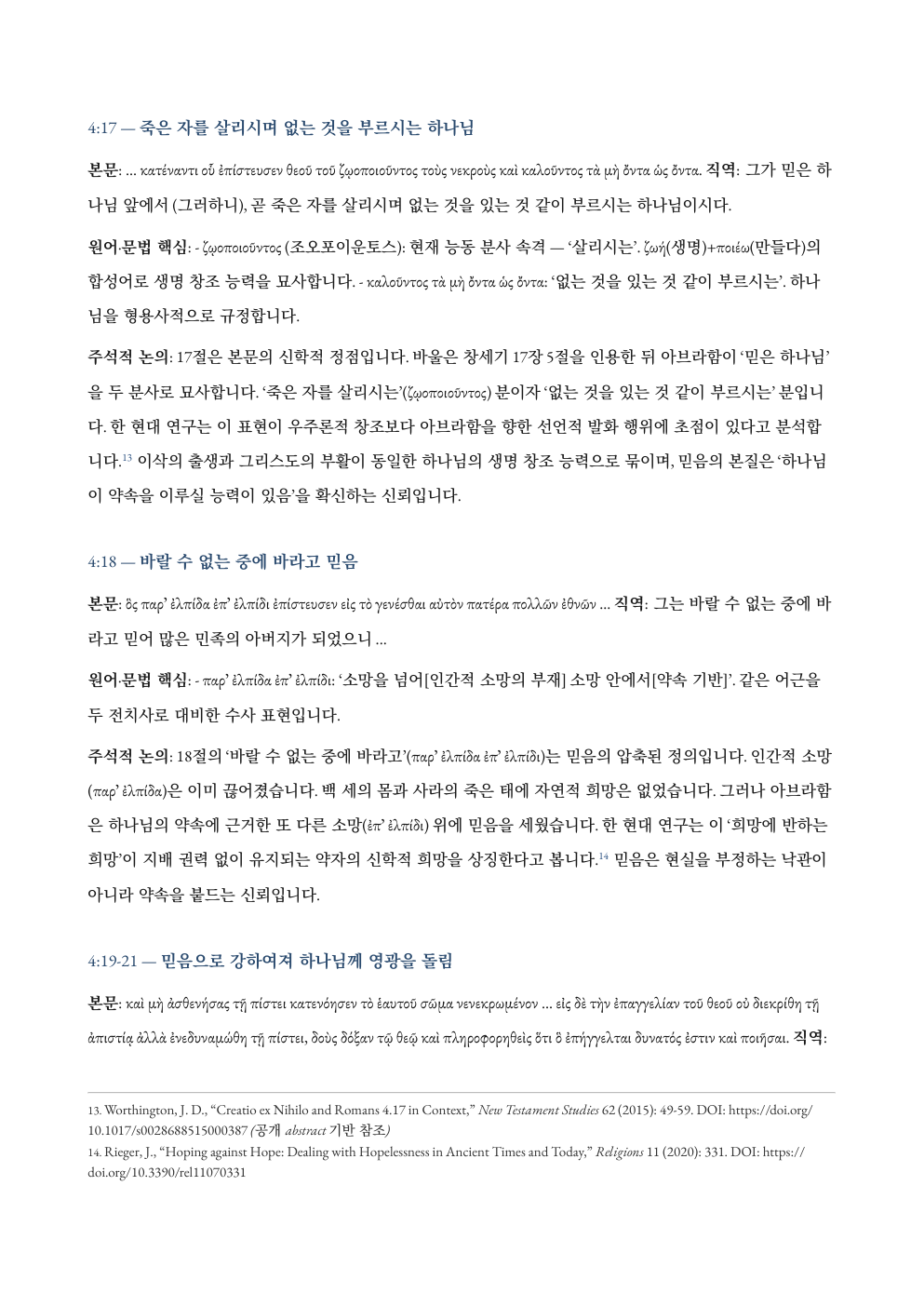
For a sermon built around a single doctrine the way Kim’s law-gospel material is — rather than a passage’s verse-by-verse argument — a doctrine-focused report tackling one theological topic head-on is a useful companion tool. The doctrine report sample on justification (Westminster Shorter Catechism Q33) demonstrates the same kind of doctrinal precision Kim brings to distinguishing forensic condemnation from existential guilt in Romans 8 — but starting from the doctrine itself rather than from the passage.
Ministry Background
Kim Hyung-ik studied history and philosophy at Konkuk University before completing his M.Div. at Chongshin Theological Seminary (in the Hapdong Presbyterian tradition). From 1991 to 1995 he served as a missionary-professor at Tanjungenim Theological Seminary in Sumatra, Indonesia. He subsequently served as Korea Director of the Global Partners (GP) Missionary Fellowship, then as Associate Senior Pastor of Washington Fellowship Church in the Washington, D.C., area (2003–2006). In November 2006 he planted Joy Mission Church in Maryland, where he served until June 2015. He returned to Korea in 2015 and took up the senior pastorate of Bethshalom Church in Gwangju, where he continues to serve. He is a contributing author for TGC Korea (Gospel and City).
Summary
Kim Hyung-ik’s preaching style can be described across three axes:
- Structure: Long-running book-by-book expository series (Romans 48+, Psalms 138+), organized around the Puritan text-doctrine-application sequence
- Emphases: The law-gospel distinction, assurance of salvation, authentic conversion, gospel-shaped application to ordinary life
- Parallel formation: Westminster Confession, Apostles’ Creed, and Heidelberg Catechism series running alongside biblical exposition, building a dual-track theological base for the congregation
What recurs across his sermons is a preference for theological precision over rhetorical embellishment, and for doctrine-grounded application over emotional appeal. The “Hidden Master” quality comes from practicing this method consistently in a regional church, over many years, without particular attention from the national church media.
Know a hidden master? If you know an excellent preacher who hasn’t been covered by research or press but deserves recognition, send us a tip at didymus@didymuslab.com.
Comments
Leave a comment
Comments are reviewed before being published. Only your name and comment are stored — no personal data collected.
You might also like
preacher-style
Ji Sung-up's Preaching Style — Setting the World's Way Against God's Way
Pastor Ji Sung-up of Sanseong Church (Daejeon) preaches Exodus, the Beatitudes, the fruit of the Spirit, and the Lord's Prayer as sustained series that run to completion, structuring each sermon around a contrast between the world's way and God's way before translating the biblical narrative into a present-day principle of faith.
preacher-style
Lee Sang-jun's Preaching Style — Vancouver Memories, the Theology of Reversal, and a Pulpit That Walks Together
Pastor Lee Sang-jun of 1516 Church preaches through Mark, Genesis, 1 Samuel, and 1 Timothy — different texts that share the same skeleton of craft. This piece looks at illustrations drawn from immigrant ministry, a theology of reversal in which 'God uses unexpected people,' and a conversational pulpit that pulls the congregation's own responses into the argument.
preacher-style
Lee Ho-sang's Preaching Style — Tracing the Narrative of Acts with Embedded Word Studies
Pastor Lee Ho-sang of Ulsan Church works sequentially through Acts, situating each passage inside the story's unfolding movement and weaving Greek and Hebrew etymology into the body of the sermon itself.
Loading comments…